Page Text
            who actually made it possible for
people like us to come along by
standing up to the mob in
Chicago. America would rather
deal with the smiling Sambo
type of thing. Public Enemy just
isn't backing off. It's a matter of
bringing rage to the forefront.
They lay it on the line and
basically say, "If you don't deal
with your rage in a way this
country has never seen before,
things are going to become
worse and worse." Otherwise,
it's like putting a Band-Aid on a
festering sore. If you don't treat
it immediately, you're eventually
going to lose the arm or the leg.
We're not the moderate guys by
any means. "Funny Vibe" or
"Which Way to America" speak
very directly about this anger.
They talk about the dynasty you
see, the Dynasty on TV, while
you live your life constantly
getting shit on.
You're by no means as separ-
atist as Public Enemy.
Separatist is a funny word. I
believe in black economic power
and survival, but I also believe
in connecting with people. I think
the racist violence has to stop
or at least be stopped-the shit
that's happening in Miami with
cops killing unarmed people. It
has to come to some sort of
resolution. We try to speak clear-
ly about what's going on and we
try to speak our minds. I'm into
the idea of people connecting.
but I'm not into assimilation. I
don't play rock and roll to become part of a
culture I'm not a part of. I relate to my music
as part of my culture and try to show people
what I've got to offer. We're trying to deal
honestly with the facts of our lives as black
Americans and hopefully give people
enough of ourselves that we can all walk
away with a unified point of view and even-
tually resolve some of our problems.
Have you ever faced rejection from black
audiences?
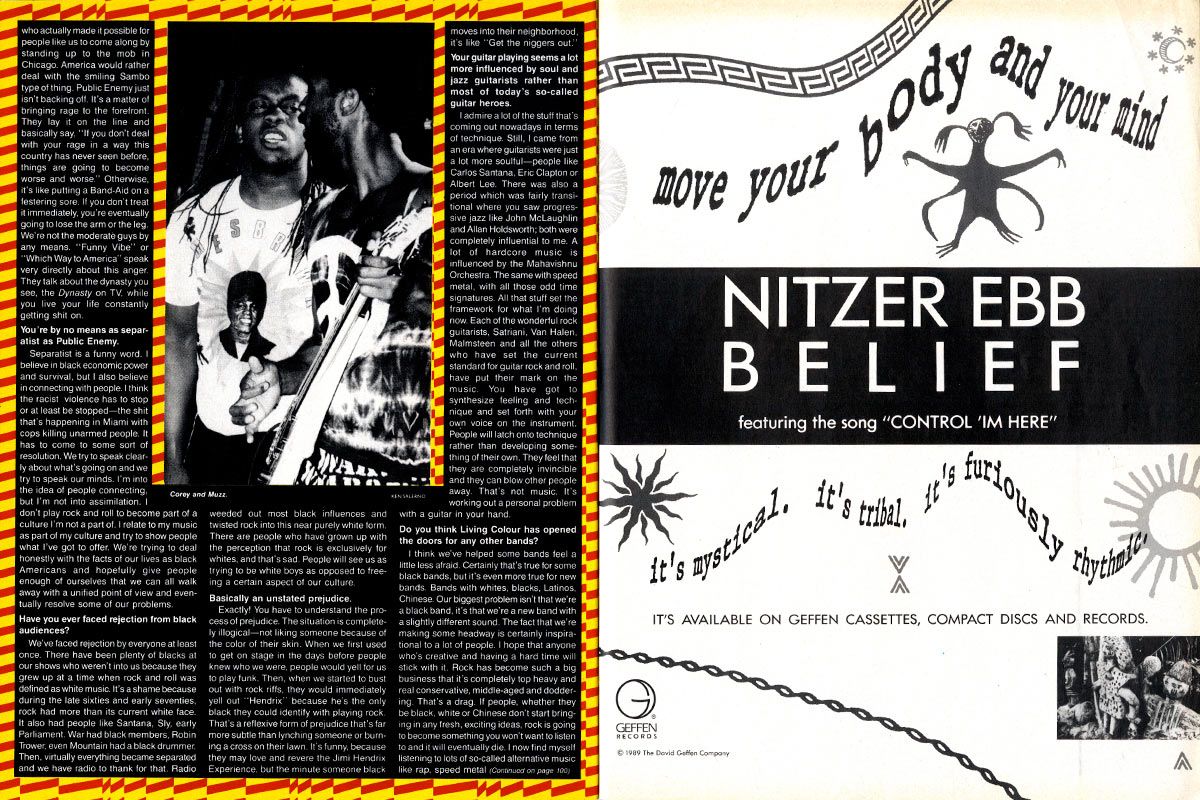
Corey and Muzz
We've faced rejection by everyone at least
once. There have been plenty of blacks at
our shows who weren't into us because they
grew up at a time when rock and roll was
defined as white music. It's a shame because
during the late sixties and early seventies,
rock had more than its current white face.
It also had people like Santana, Sly, early
Parliament. War had black members, Robin
Trower, even Mountain had a black drummer.
Then, virtually everything became separated
and we have radio to thank for that. Radio
weeded out most black influences and
twisted rock into this near purely white form.
There are people who have grown up with
the perception that rock is exclusively for
whites, and that's sad. People will see us as
trying to be white boys as opposed to free-
ing a certain aspect of our culture.
Basically an unstated prejudice.
Exactly! You have to understand the pro-
cess of prejudice. The situation is complete-
ly illogical-not liking someone because of
the color of their skin. When we first used
10 get on stage in the days before people
knew who we were, people would yell for us
to play funk. Then, when we started to bust
out with rock riffs, they would immediately
yell out "Hendrix" because he's the only
black they could identify with playing rock.
That's a reflexive form of prejudice that's far
more subtle than lynching someone or burn-
ing a cross on their lawn. It's funny, because
they may love and revere the Jimi Hendrix
Experience, but the minute someone black
moves into their neighborhood.
it's like "Get the niggers out.""
Your guitar playing seems a lot
more influenced by soul and
jazz guitarists rather than
most of today's so-called
guitar heroes.
I admire a lot of the stuff that's
coming out nowadays in terms
of technique. Still, I came from
an era where guitarists were just
a lot more soulful-people like
Carlos Santana, Eric Clapton or
Albert Lee. There was also a
period which was fairly transi-
tional where you saw progres-
sive jazz like John McLaughlin.
and Allan Holdsworth; both were
completely influential to me. A
lot of hardcore music is
influenced by the Mahavishnu
Orchestra. The same with speed
metal, with all those odd time
signatures. All that stuff set the
framework for what I'm doing
now. Each of the wonderful rock
guitarists, Satriani, Van Halen.
Malmsteen and all the others
who have set the current
standard for guitar rock and roll,
have put their mark on the
music. You have got to
synthesize feeling and tech-
nique and set forth with your
own voice on the instrument.
People will latch onto technique
rather than developing some-
thing of their own. They feel that
they are completely invincible
and they can blow other people
away. That's not music. It's
working out a personal problem
with a guitar in your hand.
Do you think Living Colour has opened
the doors for any other bands?
I think we've helped some bands feel a
little less afraid. Certainly that's true for some
black bands, but it's even more true for new
bands. Bands with whites, blacks, Latinos.
Chinese. Our biggest problem isn't that we're
a black band, it's that we're a new band with
a slightly different sound. The fact that we're
making some headway is certainly inspira-
tional to a lot of people. I hope that anyone
who's creative and having a hard time will
stick with it. Rock has become such a big
business that it's completely top heavy and
real conservative, middle-aged and dodder-
ing. That's a drag. If people, whether they
be black, white or Chinese don't start bring-
ing in any fresh, exciting ideas, rock is going
to become something you won't want to listen
to and it will eventually die. I now find myself
listening to lots of so-called alternative music
like rap, speed metal (Continued on page 100)
and your id
Dove your body
NITZER EBB
BELIEF
featuring the song "CONTROL 'IM HERE"
it's mystical.
G
GEFFEN
RECORDS
it's
s tribal.
It's.
riously
mind
Mychal
IT'S AVAILABLE ON GEFFEN CASSETTES, COMPACT DISCS AND RECORDS.
1989 The Devid Geffen Company
A