Page Text
            F
new bands hit as hard as Living Colour.
They've got every ingredient that's miss-
ing from rock-n-roll today-the stuff of
greatness that the hairspray merchants,
Kingdom Clones and other assorted drecksters
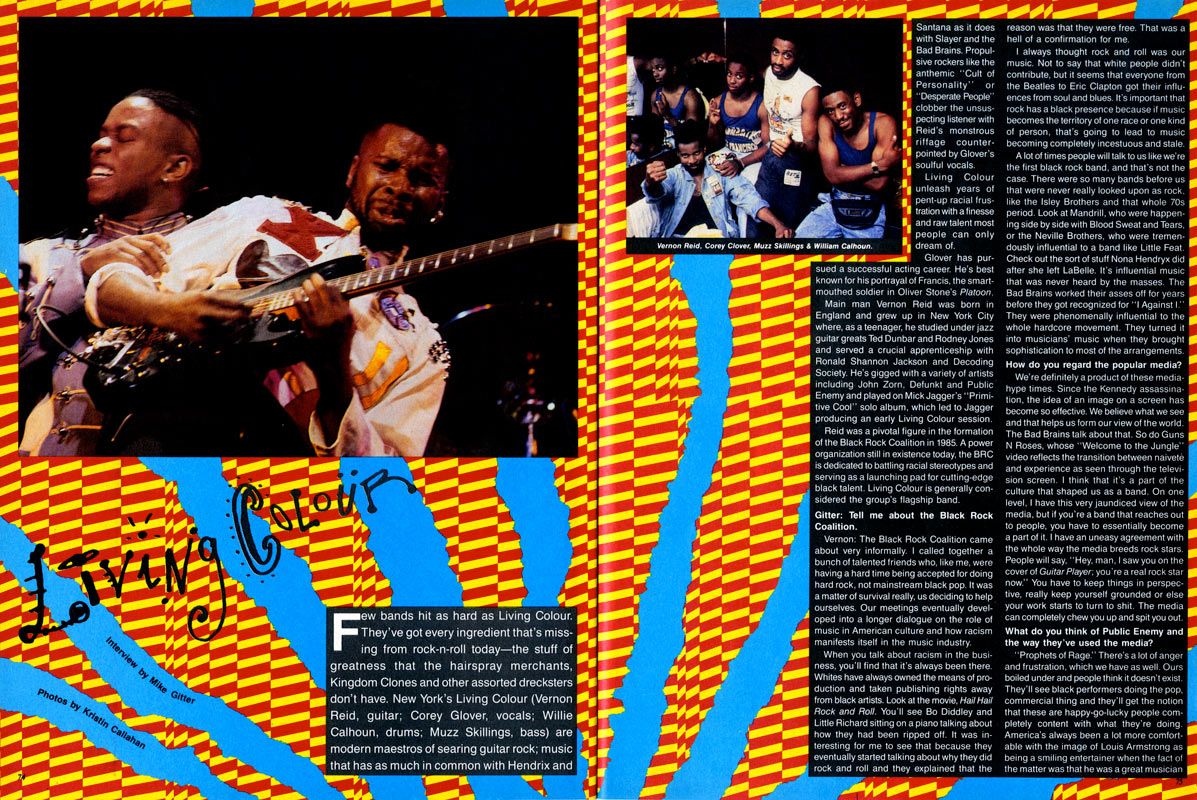
don't have. New York's Living Colour (Vernon
Reid, guitar; Corey Glover, vocals; Willie
Calhoun, drums; Muzz Skillings, bass) are
modern maestros of searing guitar rock; music
that has as much in common with Hendrix and
FRANCISC
Vernon Reid, Corey Clover, Muzz Skillings & William Calhoun.
Santana as it does
with Slayer and the
Bad Brains. Propul-
sive rockers like the
anthemic "Cult of
Personality" or
"Desperate People"
clobber the unsus
pecting listener with
Reid's monstrous
riffage counter
pointed by Glover's
soulful vocals.
Living Colour
unleash years of
pent-up racial frus-
tration with a finesse
and raw talent most
people can only
dream of.
Glover has pur-
sued a successful acting career. He's best.
known for his portrayal of Francis, the smart-
mouthed soldier in Oliver Stone's Platoon.
Main man Vernon Reid was born in
England and grew up in New York City
where, as a teenager, he studied under jazz
guitar greats Ted Dunbar and Rodney Jones
and served a crucial apprenticeship with
Ronald Shannon Jackson and Decoding
Society. He's gigged with a variety of artists
including John Zorn, Defunkt and Public
Enemy and played on Mick Jagger's "Primi-
tive Cool" solo album, which led to Jagger
producing an early Living Colour session.
Reid was a pivotal figure in the formation
of the Black Rock Coalition in 1985. A power
organization still in existence today, the BRC
is dedicated to battling racial stereotypes and
serving as a launching pad for cutting-edge
black talent. Living Colour is generally con
sidered the group's flagship band.
Gitter: Tell me about the Black Rock
Coalition.
Vernon: The Black Rock Coalition came
about very informally. I called together a
bunch of talented friends who, like me, were
having a hard time being accepted for doing
hard rock, not mainstream black pop. It was
a matter of survival really, us deciding to help
ourselves. Our meetings eventually devel
oped into a longer dialogue on the role of
music in American culture and how racism
manifests itself in the music industry.
When you talk about racism in the busi-
ness, you'll find that it's always been there.
Whites have always owned the means of pro-
duction and taken publishing rights away
from black artists. Look at the movie, Hail Hail
Rock and Roll. You'll see Bo Diddley and
Little Richard sitting on a piano talking about
how they had been ripped off. It was in-
teresting for me to see that because they
eventually started talking about why they did
rock and roll and they explained that the
reason was that they were free. That was a
hell of a confirmation for me.
I always thought rock and roll was our
music. Not to say that white people didn't
contribute, but it seems that everyone from
the Beatles to Eric Clapton got their influ-
ences from soul and blues. It's important that
rock has a black presence because if music
becomes the territory of one race or one kind
of person, that's going to lead to music
becoming completely incestuous and stale.
A lot of times people will talk to us like we're
the first black rock band, and that's not the
case. There were so many bands before us
that were never really looked upon as rock.
like the Isley Brothers and that whole 70s
period. Look at Mandrill, who were happen-
ing side by side with Blood Sweat and Tears,
or the Neville Brothers, who were tremen-
dously influential to a band like Little Feat.
Check out the sort of stuff Nona Hendryx did
after she left LaBelle. It's influential music
that was never heard by the masses. The
Bad Brains worked their asses off for years
before they got recognized for "I Against I."
They were phenomenally influential to the
whole hardcore movement. They turned it
into musicians' music when they brought
sophistication to most of the arrangements.
How do you regard the popular media?
We're definitely a product of these media-
hype times. Since the Kennedy assassina-
tion, the idea of an image on a screen has
become so effective. We believe what we see
and that helps us form our view of the world.
The Bad Brains talk about that. So do Guns
N Roses, whose "Welcome to the Jungle"
video reflects the transition between naiveté
and experience as seen through the televi-
sion screen. I think that it's a part of the
culture that shaped us as a band. On one
level, I have this very jaundiced view of the
media, but if you're a band that reaches out
to people, you have to essentially become
a part of it. I have an uneasy agreement with
the whole way the media breeds rock stars.
People will say, "Hey, man, I saw you on the
cover of Guitar Player, you're a real rock star
now." You have to keep things in perspec-
tive, really keep yourself grounded or else
your work starts to turn to shit. The medial
can completely chew you up and spit you out.
What do you think of Public Enemy and
the way they've used the media?
"Prophets of Rage. There's a lot of anger
and frustration, which we have as well. Ours
boiled under and people think it doesn't exist.
They'll see black performers doing the pop.
commercial thing and they'll get the notion
that these are happy-go-lucky people com-
pletely content with what they're doing.
America's always been a lot more comfort-
able with the image of Louis Armstrong as
being a smiling entertainer when the fact of
the matter was that he was a great musician
Interview by Mike Gitter
Photos by Kristin Callahan