Page Text
            DEE DEAMONE
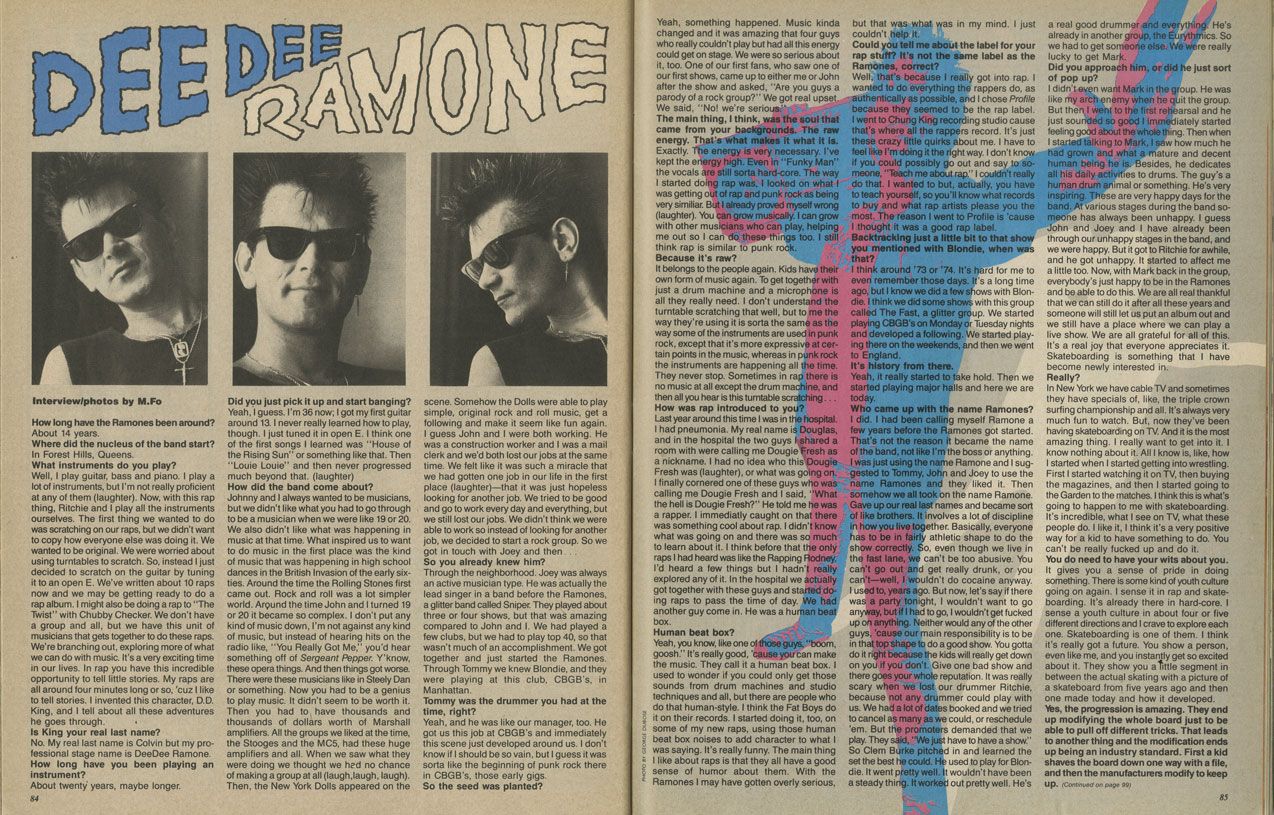
Interview/photos by M.Fo
Did you just pick it up and start banging?
Yeah, I guess. I'm 36 now; I got my first guitar
How long have the Ramones been around? around 13. I never really learned how to play,
About 14 years.
Where did the nucleus of the band start?
In Forest Hills, Queens.
What instruments do you play?
Well, I play guitar, bass and piano. I play a
lot of instruments, but I'm not really proficient
at any of them (laughter). Now, with this rap
thing, Ritchie and I play all the instruments
ourselves. The first thing we wanted to do
was scratching on our raps, but we didn't want
to copy how everyone else was doing it. We
wanted to be original. We were worried about
using turntables to scratch. So, instead I just
decided to scratch on the guitar by tuning
it to an open E. We've written about 10 raps
now and we may be getting ready to do a
rap album. I might also be doing a rap to "The
Twist" with Chubby Checker. We don't have
a group and all, but we have this unit of
musicians that gets together to do these raps.
We're branching out, exploring more of what
we can do with music. It's a very exciting time
in our lives. In rap you have this incredible
opportunity to tell little stories. My raps are
all around four minutes long or so, 'cuz I like
to tell stories. I invented this character, D.D.
King, and I tell about all these adventures
he goes through.
Is King your real last name?
No. My real last name is Colvin but my pro-
fessional stage name is DeeDee Ramone.
How long have you been playing an
instrument?
About twenty years, maybe longer.
84
though. I just tuned it in open E. I think one
of the first songs I learned was "House of
the Rising Sun" or something like that. Then
"Louie Louie" and then never progressed
much beyond that. (laughter)
How did the band come about?
Johnny and I always wanted to be musicians,
but we didn't like what you had to go through
to be a musician when we were like 19 or 20.
We also didn't like what was happening in
music at that time. What inspired us to want
to do music in the first place was the kind
of music that was happening in high school.
dances in the British Invasion of the early six-
ties. Around the time the Rolling Stones first
came out. Rock and roll was a lot simpler
world. Around the time John and I turned 19
or 20 it became so complex. I don't put any
kind of music down, I'm not against any kind
of music, but instead of hearing hits on the
radio like, "You Really Got Me," you'd hear
something off of Sergeant Pepper. Y'know,
these opera things. And then things got worse.
There were these musicians like in Steely Dan
or something. Now you had to be a genius
to play music. It didn't seem to be worth it.
Then you had to, have thousands and
thousands of dollars worth of Marshall
amplifiers. All the groups we liked at the time,
the Stooges and the MC5, had these huge
amplifiers and all. When we saw what they
were doing we thought we hed no chance
of making a group at all (laugh, laugh, laugh).
Then, the New York Dolls appeared on the
scene. Somehow the Dolls were able to play
simple, original rock and roll music, get a
following and make it seem like fun again.
I guess John and I were both working. He
was a construction worker and I was a mail
clerk and we'd both lost our jobs at the same
time. We felt like it was such a miracle that
we had gotten one job in our life in the first
place (laughter)-that it was just hopeless.
looking for another job. We tried to be good
and go to work every day and everything, but
we still lost our jobs. We didn't think we were
able to work so instead of looking for another
job, we decided to start a rock group. So we
got in touch with Joey and then.
So you already knew him?
Through the neighborhood. Joey was always
an active musician type. He was actually the
lead singer in a band before the Ramones,
a glitter band called Sniper. They played about
three or four shows, but that was amazing.
compared to John and I. We had played a
few clubs, but we had to play top 40, so that
wasn't much of an accomplishment. We got
together and just started the Ramones.
Through Tommy we knew Blondie, and they
were playing at this club, CBGB's, in
Manhattan.
Tommy was the drummer you had at the
time, right?
Yeah, and he was like our manager, too. He
got us this job at CBGB's and immediately.
this scene just developed around us. I don't
know if I should be so vain, but I guess it was
sorta like the beginning of punk rock there
in CBGB's, those early gigs.
So the seed was planted?
Yeah, something happened. Music kinda
changed and it was amazing that four guys
who really couldn't play but had all this energy
could get on stage. We were so serious about
it, too. One of our first fans, who saw one of
our first shows, came up to either me or John
after the show and asked, "Are you guys a
parody of a rock group?" We got real upset.
We said, "No! we're serious
The main thing, I think, was the soul that
came from your backgrounds. The raw
energy. That's what makes it what it is.
Exactly. The energy is very necessary. I've
kept the energy high. Even in "Funky Man"
the vocals are still sorta hard-core. The way
I started doing rap was, I looked on what I
was getting out of rap and punk rock as being
very similiar. But I already proved myself wrong
(laughter). You can grow musically. I can grow.
with other musicians who can play, helping
me out so I can do these things too. I still
think rap is similar to punk rock.
Because it's raw?
It belongs to the people again. Kids have their
own form of music again. To get together with
just a drum machine and a microphone is
all they really need. I don't understand the
turntable scratching that well, but to me the
way they're using it is sorta the same as the
way some of the instruments are used in punk
rock, except that it's more expressive at cer-
tain points in the music, whereas in punk rock
the instruments are happening all the time.
They never stop. Sometimes in rap there is
no music at all except the drum machine, and
then all you hear is this turntable scratching....
How was rap introduced to you?
Last year around this time I was in the hospital.
I had pneumonia. My real name is Douglas,
and in the hospital the two guys I shared a
room with were calling me Dougie Fresh as
a nickname. I had no idea who this Dougie
Fresh was (laughter), or what was going on.
I finally cornered one of these guys who was
calling me Dougie Fresh and I said, "What
the hell is Dougie Fresh?" He told me he was
a rapper. I immediatly caught on that there
was something cool about rap. I didn't know
what was going on and there was so much
to learn about it. I think before that the only
raps I had heard was like the Rapping Rodney
I'd heard a few things but I hadn't really
explored any of it. In the hospital we actually
got together with these guys and started do-
ing raps to pass the time of day. We had
another guy come in. He was a human beat
box.
Human beat box?
Yeah, you know, like one of those guys, "boom,
goosh." It's really good, 'cause you can make
the music. They call it a human beat box. I
used to wonder if you could only get those
sounds from drum machines and studio
techniques and all, but there are people who
do that human-style. I think the Fat Boys do
it on their records. I started doing it, too, on
some of my new raps, using those human
beat box noises to add character to what I
was saying. It's really funny. The main thing
I like about raps is that they all have a good
sense of humor about them. With the
Ramones I may have gotten overly serious,
but that was what was in my mind. I just
couldn't help it.
Could you tell me about the label for your
rap stuff? It's not the same label as the
Ramones, correct?
Well, that's because I really got into rap. I
wanted to do everything the rappers do, as
authentically as possible, and I chose Profile
because they seemed to be the rap label.
I went to Chung King recording studio cause
that's where all the rappers record. It's just
these crazy little quirks about me. I have to
feel like I'm doing it the right way. I don't know
if you could possibly go out and say to so-
meone, "Teach me about rap." I couldn't really
do that. I wanted to but, actually, you have
to teach yourself, so you'll know what records
to buy and what rap artists please you the
most. The reason I went to Profile is 'cause
I thought it was a good rap label.
Backtracking just a little bit to that show
you mentioned with Blondie, when was
that?
I think around '73 or '74. It's hard for me to
even remember those days. It's a long time
ago, but I know we did a few shows with Blon-
die. I think we did some shows with this group
called The Fast, a glitter group. We started
playing CBGB's on Monday or Tuesday nights
and developed a following. We started play
ing there on the weekends, and then we went
to England.
It's history from there.
Yeah, it really started to take hold. Then we
started playing major halls and here we are
today.
Who came up with the name Ramones?
I did. I had been calling myself Ramone a
few years before the Ramones got started.
That's not the reason it became the name
of the band, not like I'm the boss or anything.
I was just using the name Ramone and I sug-
gested to Tommy, John and Joey to use the
name Ramones and they liked it. Then
somehow we all took on the name Ramone.
Gave up our real last names and became sort
of like brothers. It involves a lot of discipline
in how you live together. Basically, everyone
has to be in fairly athletic shape to do the
show correctly. So, even though we live in
the fast lane, we can't be too abusive. You
can't go out and get really drunk, or you
can't-well, I wouldn't do cocaine anyway.
Fused to, years ago. But now, let's say if there
was a party tonight, I wouldn't want to go
anyway, but if I had to go, I wouldn't get fucked
up on anything. Neither would any of the other
guys, 'cause our main responsibility is to be
in that top shape to do a good show. You gotta
do it right because the kids will really get down
on you if you don't. Give one bad show and
there goes your whole reputation. It was really
scary when we lost our drummer Ritchie,
because not any drummer could play with
us. We had a lot of dates booked and we tried
to cancel as many as we could, or reschedule
'em. But the promoters demanded that we
play. They said, "We just have to have a show."
So Clem Burke pitched in and learned the
set the best he could. He used to play for Blon-
die. It went pretty well. It wouldn't have been
a steady thing. It worked out pretty well. He's
a
real good drummer and everything. He's
already in another group, the Eurythmics. So
we had to get someone else. We were really
lucky to get Mark.
Did you approach him, or did he just sort
of pop up?
I didn't even want Mark in the group. He was
like my arch enemy when he quit the group.
But then I went to the first rehearsal and he
just sounded so good I immediately started
feeling good about the whole thing. Then when
I started talking to Mark, I saw how much he
had grown and what a mature and decent.
human being he is. Besides, he dedicates
all his daily activities to drums. The guy's a
human drum animal or something. He's very
inspiring. These are very happy days for the
band. At various stages during the band so-
meone has always been unhappy. I guess
John and Joey and I have already been
through our unhappy stages in the band, and
we were happy. But it got to Ritchie for awhile,
and he got unhappy. It started to affect me
a little too. Now, with Mark back in the group,
everybody's just happy to be in the Ramones
and be able to do this. We are all real thankful
that we can still do it after all these years and
someone will still let us put an album out and
we still have a place where we can play a
live show. We are all grateful for all of this.
It's a real joy that everyone appreciates it.
Skateboarding is something that I have
become newly interested in.
Really?
In New York we have cable TV and sometimes
they have specials of, like, the triple crown
surfing championship and all. It's always very
much fun to watch. But, now they've been
having skateboarding on TV. And it is the most
amazing thing. I really want to get into it. I
know nothing about it. All I know is, like, how
I started when I started getting into wrestling.
First I started watching it on TV, then buying
the magazines, and then I started going to
the Garden to the matches. I think this is what's
going to happen to me with skateboarding.
It's incredible, what I see on TV, what these
people do. I like it, I think it's a very positive
way for a kid to have something to do. You!
can't be really fucked up and do it.
You do need to have your wits about you.
It gives you a sense of pride in doing
something. There is some kind of youth culture
going on again. I sense it in rap and skate-
boarding. It's already there in hard-core. I
sense a youth culture in about four or five
different directions and I crave to explore each
one. Skateboarding is one of them. I think
it's really got a future. You show a person,
even like me, and you instantly get so excited
about it. They show you a little segment in
between the actual skating with a picture of
a skateboard from five years ago and then
one made today and how it developed.
Yes, the progression is amazing. They end
up modifying the whole board just to be
able to pull off different tricks. That leads
to another thing and the modification ends
up being an industry standard. First a kid
shaves the board down one way with a file,
and then the manufacturers modify to keep
up. (Continued on page 99)
85