Page Text
            B.O.M.B.
UN FORM
CHOICE
COMBIT
CRUMBSUCKERS'
DEVASTATING
NEW ALBUM
NOW
AVAILABLE
ON
COMBAT
'BEAST
ON MY
BACK'
U
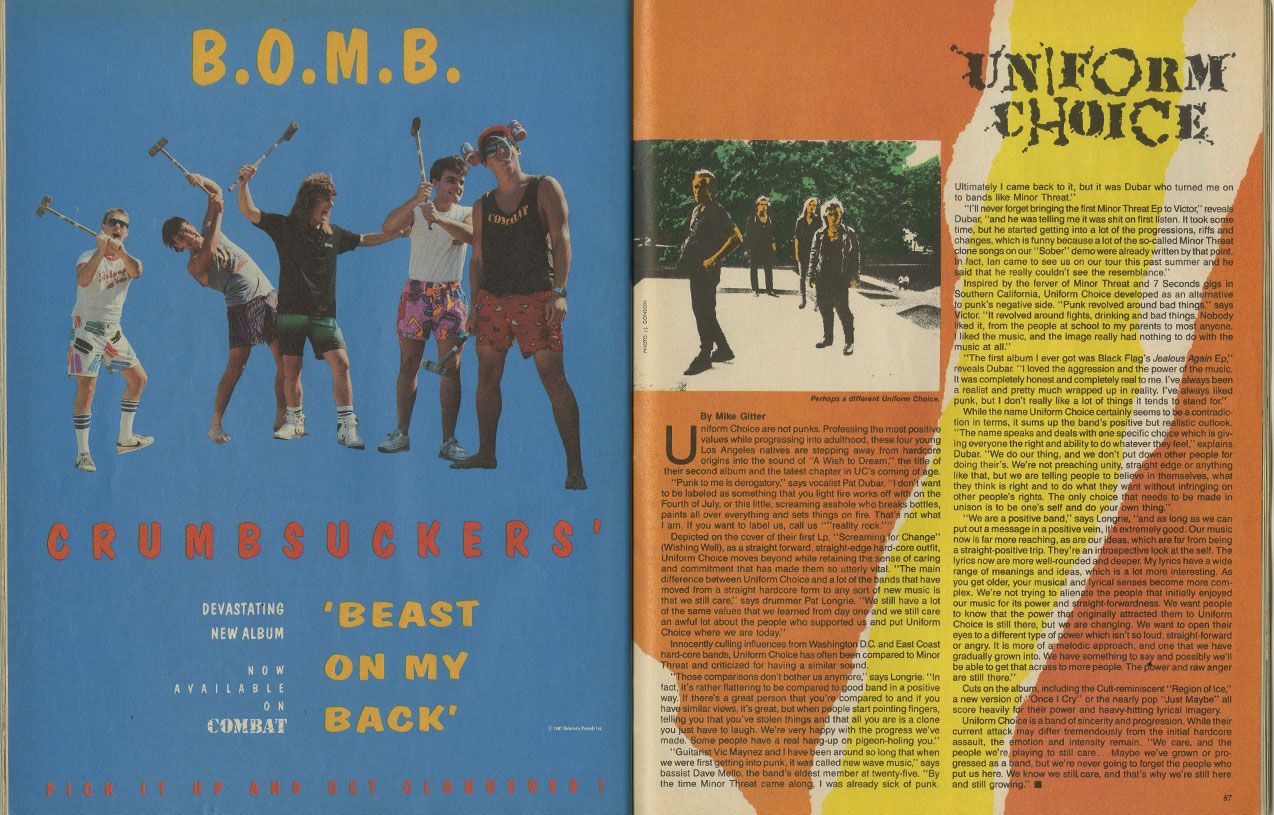
Perhaps a different Uniform Choice
By Mike Gitter
niform Choice are not punks. Professing the most positive
values while progressing into adulthood, these four young
Los Angeles natives are stepping away from hardcore
origins into the sound of "A Wish to Dream," the title of
their second album and the latest chapter in UC's coming of age.
"Punk to me is derogatory," says vocalist Pat Dubar. "I don't want
to be labeled as something that you light fire works off with on the
Fourth of July, or this little, screaming asshole who breaks bottles,
paints all over everything and sets things on fire. That's not what
I am. If you want to label us, call us reality rock.
Depicted on the cover of their first Lp, "Screaming for Change"
(Wishing Well), as a straight forward, straight-edge hard-core outfit,
Uniform Choice moves beyond while retaining the sense of caring
and commitment that has made them so utterly vital. "The main
difference between Uniform Choice and a lot of the bands that have
moved from a straight hardcore form to any sort of new music is
that we still care," says drummer Pat Longrie. "We still have a lot
of the same values that we learned from day one and we still care
an awful lot about the people who supported us and put Uniform
Choice where we are today."
Innocently culling influences from Washington DC. and East Coast
hard-core bands, Uniform Choice has often been compared to Minor
Threat and criticized for having a similar sound.
"Those comparisons don't bother us anymore," says Longrie. "In
fact, it's rather flattering to be compared to good band in a positive
way. If there's a great person that you're compared to and if you
have similar views, it's great, but when people start pointing fingers,
telling you that you've stolen things and that all you are is a clone
you just have to laugh. We're very happy with the progress we've
made. Some people have a real hang-up on pigeon-holing you."
"Guitarist Vic Maynez and I have been around so long that when
we were first getting into punk, it was called new wave music," says
bassist Dave Mello, the band's eldest member at twenty-five. "By
the time Minor Threat came along. I was already sick of punk.
Ultimately I came back to it, but it was Dubar who turned me on
to bands like Minor Threat."
"I'll never forget bringing the first Minor Threat Ep to Victor," reveals
Dubar, "and he was telling me it was shit on first listen. It took some
time, but he started getting into a lot of the progressions, riffs and
changes, which is funny because a lot of the so-called Minor Threat
clone songs on our "Sober" demo were already written by that point.
In fact, lan came to see us on our tour this past summer and he
said that he really couldn't see the resemblance."
Inspired by the ferver of Minor Threat and 7 Seconds gigs in
Southern California, Uniform Choice developed as an alternative
to punk's negative side. "Punk revolved around bad things," says
Victor. "It revolved around fights, drinking and bad things. Nobody
liked it, from the people at school to my parents to most anyone.
liked the music, and the image really had nothing to do with the
music at all."
"The first album I ever got was Black Flag's Jealous Again Ep."
reveals Dubar. "I loved the aggression and the power of the music.
It was completely honest and completely real to me. I've always been
a realist and pretty much wrapped up in reality. I've always liked
punk, but I don't really like a lot of things it tends to stand for."
While the name Uniform Choice certainly seems to be a contradic-
tion in terms, it sums up the band's positive but realistic outlook.
"The name speaks and deals with one specific choice which is giv-
ing everyone the right and ability to do whatever they feel," explains
Dubar. "We do our thing, and we don't put down other people for
doing their's. We're not preaching unity, straight edge or anything
like that, but we are telling people to believe in themselves, what
they think is right and to do what they want without infringing on
other people's rights. The only choice that needs to be made in
unison is to be one's self and do your own thing."
""We are a positive band," says Longrie, "and as long as we can
put out a message in a positive vein, it's extremely good. Our music
now is far more reaching, as are our ideas, which are far from being
a straight-positive trip. They're an introspective look at the self. The
lyrics now are more well-rounded and deeper. My lyrics have a wide
range of meanings and ideas, which is a lot more interesting. As
you get older, your musical and lyrical senses become more com-
plex. We're not trying to alienate the people that initially enjoyed
our music for its power and straight-forwardness. We want people
to know that the power that originally attracted them to Uniform
Choice is still there, but we are changing. We want to open their
eyes to a different type of power which isn't so loud, straight-forward
or angry. It is more of a melodic approach, and one that we have
gradually grown into. We have something to say and possibly we'll
be able to get that across to more people. The power and raw anger
are still there."
Cuts on the album, including the Cult-reminiscent "Region of Ice,"
a new version of "Once I Cry" or the nearly pop "Just Maybe" all
score heavily for their power and heavy-hitting lyrical Imagery.
Uniform Choice is a band of sincerity and progression. While their
current attack may differ tremendously from the initial hardcore
assault, the emotion and intensity remain. "We care, and the
people we're playing to still care.. Maybe we've grown or pro-
gressed as a band, but we're never going to forget the people who
put us here. We know we still care, and that's why we're still here
and still growing."