Page Text
            SIMS
STACY PERALTA
心
SUBSCRIBE
---don't be
denied!!
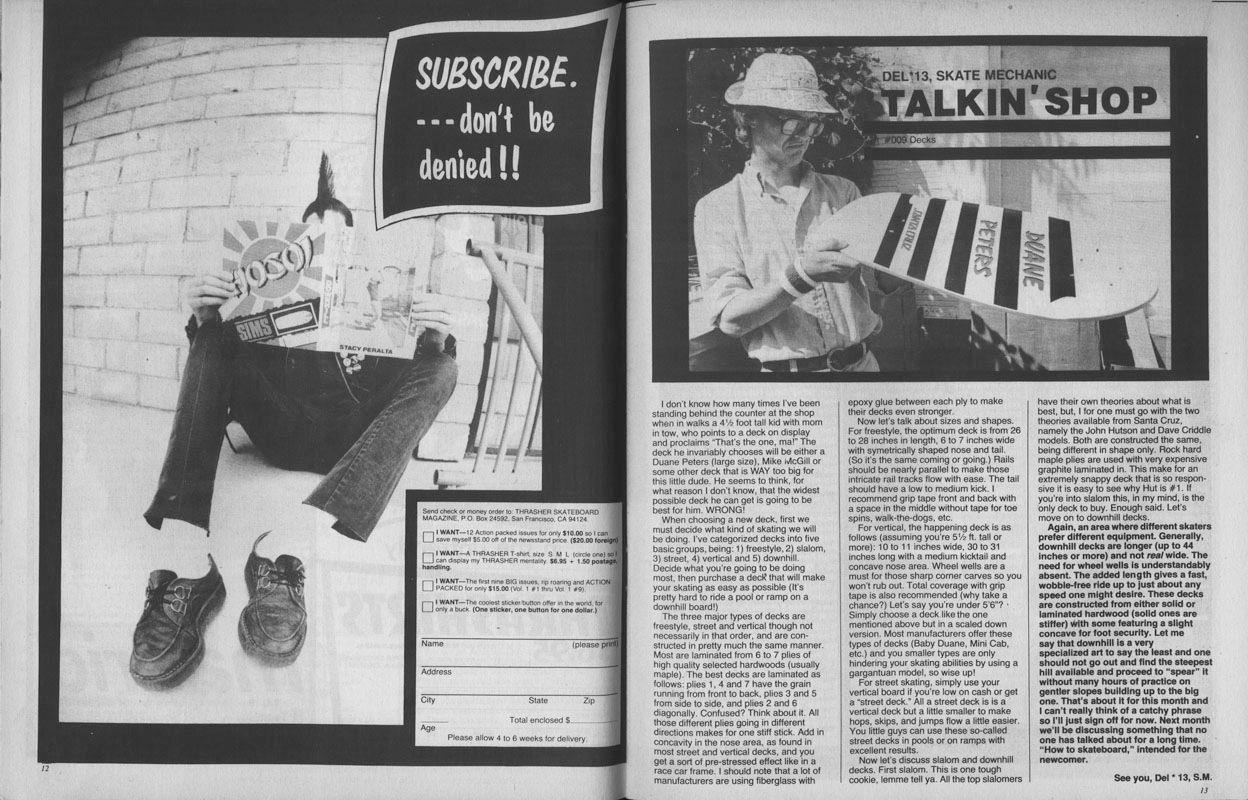
DEL 13, SKATE MECHANIC
TALKIN'SHOP
009 Decks
2TS
Send check or money order to: THRASHER SKATEBOARD
MAGAZINE, PO Box 24592. San Francisco, CA 94124
I WANT-12 Action packed issues for only $10.00 so I can
save myself $5.00 off of the newsstand price. ($20.00 foreign)
I WANT A THRASHER T-shirt size S M L (circle one) so
can display my THRASHER mentality $6.95 +1.50 postage
I WANT-The first nine BIG issues, rip roaring and ACTION
PACKED for only $15.00 (Vol 1 #1 thru Vol 1 #9)
I WANT-The coolest sticker button offer in the world, for
only a buck (One sticker, one button for one dollar.)
Name
Address
City
Age
State
(please print)
Zip
Total enclosed S
Please allow 4 to 6 weeks for delivery.
I don't know how many times I've been
standing behind the counter at the shop
when in walks a 4% foot tall kid with mom
in tow, who points to a deck on display
and proclaims "That's the one, mal" The
deck he invariably chooses will be either a
Duane Peters (large size), Mike McGill or
some other deck that is WAY too big for
this little dude. He seems to think, for
what reason I don't know, that the widest
possible deck he can get is going to be
best for him. WRONG!
When choosing a new deck, first we
must decide what kind of skating we will
be doing. I've categorized decks into five
basic groups, being: 1) freestyle, 2) slalom,
3) street, 4) vertical and 5) downhill.
Decide what you're going to be doing
most, then purchase a deck that will make
your skating as easy as possible (It's
pretty hard to ride a pool or ramp on a
downhill board!)
The three major types of decks are
freestyle, street and vertical though not
necessarily in that order, and are con-
structed in pretty much the same manner.
Most are laminated from 6 to 7 plies of
high quality selected hardwoods (usually
maple). The best decks are laminated as
follows: plies 1, 4 and 7 have the grain
running from front to back, plios 3 and 5
from side to side, and plies 2 and 6
diagonally. Confused? Think about it. All
those different plies going in different
directions makes for one stiff stick. Add in
concavity in the nose area, as found in
most street and vertical decks, and you
get a sort of pre-stressed effect like in a
race car frame. I should note that a lot of
manufacturers are using fiberglass with
epoxy glue between each ply to make
their decks even stronger.
Now let's talk about sizes and shapes.
For freestyle, the optimum deck is from 26.
to 28 inches in length, 6 to 7 inches wide
with symetrically shaped nose and tail.
(So it's the same coming or going.) Rails
should be nearly parallel to make those
intricate rail tracks flow with ease. The tail
should have a low to medium kick. I
recommend grip tape front and back with
a space in the middle without tape for toe
spins, walk-the-dogs, etc.
For vertical, the happening deck is as
follows (assuming you're 5% ft. tall or
more): 10 to 11 inches wide, 30 to 31
inches long with a medium kicktail and
concave nose area. Wheel wells are a
must for those sharp corner carves so you
won't rub out. Total coverage with grip
tape is also recommended (why take a
chance?) Let's say you're under 5'6"?
Simply choose a deck like the one
mentioned above but in a scaled down
version. Most manufacturers offer these
types of decks (Baby Duane, Mini Cab,
etc.) and you smaller types are only
hindering your skating abilities by using a
gargantuan model, so wise up!
For street skating, simply use your
vertical board if you're low on cash or get
a "street deck." All a street deck is is a
vertical deck but a little smaller to make
hops, skips, and jumps flow a little easier..
You little guys can use these so-called
street decks in pools or on ramps with
excellent results.
Now let's discuss slalom and downhill
decks. First slalom. This is one tough
cookie, lemme tell ya. All the top slalomers
have their own theories about what is
best, but, I for one must go with the two
theories available from Santa Cruz,
namely the John Hutson and Dave Criddle
models. Both are constructed the same,
being different in shape only. Rock hard
maple plies are used with very expensive
graphite laminated in. This make for an
extremely snappy deck that is so respon-
sive it is easy to see why Hut is #1. If
you're into slalom this, in my mind, is the
only deck to buy. Enough said. Let's
move on to downhill decks.
Again, an area where different skaters
prefer different equipment. Generally,
downhill decks are longer (up to 44
inches or more) and not real wide. The
need for wheel wells is understandably
absent. The added length gives a fast,
wobble-free ride up to just about any
speed one might desire. These decks
are constructed from either solid or
laminated hardwood (solid ones are
stiffer) with some featuring a slight
concave for foot security. Let me
say that downhill is a very
specialized art to say the least and one
should not go out and find the steepest
hill available and proceed to "spear" it
without many hours of practice on
gentler slopes building up to the big
one. That's about it for this month and
I can't really think of a catchy phrase
so I'll just sign off for now. Next month
we'll be discussing something that no
one has talked about for a long time.
"How to skateboard," intended for the
newcomer.
See you, Del 13, S.M.
13