Page Text
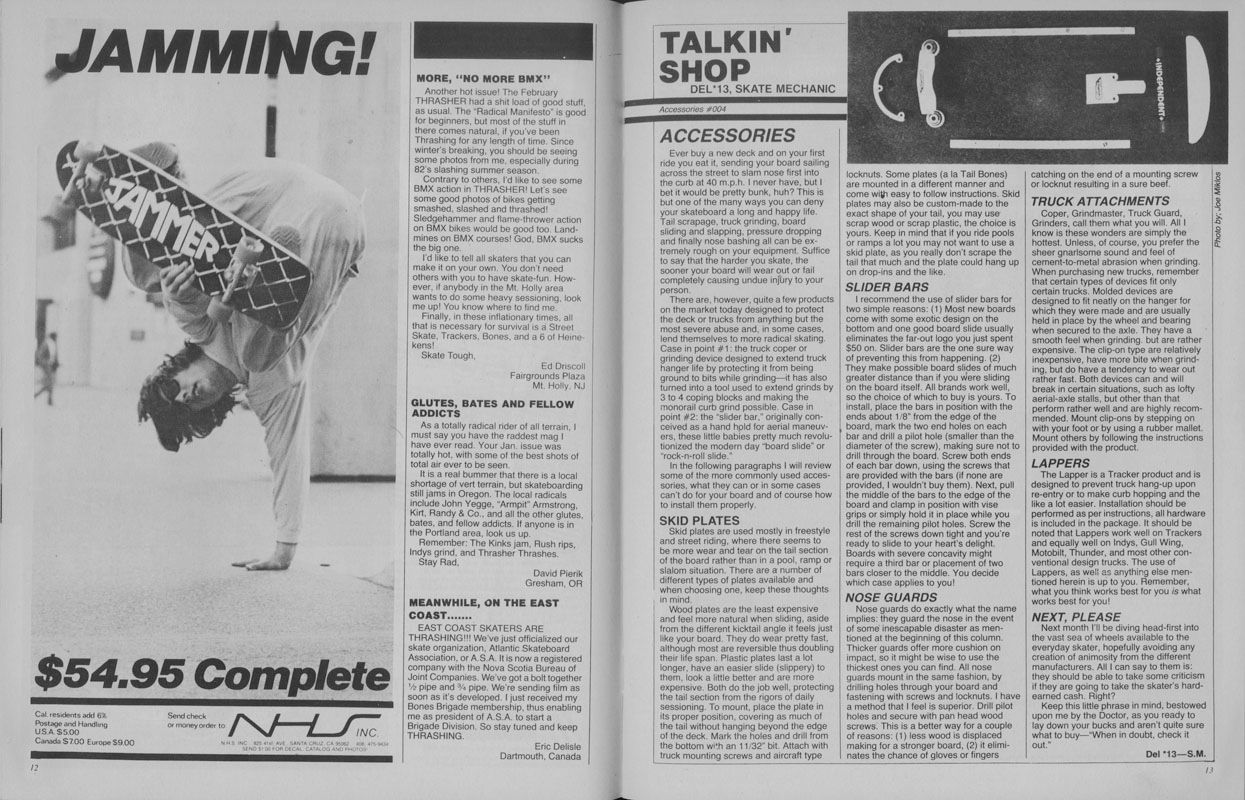
            JAMMING!
JAMMER
$54.95 Complete
Cal residents add 6%
Postage and Handling
USA $5.00
Canada $7.00 Europe $9.00
Send check
or money order to
NHS
INC.
NHS INCAVE SANTA CRUZ CA 447-04
SEND 100 FOR DECAL CATALOG AND PHOTOS
MORE, "NO MORE BMX"
Another hot issue! The February
THRASHER had a shit load of good stuff,
as usual. The "Radical Manifesto" is good
for beginners, but most of the stuff in
there comes natural, if you've been
Thrashing for any length of time. Since
winter's breaking, you should be seeing
some photos from me, especially during
82's slashing summer season.
Contrary to others, I'd like to see some
BMX action in THRASHER! Let's see
some good photos of bikes getting
smashed, slashed and thrashed!
Sledgehammer and flame-thrower action
on BMX bikes would be good too. Land-
mines on BMX courses! God, BMX sucks
the big one.
I'd like to tell all skaters that you can
make it on your own. You don't need
others with you to have skate-fun. How-
ever, if anybody in the Mt. Holly area
wants to do some heavy sessioning, look
me up! You know where to find me.
Finally, in these inflationary times, all
that is necessary for survival is a Street
Skate, Trackers, Bones, and a 6 of Heine-
kens!
Skate Tough,
Ed Driscoll
Fairgrounds Plaza
Mt. Holly, NJ
GLUTES, BATES AND FELLOW
ADDICTS
As a totally radical rider of all terrain, I
must say you have the raddest mag I
have ever read. Your Jan. issue was
totally hot, with some of the best shots of
total air ever to be seen.
It is a real bummer that there is a local
shortage of vert terrain, but skateboarding
still jams in Oregon. The local radicals
include John Yegge, "Armpit" Armstrong,
Kirt, Randy & Co., and all the other glutes,
bates, and fellow addicts. If anyone is in
the Portland area, look us up.
Remember: The Kinks jam, Rush rips,
Indys grind, and Thrasher Thrashes.
Stay Rad,
David Pierik
Gresham, OR
MEANWHILE, ON THE EAST
COAST.......
EAST COAST SKATERS ARE
THRASHING!!! We've just officialized our
skate organization, Atlantic Skateboard
Association, or A.S.A. It is now a registered
company with the Nova Scotia Bureau of
Joint Companies. We've got a bolt together
% pipe and % pipe. We're sending film as
soon as it's developed. I just received my
Bones Brigade membership, thus enabling
me as president of A.S.A. to start a
Brigade Division. So stay tuned and keep
THRASHING.
Eric Delisle
Dartmouth, Canada
TALKIN'
SHOP
DEL 13, SKATE MECHANIC
Accessories #004
ACCESSORIES
Ever buy a new deck and on your first
ride you eat it, sending your board sailing
across the street to slam nose first into
the curb at 40 m.p.h. I never have, but I
bet it would be pretty bunk, huh? This is
but one of the many ways you can deny
your skateboard a long and happy life.
Tail scrapage, truck grinding, board
sliding and slapping, pressure dropping
and finally nose bashing all can be ex-
tremely rough on your equipment. Suffice
to say that the harder you skate, the
sooner your board will wear out or fail
completely causing undue injury to your
person.
There are, however, quite a few products
on the market today designed to protect
the deck or trucks from anything but the
most severe abuse and, in some cases,
lend themselves to more radical skating.
Case in point #1: the truck coper or
grinding device designed to extend truck
hanger life by protecting it from being
ground to bits while grinding-it has also
turned into a tool used to extend grinds by
3 to 4 coping blocks and making the
monorail curb grind possible. Case in
point #2: the "slider bar," originally con-
ceived as a hand hold for aerial maneuv-
ers, these little babies pretty much revolu-
tionized the modern day "board slide" or
"rock-n-roll slide."
In the following paragraphs I will review
some of the more commonly used acces-
sories, what they can or in some cases
can't do for your board and of course how
to install them properly.
SKID PLATES
Skid plates are used mostly in freestyle
and street riding, where there seems to
be more wear and tear on the tail section
of the board rather than in a pool, ramp or
slalom situation. There are a number of
different types of plates available and
when choosing one, keep these thoughts
in mind.
Wood plates are the least expensive
and feel more natural when sliding, aside
from the different kicktail angle it feels just
like your board. They do wear pretty fast,
although most are reversible thus doubling
their life span. Plastic plates last a lot
longer, have an easier slide (slippery) to
them, look a little better and are more
expensive. Both do the job well, protecting
the tail section from the rigors of daily
sessioning. To mount, place the plate in
its proper position, covering as much of
the tail without hanging beyond the edge
of the deck. Mark the holes and drill from
the bottom with an 11/32" bit. Attach with
truck mounting screws and aircraft type
locknuts. Some plates (a la Tail Bones)
are mounted in a different manner and
come with easy to follow instructions. Skid
plates may also be custom-made to the
exact shape of your tail, you may use
scrap wood or scrap plastic, the choice is
yours. Keep in mind that if you ride pools
or ramps a lot you may not want to use a
skid plate, as you really don't scrape the
tail that much and the plate could hang up
on drop-ins and the like.
SLIDER BARS
I recommend the use of slider bars for
two simple reasons: (1) Most new boards
come with some exotic design on the
bottom and one good board slide usually
eliminates the far-out logo you just spent
$50 on. Slider bars are the one sure way
of preventing this from happening. (2)
They make possible board slides of much
greater distance than if you were sliding
on the board itself. All brands work well,
so the choice of which to buy is yours. To
install, place the bars in position with the
ends about 1/8" from the edge of the
board, mark the two end holes on each
bar and drill a pilot hole (smaller than the
diameter of the screw), making sure not to
drill through the board. Screw both ends
of each bar down, using the screws that
are provided with the bars (if none are
provided, I wouldn't buy them). Next, pull
the middle of the bars to the edge of the
board and clamp in position with vise
grips or simply hold it in place while you
drill the remaining pilot holes. Screw the
rest of the screws down tight and you're
ready to slide to your heart's delight.
Boards with severe concavity might
require a third bar or placement of two
bars closer to the middle. You decide
which case applies to you!
NOSE GUARDS
Nose guards do exactly what the name
implies: they guard the nose in the event
of some inescapable disaster as men-
tioned at the beginning of this column.
Thicker guards offer more cushion on
impact, so it might be wise to use the
thickest ones you can find. All nose
guards mount in the same fashion, by
drilling holes through your board and
fastening with screws and locknuts. I have
a method that I feel is superior. Drill pilot
holes and secure with pan head wood
screws. This is a better way for a couple
of reasons: (1) less wood is displaced
making for a stronger board, (2) it elimi-
nates the chance of gloves or fingers
catching on the end of a mounting screw
or locknut resulting in a sure beef.
TRUCK ATTACHMENTS
Coper, Grindmaster, Truck Guard,
Grinders, call them what you will. All I
know is these wonders are simply the
hottest. Unless, of course, you prefer the
sheer gnarlsome sound and feel of
cement-to-metal abrasion when grinding.
When purchasing new trucks, remember
that certain types of devices fit only
certain trucks. Molded devices are
designed to fit neatly on the hanger for
which they were made and are usually
held in place by the wheel and bearing
when secured to the axle. They have a
smooth feel when grinding. but are rather
expensive. The clip-on type are relatively
inexpensive, have more bite when grind-
ing, but do have a tendency to wear out
rather fast. Both devices can and will
break in certain situations, such as lofty
aerial-axle stalls, but other than that
perform rather well and are highly recom-
mended. Mount clip-ons by stepping on
with your foot or by using a rubber mallet.
Mount others by following the instructions
provided with the product.
LAPPERS
The Lapper is a Tracker product and is
designed to prevent truck hang-up upon
re-entry or to make curb hopping and the
like a lot easier. Installation should be
performed as per instructions, all hardware
is included in the package. It should be
noted that Lappers work well on Trackers
and equally well on Indys, Gull Wing,
Motobilt, Thunder, and most other con-
ventional design trucks. The use of
Lappers, as well as anything else men-
tioned herein is up to you. Remember,
what you think works best for you is what
works best for you!
NEXT, PLEASE
Next month I'll be diving head-first into
the vast sea of wheels available to the
everyday skater, hopefully avoiding any
creation of animosity from the different
manufacturers. All I can say to them is:
they should be able to take some criticism
if they are going to take the skater's hard-
earned cash, Right?
Keep this little phrase in mind, bestowed
upon me by the Doctor, as you ready to
lay down your bucks and aren't quite sure
what to buy-"When in doubt, check it
Del '13-S.M.
out."
13