Page Text
            FROM A STATISTICAL
STANDPOINT...
IT'S A SAFE BET
to say that Tony Hawk is the world's greatest "competi-
tive skater" now, and who knows, maybe of all time. It's
also probably safe to say that another Tony, Tony Alva, is the
world's greatest "natural skater" perhaps of all time. Most
people who were there, back then, would probably agree
with this assessment. Perhaps by coincidence or fate, I was
there with both of these skaters.
Tony Alva and I grew up skating the same banked schools
and empty swimming pools of the Dogtown era. Heralding
from the same skateboard team, the Zephyr team, we skat-
ed together quite a bit. This was during skateboarding's
formative years, a time when skateboarding existed as a
non-institution, as a freeform activity, without any promise
or future. If you skated you did it because you loved it.
you
Because, unlike today, there wasn't anything other than
love to be gained from it.
I also spent ten terrific years of my life involved with Tony
Hawk. I watched him grow from a scrawny little thirteen-
year-old skater into the world champion he has become.
Let me get to the point of this article, which is this: if Tony
Alva is the greatest natural skater of all time, then where
does that put Jay Adams? Because Jay Adams could also
in fact, should also be considered the world's greatest nat-
ural skater. In fact, some might say I'm leaving out other
skaters who should be in contention, most notably Steve
Caballero and Christian Hosoi. Both of these skaters were
world-class greats. But Caballero and Hosoi had something.
that skaters like Alva, Adams, and I never had. They came
into the sport with a precedent established: when they
began skating they knew it was possible to carve a swim-
ming pool, they knew a frontside grind on vertical was pos-
sible, and they knew that aerials were possible. This is not
to say that things were easier for them, but that many doors
had been blown open by the
e time
they arrived.
ol. Even
Case in point: The year was late 1975, if my memory
holds. Alva, Bob Biniak, and and perhaps a few others,
were skating the infamous Keyhole pool in Beverly Hills.
Biniak and I got into a fiery debate over whether or not it
was possible to do a frontside kickturn in
in a pool.
though I couldn't do it. I told him
t was possible. He veh
mently disagreed with me, put his foot down, and said it
was impossible. And he wouldn't budge from his opinion.
Right now you're thinking to yourself, how could any-
thing be simpler than a frontside kickturn? What's the big
deal? Well, it was a big deal because we'd never seen any-
one do a frontside kickturn on vertical and we knew no
one in the world had ever done it. We weren't even sure
even sure
the human body could move in that direction when
ascending a vertical wall. In fact, we weren't the only ones
who thought it was impossible. Outsiders who would show
up at these sessions and watch us would spend most of the
time telling us what we were doing was impossible. We'd
carve coping or edge coping with one of our back wheels,
and onlookers would respond with comments like, "That's
impossible," "That can't be done," and "You can't do that."
Well, we were doing it.
one
Two days later, Biniak, Alva, and I were skating the same
pool, the Keyhole, after having spent the morning surfing a
big six-foot swell out of the southern hemi. Biniak and I
picked up on the same unresolved conversation. He'd given
it some thought and still maintained that it was impossible
to do a frontside kickturn on vertical. I decided to challenge
him. I got out of the pool and stood on the coping above
10
NO PA
TURN
ONLY
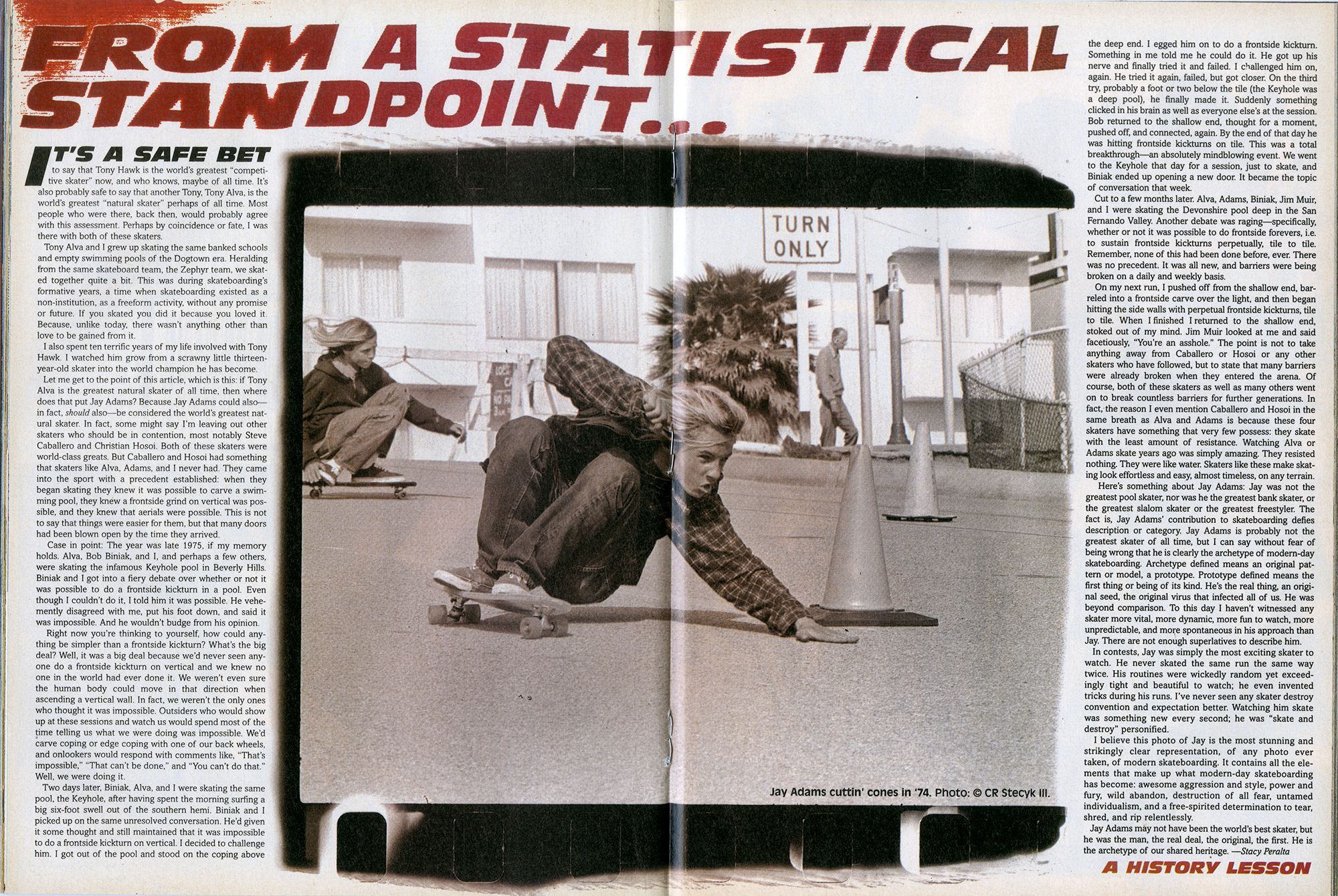
Jay Adams cuttin' cones in '74. Photo: OCR Stecyk III.
the deep end. I egged him on to do a frontside kickturn.
Something in me told me he could do it. He got up his
nerve and finally tried it and failed. I challenged him on,
again. He tried it again, failed, but got closer. On the third
try, probably a foot or two below the tile (the Keyhole was
a deep pool), he finally made it. Suddenly something
clicked in his brain as well as everyone else's at the session.
Bob returned to the shallow end, thought for a moment,
pushed off, and connected, again. By the end of that day he
was hitting frontside kickturns à tile. This was a total
breakthrough an absolutely mindblowing event. We went
to the Keyhole that day for a session, just to skate, and
Biniak ended up opening a new door. It became the topic
of conversation that week.
Cut to a few months later. Alva, Adams, Biniak, Jim Muir,
and I were skating the Devonshire pool deep in the San
Fernando Valley. Another debate was raging-specifically,
whether or not I was possible to do frontside forevers, i.e.
to sustain frontside kickturns perpetually, tile to tile.
Remember, none of this had been done before, ever. There
was no precedent. It was all new, and barriers were being
broken on a daily and weekly basis.
On
my next run, I pushed off from the shallow end, bar-
reled into a frontside carve over the light, and then began
hitting the side walls with perpetual frontside kickturns, tile
to tile. When I finished I returned to the shallow end,
stoked out of my mind. Jim Muir looked at me and said
facetiously, "You're an asshole." The point is not to take
anything away from Caballero or Hosoi or any other
skaters who have followed, but to state that many barriers
were already broken when they entered the arena. Of
course, both of these skaters as well many others went
on to break countless barriers for further generations. In
fact, the reason I even mention Caballero and Hosoi in the
same breath as Alva and Adams is because these four
skaters have something that very few possess: they skate
with the least amount of resistance. Watching Alva or
Adams skate years ago was simply amazing. They resisted
nothing. They were like water. Skaters like these make skat-
ing look effortless and easy, almost timeless, on any terrain.
Here's something about Jay Adams: Jay was not the
greatest pool skater, nor was he the greatest bank skater, or
the greatest slalom skater or the greatest freestyler. The
fact is, Jay Adams' contribution to skateboarding defies
description or category. Jay Adams is probably not the
greatest skater of all time, but
can say without fear of
being wrong that he is clearly the archetype of modern-day
skateboarding. Archetype defined means an original pat-
tern or model, a prototype. Prototype defined means the
first thing or being of its kind. He's the real thing, an origi-
nal seed, the original virus that infected all of us. He was
beyond comparison. To this day I haven't witnessed any
skater more vital, more dynamic, more fun to watch, more
unpredictable, and more spontaneous i in his approach than
Jay. There are not enough superlatives to describe him.
In contests, Jay was simply the most exciting skater to
watch. He never skated the same run the same way
twice. His routines were wickedly random yet exceed-
ingly tight and beautiful to watch; he even invented
tricks during his runs. I've never seen any skater destroy
convention and expectation better. Watching him skate
was something new every second; he was "skate and
destroy" personified.
I believe this photo of Jay is the most stunning and
strikingly clear representation, of any photo ever
taken, of modern skateboarding. It contains all the ele-
ments that make up what modern-day skateboarding
has become: awesome aggression and style, power and
fury, wild abandon, destruction of all fear, untamed
individualism, and a free-spirited determination to tear,
shred, and rip relentlessly.
Jay Adams may not have been the world's best skater, but
he was the man, the real deal, the original, the first. He is
the archetype of our shared heritage. -Stacy Peralta
A HISTORY LESSON