Page Text
            N
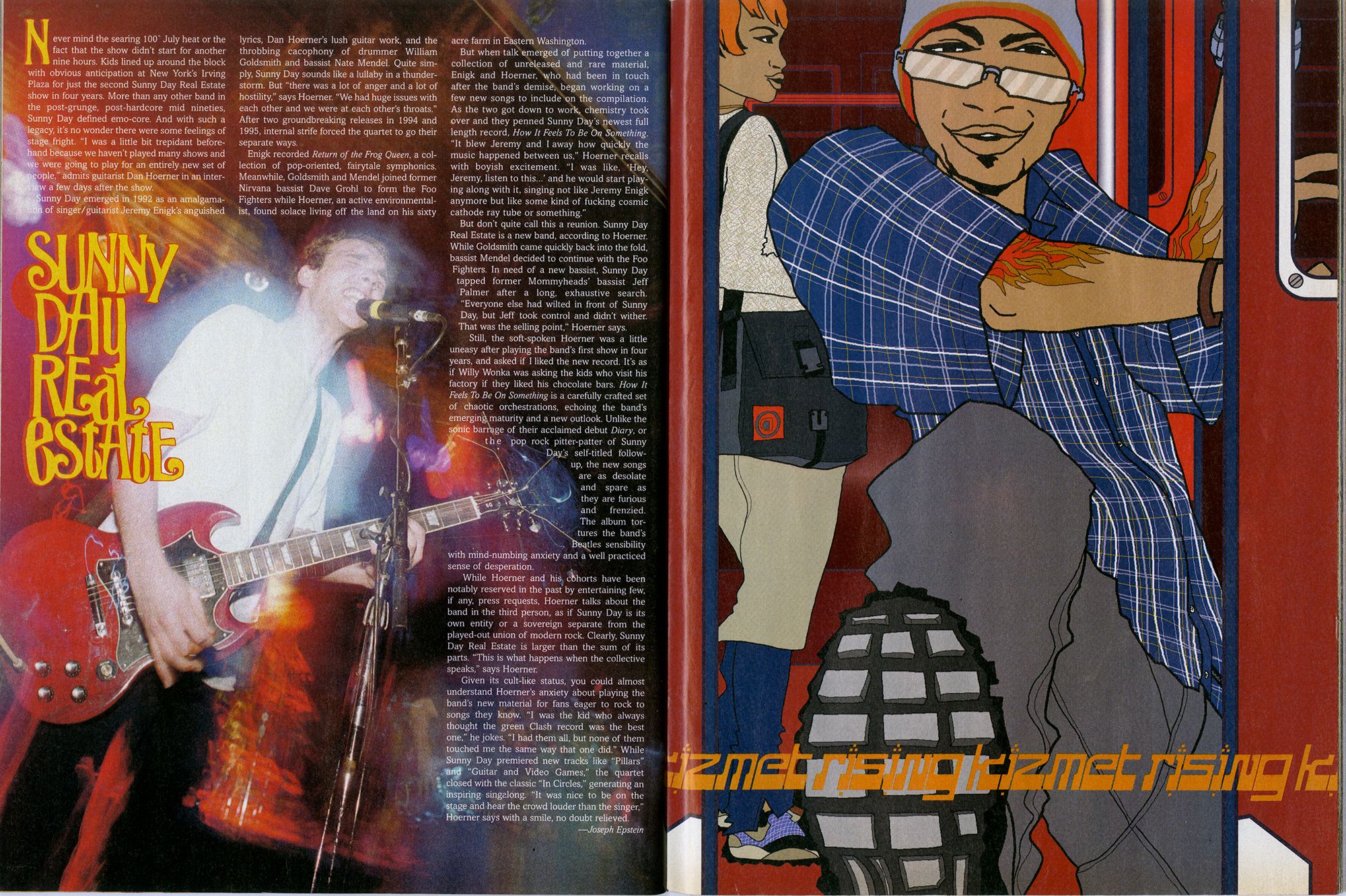
ever mind the searing 100 July heat or the
fact that the show didn't start for another
nine hours. Kids lined up around the block
with obvious anticipation at New York's Irving
Plaza for just the second Sunny Day Real Estate
show in four years. More than any other band in
the post-grunge, post-hardcore mid nineties,
Sunny Day defined emo-core. And with such a
legacy, it's no wonder there were some feelings of
stage fright. "I was a little bit trepidant before-
hand because we haven't played many shows and
we were going to play for an entirely new set of
people," admits guitarist Dan Hoerner in an inter-
View a few days after the show.
Sunny Day emerged in 1992 as an amalgama-
tion of singer/guitarist Jeremy Enigk's anguished
SUNNY
DAU
REal
OSTATE
lyrics, Dan Hoerner's lush guitar work, and the
throbbing cacophony of drummer William
Goldsmith and bassist Nate Mendel. Quite sim-
ply, Sunny Day sounds like a lullaby in a thunder-
storm. But "there was a lot of anger and a lot of
hostility," says Hoerner. "We had huge issues with
each other and we were at each other's throats."
After two groundbreaking releases in 1994 and
1995, internal strife forced the quartet to go their
separate ways.
Enigk recorded Return of the Frog Queen, a col-
lection of pop-oriented, fairytale symphonics.
Meanwhile, Goldsmith and Mendel joined former
Nirvana bassist Dave Grohl to form the Foo
Fighters while Hoerner, an active environmental-
ist, found solace living off the land on his sixty
acre farm in Eastern Washington.
But when talk emerged of putting together a
collection of unreleased and rare material,
Enigk and Hoerner, who had been in touch
after the band's demise, began working on a
few new songs to include on the compilation.
As the two got down to work, chemistry took
over and they penned Sunny Day's newest full
length record, How It Feels To Be On Something.
"It blew Jeremy and I away how quickly the
music happened between us," Hoerner recalls
with boyish excitement. "I was like, 'Hey,
Jeremy, listen to this... and he would start play-
ing along with it, singing not like Jeremy Enigk
anymore but like some kind of fucking cosmic
cathode ray tube or something."
But don't quite call this a reunion. Sunny Day
Real Estate is a new band, according to Hoerner.
While Goldsmith came quickly back into the fold,
bassist Mendel decided to continue with the Foo
Fighters. In need of a new bassist, Sunny Day
tapped former Mommyheads' bassist Jeff
Palmer after a long, exhaustive search.
"Everyone else had wilted in front of Sunny
Day, but Jeff took control and didn't wither.
That was the selling point," Hoerner says.
Still, the soft-spoken Hoerner was a little
uneasy after playing the band's first show in four
years, and asked if I liked the new record. It's as
if Willy Wonka was asking the kids who visit his
factory if they liked his chocolate bars. How It
Feels To Be On Something is a carefully crafted set
of chaotic orchestrations, echoing the band's
emerging maturity and a new outlook. Unlike the
sonic barrage of their acclaimed debut Diary, or
the pop rock pitter-patter of Sunny
Day's self-titled follow-
up, the new songs
are as desolate
and spare as
they are furious
and frenzied.
The album tor-
tures the band's
Beatles sensibility
with mind-numbing anxiety and a well practiced
sense of desperation.
While Hoerner and his cohorts have been
notably reserved in the past by entertaining few,
if any, press requests, Hoerner talks about the
band in the third person, as if Sunny Day is its
own entity or a sovereign separate from the
played-out union of modern rock. Clearly, Sunny
Day Real Estate is larger than the sum of its
parts. "This is what happens when the collective
speaks," says Hoerner.
Given its cult-like status, you could almost
understand Hoerner's anxiety about playing the
band's new material for fans eager to rock to
songs they know. "I was the kid who always
thought the green Clash record was the best
one," he jokes. "I had them all, but none of them
touched me the same way that one did." While
Sunny Day premiered new tracks like "Pillars"
and "Guitar and Video Games," the quartet
closed with the classic "In Circles," generating an
inspiring singalong. "It was nice to be on the
stage and hear the crowd louder than the singer,"
Hoerner says with a smile, no doubt relieved.
-Joseph Epstein
Zmetrisugizmet rising k