Page Text
            Both forms also shared the fate of even-
tually being co-opted and spawning
countless pale imitations. Nevertheless,
the chairs and tables are simple and
straightforward, and so was punk. The
magnetism of dichotomy and disso-
nance.
Coming across an issue of NO maga-
zine in the middle of the middle
American nowhere in 1981 could be a
TO SAY FUCK YOU
TO THE ESTABLISHMENT
IN A YOUTHFUL, NATURAL,
INSTINCTUAL WAY
lost soul's first encounter with Ed
Colver's photographs. The cover was a
picture of a woman's hands, a molest-
ed baby doll and a faux tribal mask
extending a rigid tongue. Underneath,
the words "Sex-Music-Death-
Garbage." Inside was an alternate real-
ity-morbid, sexy, unsettling and gen-
uinely strange. There were graphic
spreads of spiders and syphilitic lips,
purloined mug shots coupled with
their owner's fictive sexual proclivities
that ranged from body shaving to
intercourse with extraterrestrials,
bondage photos, an interview with
antagonistic machine maker Mark
Pauline of Survival Research
Laboratories, and lots of photos of LA
bands. It also had a sometimes
wicked, sometimes corny sense of
humor. The main article was a long
history of LA punk rock by Black
Flag's bassist Charles Dukowski, the
accompanying full page photographs
all by Ed Colver.
The pictures made the thriving
scene in Los Angeles come alive; they
were reports from the epicenter of a
secret world and they showed it in all
its chaotic anarchic glory, right there
on the stage and in the pit. A
Experiences that could only be hoped
for and were happening far away
could be seen and felt through these
documents. Boschian to the uniniti-
ated but to the neophyte a com-
forting array of freaks who repre-
sented instant friendship and a
shared vision of life and how to
cope with it. They inspired a
yearning to be there, to be
one of the participants, revolting
against everything. To say fuck
you to the establishment in a
youthful, natural, instinctual way.
To be there at ground zero with
the exceedingly hard and fast
music, the shouted lyrics, a scream
against injustice, placidity, and
conformity. The phantasmagoric
blur of movement, the band and
audience almost interchangeable,
the sweaty pit with people run-
ning, slamming and flying off the
stage, getting kicked and
knocked and exalting in it.
In his photographs Paul Cutler
from 45 Grave shrieks into the
camera with a bloody stigmata
on his hand, alarming in his
intensity. Lee Ving of Fear lights
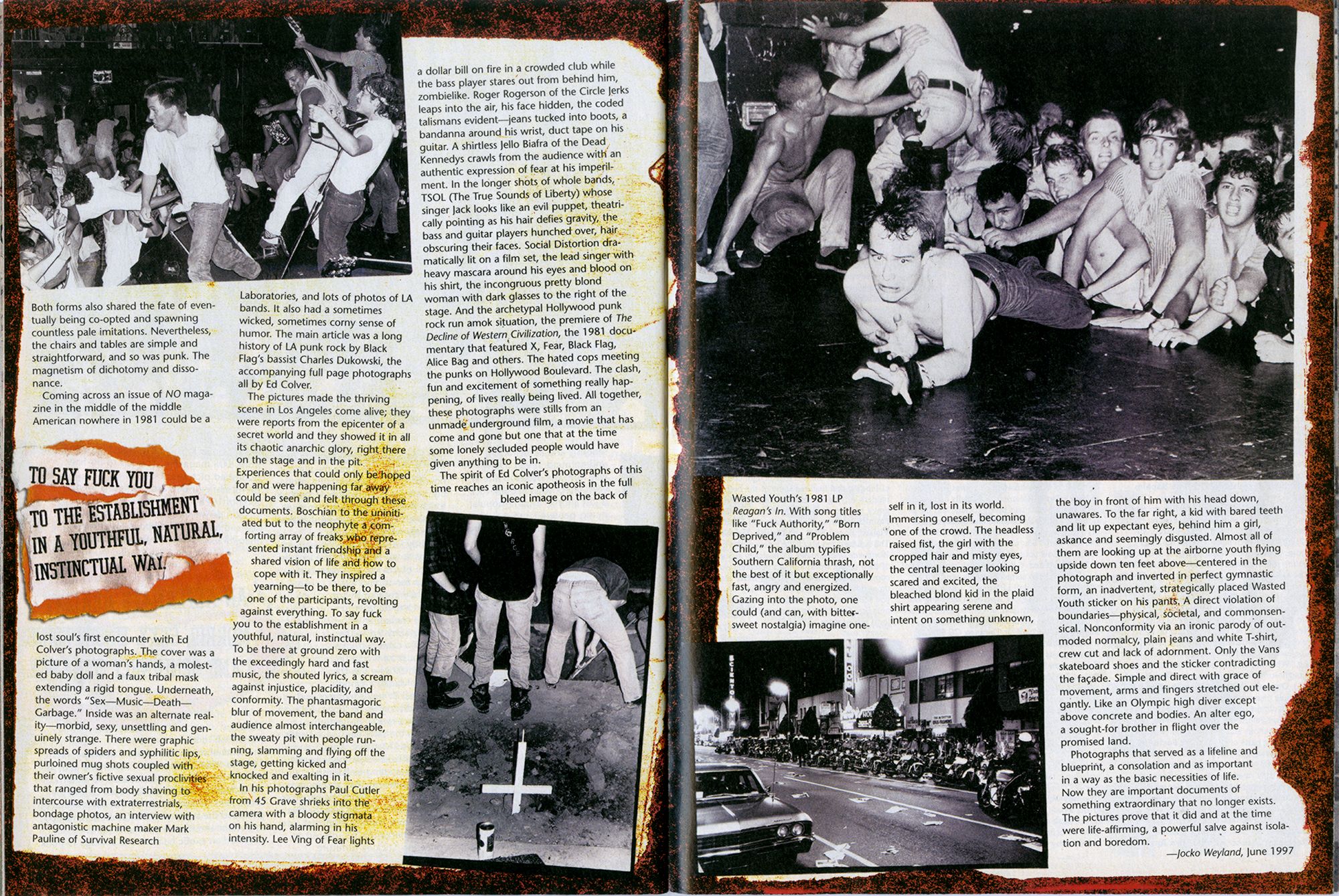
a dollar bill on fire in a crowded club while
the bass player stares out from behind him,
zombielike. Roger Rogerson of the Circle Jerks
leaps into the air, his face hidden, the coded
talismans evident-jeans tucked into boots, a
bandanna around his wrist, duct tape on his
guitar. A shirtless Jello Biafra of the Dead
Kennedys crawls from the audience with an
authentic expression of fear at his imperil-
ment. In the longer shots of whole bands,
TSOL (The True Sounds of Liberty) whose
singer Jack looks like an evil puppet, theatri-
cally pointing as his hair defies gravity, the
bass and guitar players hunched over, hair
obscuring their faces. Social Distortion dra-
matically lit on a film set, the lead singer with
heavy mascara around his eyes and blood on
his shirt, the incongruous pretty blond
woman with dark glasses to the right of the
stage. And the archetypal Hollywood punk
rock run amok situation, the premiere of The
Decline of Western Civilization, the 1981 docu-
mentary that featured X, Fear, Black Flag,
Alice Bag and others. The hated cops meeting
the punks on Hollywood Boulevard. The clash,
fun and excitement of something really hap-
pening, of lives really being lived. All together,
these photographs were stills from an
unmade underground film, a movie that has
come and gone but one that at the time
some lonely secluded people would have
given anything to be in.
The spirit of Ed Colver's photographs of this
time reaches an iconic apotheosis in the full
bleed image on the back of
Wasted Youth's 1981 LP
Reagan's In. With song titles
like "Fuck Authority," "Born
Deprived," and "Problem
Child," the album typifies
Southern California thrash, not
the best of it but exceptionally
fast, angry and energized.
Gazing into the photo, one
could (and can, with bitter-
sweet nostalgia) imagine one-
HO
self in it, lost in its world.
Immersing oneself, becoming
one of the crowd. The headless
raised fist, the girl with the
cropped hair and misty eyes,
the central teenager looking
scared and excited, the
bleached blond kid in the plaid
shirt appearing serene and
intent on something unknown,
the boy in front of him with his head down,
unawares. To the far right, a kid with bared teeth
and lit up expectant eyes, behind him a girl,
askance and seemingly disgusted. Almost all of
them are looking up at the airborne youth flying
upside down ten feet above-centered in the
photograph and inverted in perfect gymnastic
form, an inadvertent, strategically placed Wasted
Youth sticker on his pants, A direct violation of
boundaries-physical, societal, and commonsen-
sical. Nonconformity via an ironic parody of out-
moded normalcy, plain jeans and white T-shirt,
crew cut and lack of adornment. Only the Vans
skateboard shoes and the sticker contradicting
the façade. Simple and direct with grace of
movement, arms and fingers stretched out ele-
gantly. Like an Olympic high diver except
above concrete and bodies. An alter ego,
a sought-for brother in flight over the
promised land.
Photographs that served as a lifeline and
blueprint, a consolation and as important
in a way as the basic necessities of life.
Now they are important documents of
something extraordinary that no longer exists.
The pictures prove that it did and at the time
were life-affirming, a powerful salve against isola-
tion and boredom.
-Jocko Weyland, June 1997