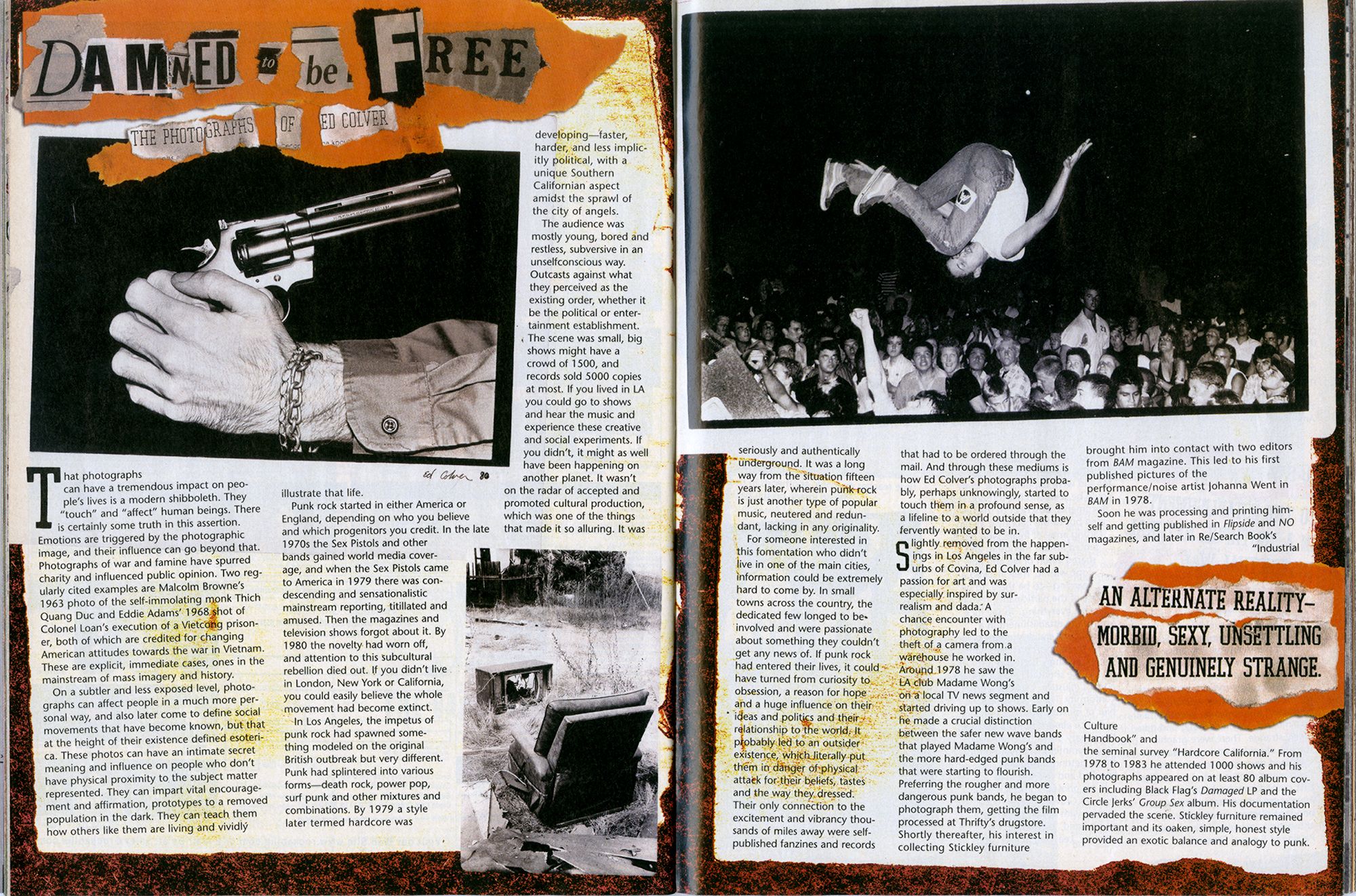
Page Text
            DAMNED be FREE
THE PHOTOGRAPHS
to
OF ED COLVER
T
hat photographs
can have a tremendous impact on peo-
ple's lives is a modern shibboleth. They
"touch" and "affect" human beings. There
is certainly some truth in this assertion.
Emotions are triggered by the photographic
image, and their influence can go beyond that.
Photographs of war and famine have spurred
charity and influenced public opinion. Two reg-
ularly cited examples are Malcolm Browne's
1963 photo of the self-immolating monk Thich
Quang Duc and Eddie Adams' 1968 shot of
Colonel Loan's execution of a Vietcong prison-
er, both of which are credited for changing
American attitudes towards the war in Vietnam.
These are explicit, immediate cases, ones in the
mainstream of mass imagery and history.
On a subtler and less exposed level, photo-
graphs can affect people in a much more per-
sonal way, and also later come to define social
movements that have become known, but that
at the height of their existence defined esoteri-
ca. These photos can have an intimate secret
meaning and influence on people who don't
have physical proximity to the subject matter
represented. They can impart vital encourage-
ment and affirmation, prototypes to a removed
population in the dark. They can teach them
how others like them are living and vividly
illustrate that life.
Ed Colver 80
Punk rock started in either America or
England, depending on who you believe
and which progenitors you credit. In the late
1970s the Sex Pistols and other
bands gained world media cover-
age, and when the Sex Pistols came
to America in 1979 there was con-
descending and sensationalistic
mainstream reporting, titillated and
amused. Then the magazines and
television shows forgot about it. By
1980 the novelty had worn off,
and attention to this subcultural
rebellion died out. If you didn't live
in London, New York or California,
you could easily believe the whole
movement had become extinct.
In Los Angeles, the impetus of
punk rock had spawned some-
thing modeled on the original
British outbreak but very different.
Punk had splintered into various
forms death rock, power pop,
surf punk and other mixtures and
combinations. By 1979 a style
later termed hardcore was
developing-faster,
harder, and less implic-
itly political, with a
unique Southern
Californian aspect
amidst the sprawl of
the city of angels.
The audience was
mostly young, bored and
restless, subversive in an
unselfconscious way.
Outcasts against what
they perceived as the
existing order, whether it
be the political or enter-
tainment establishment.
The scene was small, big
shows might have a
crowd of 1500, and
records sold 5000 copies
at most. If you lived in LA
you could go to shows
and hear the music and
experience these creative
and social experiments. If
you didn't, it might as well.
have been happening on
another planet. It wasn't
on the radar of accepted and
promoted cultural production,
which was one of the things
that made it so alluring. It was
seriously and authentically
underground. It was a long
way from the situation fifteen
years later, wherein punk-rock
is just another type of popular
music, neutered and redun-
dant, lacking in any originality.
For someone interested in
this fomentation who didn't
live in one of the main cities,
information could be extremely
hard to come by. In small
towns across the country, the
dedicated few longed to be-
involved and were passionate
about something they couldn't
get any news of. If punk rock
had entered their lives, it could:
have turned from curiosity to
obsession, a reason for hope
and a huge influence on their
ideas and politics and their
relationship to the world, It
probably led to an outsider
existence, which literally put
them in danger of physical
attack for their beliefs, tastes
and the way they dressed.
Their only connection to the
excitement and vibrancy thou-
sands of miles away were self-
published fanzines and records
that had to be ordered through the
mail. And through these mediums is
how Ed Colver's photographs proba-
bly, perhaps unknowingly, started to
touch them in a profound sense, as
a lifeline to a world outside that they
fervently wanted to be in.
S
lightly removed from the happen-
ings in Los Angeles in the far sub-
urbs of Covina, Ed Colver had a
passion for art and was
especially inspired by sur-
realism and dada. A
chance encounter with
photography led to the
theft of a camera from.a
warehouse he worked in.
Around 1978 he saw the
LA club Madame Wong's
on a local TV news segment and
started driving up to shows. Early on
he made a crucial distinction
between the safer new wave bands
that played Madame Wong's and
the more hard-edged punk bands
that were starting to flourish.
Preferring the rougher and more
dangerous punk bands, he began to
photograph them, getting the film
processed at Thrifty's drugstore.
Shortly thereafter, his interest in
collecting Stickley furniture
brought him into contact with two editors
from BAM magazine. This led to his first
published pictures of the
performance/noise artist Johanna Went in
BAM in 1978.
Soon he was processing and printing him-
self and getting published in Flipside and NO
magazines, and later in Re/Search Book's
"Industrial
AN ALTERNATE REALITY-
MORBID, SEXY, UNSETTLING
AND GENUINELY STRANGE.
Culture
Handbook" and
the seminal survey "Hardcore California." From
1978 to 1983 he attended 1000 shows and his
photographs appeared on at least 80 album cov-
ers including Black Flag's Damaged LP and the
Circle Jerks' Group Sex album. His documentation
pervaded the scene. Stickley furniture remained
important and its oaken, simple, honest style
provided an exotic balance and analogy to punk.