Page Text
            mark GONZALes
1. The concrete wave. Metal Banzai boards
on sale at Save On's Drugstore. Guys riding
around on boards with wide wheels in the
back and skinny ones in the front.
2. It really hasn't changed my life. It's
always been a part of my life. But because of
skateboarding, I've been able to travel and
see new things.
3. Fun.
4. A list from me would be too long. So
many skateboarders in my eyes are great. I
love watching beginners. There's something
special there when you're just learning.
5. Knocked myself out on a lien air at Joe
Lopes' ramp.
6. I see it getting more difficult, because
difficulty is progression. No, I'm joking. I see
more people doing it for self-satisfaction and
as a way to relieve stress. It's hard to say
which direction skating is going in, because
it's going in all directions at once. It's a very
unpredictable sport.
H
OW TO
BUILD A
SKATEPARK
ocal governments besieged by the proliferation
of skateboarders have been trying to address
the need for public facilities intended for the
sole use of skateboarders. Cities and counties with no
experience in building "public skateparks" have taken
the expedient route by building copies of earlier pub-
lic parks (most of which were total failures), or hiring
architectural firms with little or no experience in
skatepark design.
A
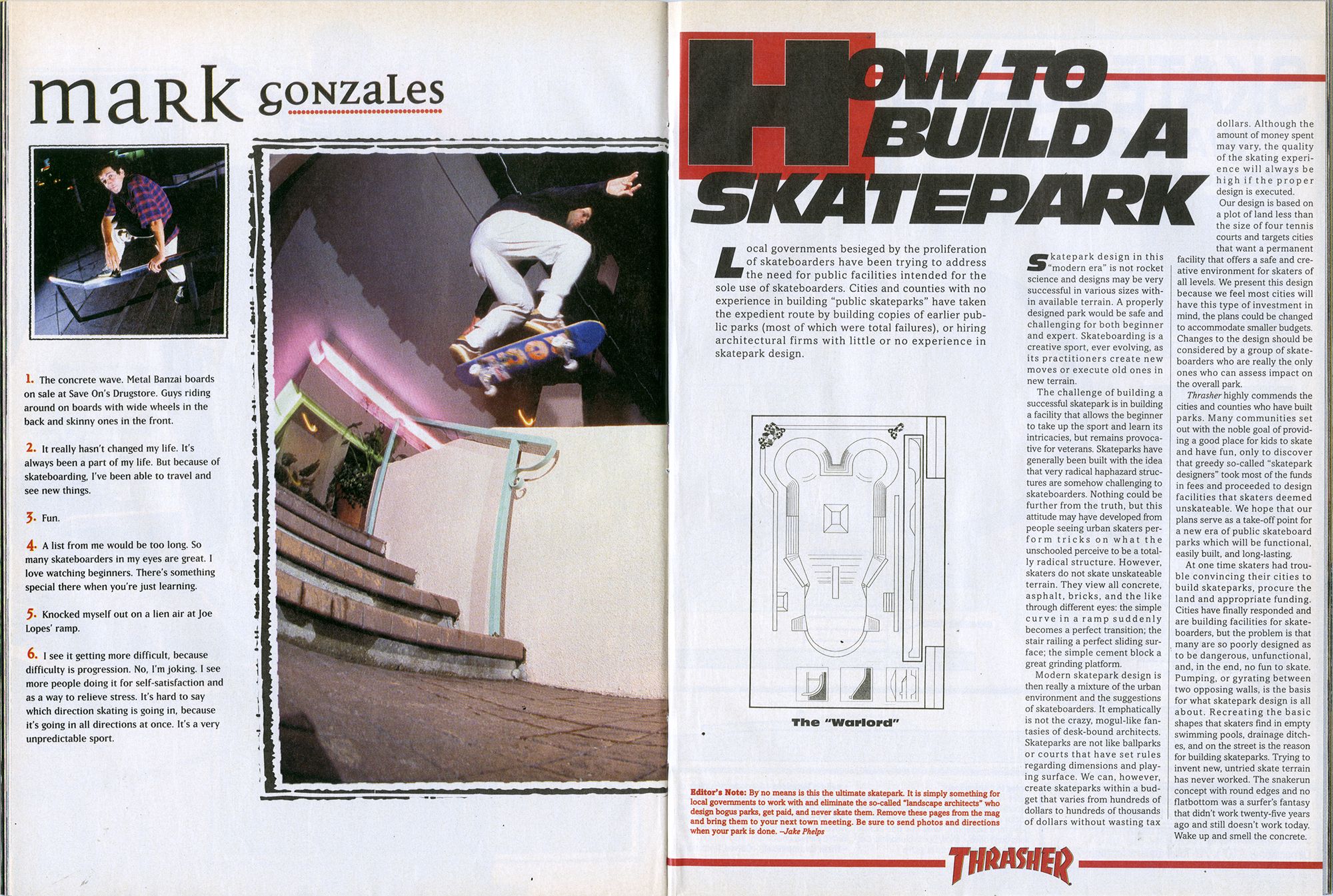
The "Warlord"
Editor's Note: By no means is this the ultimate skatepark. It is simply something for
local governments to work with and eliminate the so-called "landscape architects" who
design bogus parks, get paid, and never skate them. Remove these pages from the mag
and bring them to your next town meeting. Be sure to send photos and directions.
when your park is done. -Jake Phelps
katepark design in this
"modern era" is not rocket
science and designs may be very
successful in various sizes with-
in available terrain. A properly
designed park would be safe and
challenging for both beginner
and expert. Skateboarding is a
creative sport, ever evolving, as
its practitioners create new
moves or execute old ones in
new terrain.
The challenge of building a
successful skatepark is in building
a facility that allows the beginner
to take o the sport and learn its
intricacies, but remains provoca-
tive for veterans. Skateparks have
generally been built with the idea
that very radical haphazard struc-
tures are somehow challenging to
skateboarders. Nothing could be
further from the truth, but this
attitude may have developed from
people seeing urban skaters per-
form tricks on what the
unschooled perceive to be a total-
ly radical structure. However,
skaters do not skate unskateable
terrain. They view all concrete,
asphalt, bricks, and the like
through different eyes: the simple
curve in a ramp suddenly.
becomes a perfect transition; the
stair railing a perfect sliding sur-
face; the simple cement block a
great grinding platform.
Modern skatepark design is
then really a mixture of the urban
environment and the suggestions
of skateboarders. It emphatically
is not the crazy, mogul-like fan-
tasies of desk-bound architects.
Skateparks are not like ballparks
or courts that have set rules
regarding dimensions and play-
ing surface. We can, however,
create skateparks within a bud-
get that varies from hundreds of
dollars to hundreds of thousands
of dollars without wasting tax
THRASHER
dollars. Although the
amount of money spent
may vary, the quality
of the skating experi-
ence will always be
high if the proper
design is executed.
Our design is based on
a plot of land less than
the size of four tennis
courts and targets cities.
that want a permanent
facility that offers a safe and cre-
ative environment for skaters of
all levels. We present this design
because we feel most cities will
have this type of investment in
mind, the plans could be changed
to accommodate smaller budgets.
Changes to the design should be
considered by a group of skate-
boarders who are really the only
ones who can assess impact on
the overall park.
Thrasher highly commends the
cities and counties who have built
parks. Many communities set
out with the noble goal of provid-
ing a good place for kids to skate
and have fun, only to discover
that greedy so-called "skatepark
designers" took most of the funds
in fees and proceeded to design
facilities that skaters deemed
unskateable. We hope that our
plans serve as a take-off point for
a new era of public skateboard
parks which will be functional,
easily built, and long-lasting.
At one time skaters had trou-
ble convincing their cities to
build skateparks, procure the
land and appropriate funding.
Cities have finally responded and
are building facilities for skate-
boarders, but the problem is that
many are so poorly designed as
to be dangerous, unfunctional,
and, in the end, no fun to skate.
Pumping, or gyrating between
two opposing walls, is the basis
for what skatepark design is all
about. Recreating the basic
shapes that skaters find in empty
swimming pools, drainage ditch-
es, and on the street is the reason
for building skateparks. Trying to
invent new, untried skate terrain
has never worked. The snakerun
concept with round edges and no
flatbottom was a surfer's fantasy
that didn't work twenty-five years
ago and still doesn't work today.
Wake up and smell the concrete.