Page Text
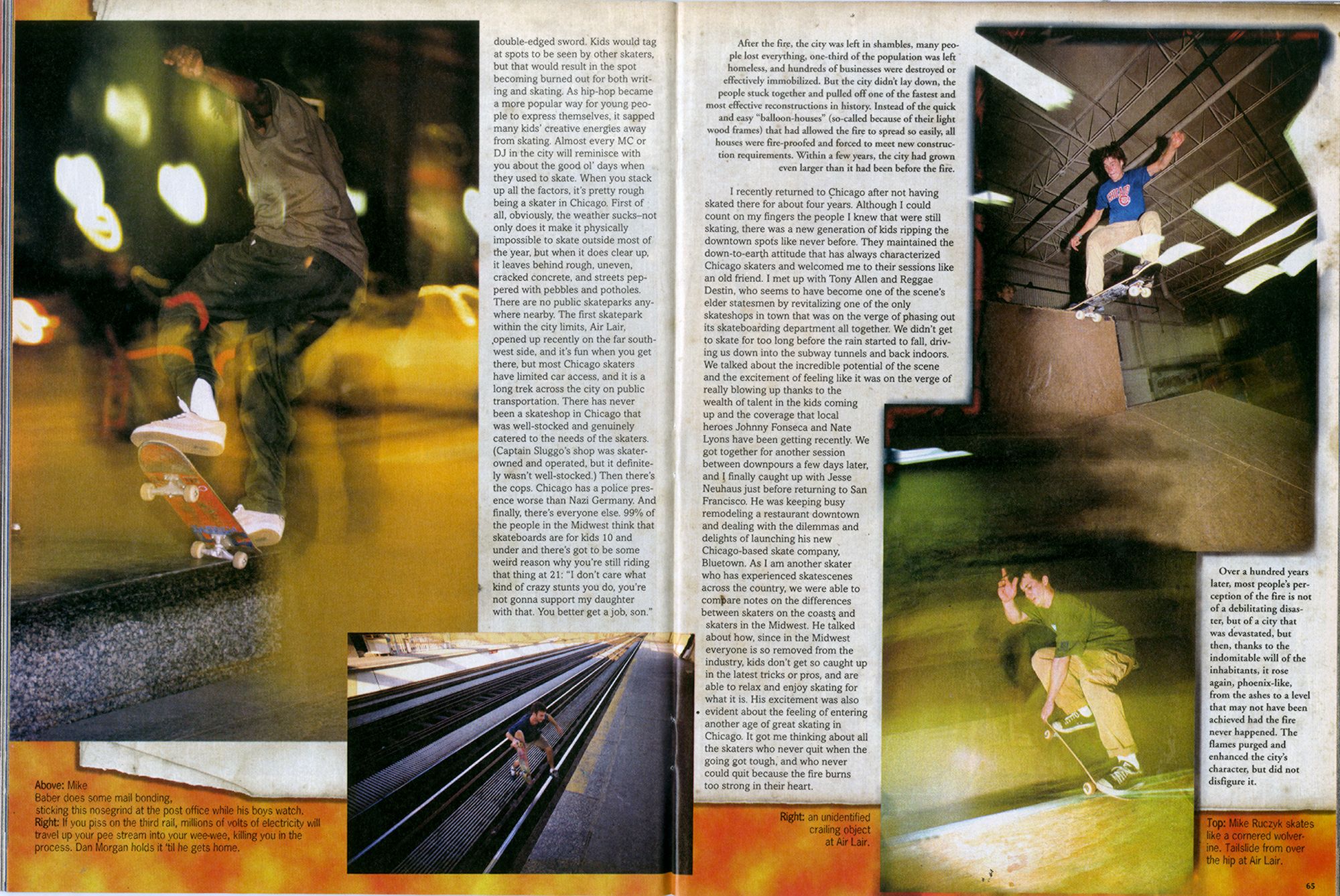
            Above: Mike
Baber does some mail bonding,
sticking this nosegrind at the post office while his boys watch.
Right: If you piss on the third rail, millions of volts of electricity will
travel up your pee stream into your wee-wee, killing you in the
process. Dan Morgan holds it 'til he gets home.
double-edged sword. Kids would tag
at spots to be seen by other skaters,
but that would result in the spot
becoming burned out for both writ-
ing and skating. As hip-hop became
a more popular way for young peo-
ple to express themselves, it sapped
many kids' creative energies away
from skating. Almost every MC or
DJ in the city will reminisce with
you about the good ol' days when
they used to skate. When you stack
up all the factors, it's pretty rough
being a skater in Chicago. First of
all, obviously, the weather sucks-not
only does it make it physically
impossible to skate outside most of
the year, but when it does clear up,
it leaves behind rough, uneven,
cracked concrete, and streets pep-
pered with pebbles and potholes.
There are no public skateparks any-
where nearby. The first skatepark
within the city limits, Air Lair,
opened up recently on the far south-
west side, and it's fun when you get
there, but most Chicago skaters
have limited car access, and it is a
long trek across the city on public
transportation. There has never
been a skateshop in Chicago that
was well-stocked and genuinely
catered to the needs of the skaters.
(Captain Sluggo's shop was skater-
owned and operated, but it definite-
ly wasn't well-stocked.) Then there's
the cops. Chicago has a police pres-
ence worse than Nazi Germany. And
finally, there's everyone else. 99% of
the people in the Midwest think that
skateboards are for kids 10 and
under and there's got to be some
weird reason why you're still riding
that thing at 21: "I don't care what
kind of crazy stunts you do, you're
not gonna support my daughter
with that. You better get a job, son."
After the fire, the city was left in shambles, many peo-
ple lost everything, one-third of the population was left
homeless, and hundreds of businesses were destroyed or
effectively immobilized. But the city didn't lay down, the
people stuck together and pulled off one of the fastest and
most effective reconstructions in history. Instead of the quick
and easy "balloon-houses" (so-called because of their light
wood frames) that had allowed the fire to spread so easily, all
houses were fire-proofed and forced to meet new construc-
tion requirements. Within a few years, the city had grown
even larger than it had been before the fire.
I recently returned to Chicago after not having
skated there for about four years. Although I could
count on my fingers the people I knew that were still
skating, there was a new generation of kids ripping the
downtown spots like never before. They maintained the
down-to-earth attitude that has always characterized
Chicago skaters and welcomed me to their sessions like
an old friend. I met up with Tony Allen and Reggae
Destin, who seems to have become one of the scene's
elder statesmen by revitalizing one of the only
skateshops in town that was on the verge of phasing out
its skateboarding department all together. We didn't get
to skate for too long before the rain started to fall, driv-
ing us down into the subway tunnels and back indoors.
We talked about the incredible potential of the scene
and the excitement of feeling like it was on the verge of
really blowing up thanks to the
wealth of talent in the kids coming
up and the coverage that local
heroes Johnny Fonseca and Nate
Lyons have been getting recently. We
got together for another session
between downpours a few days later,
and I finally caught up with Jesse
Neuhaus just before returning to San
Francisco. He was keeping busy
remodeling a restaurant downtown
and dealing with the dilemmas and
delights of launching his new
Chicago-based skate company,
Bluetown. As I am another skater
who has experienced skatescenes
across the country, we were able to
compare notes on the differences
between skaters on the coasts and
skaters in the Midwest. He talked
about how, since in the Midwest
everyone is so removed from the
industry, kids don't get so caught up
in the latest tricks or pros, and are
able to relax and enjoy skating for
what it is. His excitement was also
evident about the feeling of entering
another age of great skating in
Chicago. It got me thinking about all
the skaters who never quit when the
going got tough, and who never
could quit because the fire burns
too strong in their heart.
Right: an unidentified
crailing object
at Air Lair,
Over a hundred years
later, most people's per-
ception of the fire is not
of a debilitating disas-
ter, but of a city that
was devastated, but
then, thanks to the
indomitable will of the
inhabitants, it rose
again, phoenix-like,
from the ashes to a level
that may not have been
achieved had the fire
never happened. The
flames purged and
enhanced the city's
character, but did not
disfigure it.
Top: Mike Ruczyk skates
like a cornered wolver-
ine. Tailslide from over
the hip at Air Lair.
65