Page Text
            Chicago, I
My earliest memory of skate-
boarding in Chicago are of four
friends and I sharing three
boards on the way home from
soccer practice. Eventually I saved
up enough money for my own
board, and from then on devoted
every spare moment to skating the
sidewalks, streets, walls, and launch
ramps of my Southside neighborhood.
After a couple years my friends and I began
making the weekly pilgrimage downtown to
explore. To this day, skaters from all over the
Chicago area travel downtown every Sunday
to, as one kid I met from suburban Bowling.
Brook put it, "get religion." Like every
American metropolis, Chicago offers a
wealth of ledges, stairs, gaps, banks,
handrails, and assorted public art and archi-
tecture that screams to be skated. Spots like
the Picasso, the Post Office, the Art Institute,
the Hips, IBM plaza and highway divider,
Oak Street Beach, and the NBC building
have quenched the thirsty urethane of gener-
ations of skaters. When hordes of kids
descended upon downtown in the late '80s,
divisions were often drawn along the lines of
City vs Suburban skaters or North vs
Southsiders. But skateboarding ultimately
bonded us all together against the evil forces
of security guards, cops, businessmen, igno-
rant tourists, and general skater-haters. Just.
riding a skateboard in the city is enough to
guarantee a potential friend in any other
skater you see, but in Chicago, it also brands
you as a vandal on the street, a nuisance in
any restaurant, a shoplifter in any store, and not worth the time of day to most
members of the opposite sex. In California, and even some places on the East Coast,
the sheer volume of skaters has made it possible to support an industry and has
allowed skateboarding to become marginally accepted by the mainstream.
Meanwhile, in Chicago, it has always maintained outlaw status.
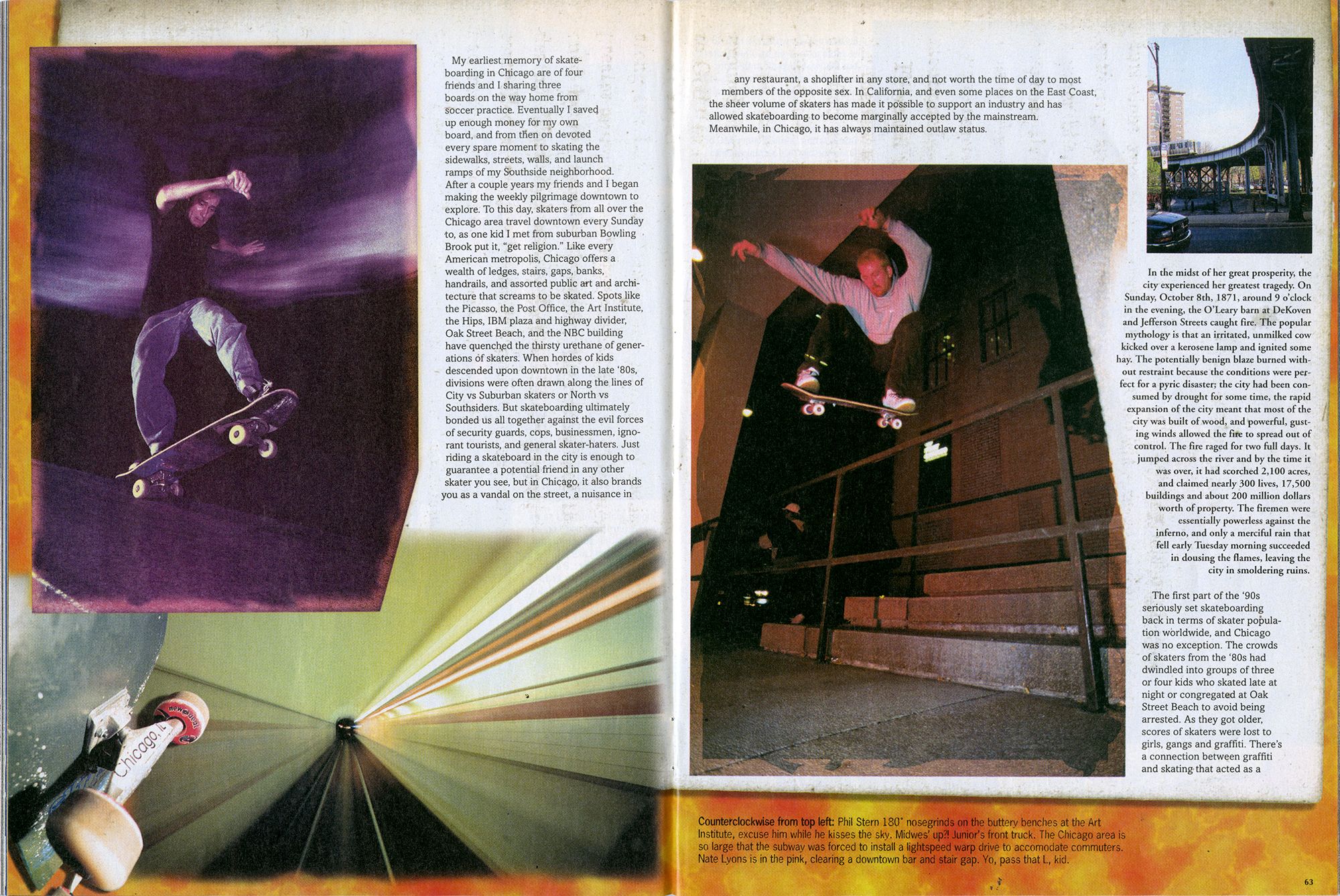
Counterclockwise from top left: Phil Stern 180° nosegrinds on the buttery benches at the Art
Institute, excuse him while he kisses the sky. Midwes' up?! Junior's front truck. The Chicago area is
so large that the subway was forced to install a lightspeed warp drive to accomodate commuters.
Nate Lyons is in the pink, clearing a downtown bar and stair gap. Yo, pass that L, kid.
In the midst of her great prosperity, the
city experienced her greatest tragedy. On
Sunday, October 8th, 1871, around 9 o'clock
in the evening, the O'Leary barn at Dekoven
and Jefferson Streets caught fire. The popular
mythology is that an irritated, unmilked cow
kicked over a kerosene lamp and ignited some
hay. The potentially benign blaze burned with-
out restraint because the conditions were per-
fect for a pyric disaster; the city had been con-
sumed by drought for some time, the rapid
expansion of the city meant that most of the
city was built of wood, and powerful, gust-
ing winds allowed the fire to spread out of
control. The fire raged for two full days. It
jumped across the river and by the time it
was over, it had scorched 2,100 acres,
and claimed nearly 300 lives, 17,500
buildings and about 200 million dollars
worth of property. The firemen were
essentially powerless against the
inferno, and only a merciful rain that
fell early Tuesday morning succeeded
in dousing the flames, leaving the
city in smoldering ruins.
The first part of the '90s
seriously set skateboarding
back in terms of skater popula-
tion worldwide, and Chicago
was no exception. The crowds
of skaters from the '80s had
dwindled into groups of three
or four kids who skated late at
night or congregated at Oak
Street Beach to avoid being
arrested. As they got older,
scores of skaters were lost to
girls, gangs and graffiti. There's
a connection between graffiti
and skating that acted as a
63