Page Text
            and expanded it in a meadow behind our
house. The fact that no one else skated in my
town wasn't a deterrent-it had the opposite
effect of solidifying my conviction to be an
iconoclast. Skating was now illegal in the
town, and that combined with the entrance
of punk rock into my life just served to accel-
erate the process. My self-imposed ostracism
was complete. I
skated the ramp,
read 'zines, and
ordered records
through the mail. I
took the bus or
hitchhiked down to
Boulder to skate
the park, which was
now closed, but
was still being skat-
ed. There were still
diehards hanging
out, skating, camp-
ing in the bowls at
night. I slept in my
sleeping bag there
or at my sister's
boyfriend's houses,
eating their food or
buying one pan-
cake at a time at
the International
House of Pancakes.
that are common on Oahu, their purpose
being to channel the run-off from the saturat-
ed mountains into the sea. The famous (in
some circles) Wallos, with its steep walls,
descending levels, and unmercifully abrasive
surface. An added attraction were the neigh-
bors who sometimes threw rocks at you
while you were riding. The incredibly silken
(for concrete)
Off The Walls,
where the
skaters had put
in the transi-
tions under
cover of dark-
ness, and you
were a half mile
from the beach
with a view of
Molokai on a
clear day. Zones
by Pearl Harbor,
next to the free-
way and cov-
ered in red dust.
It was so named
because it was
close to a high
school whose
students went
there to "zone
out." Hahaiones,
in a dank,
malaria gorge next to some high-rise apart-
ment buildings. Pipeline Bowls, a mile from
Hahaiones and in a completely different
climate, above the highest houses on the
ridge overlooking Maunalua Bay. There was
also Ulawatu, a gargantuan cement box at
the end of a lagoon with 30' walls, with a
spooky and primeval atmosphere. There
was a crude halfpipe dug into the ground
high up in the jungle of Tantalus above
Honolulu. We skated Waikiki at night,
parking garages, and abandoned fish
ponds. We skated everything.
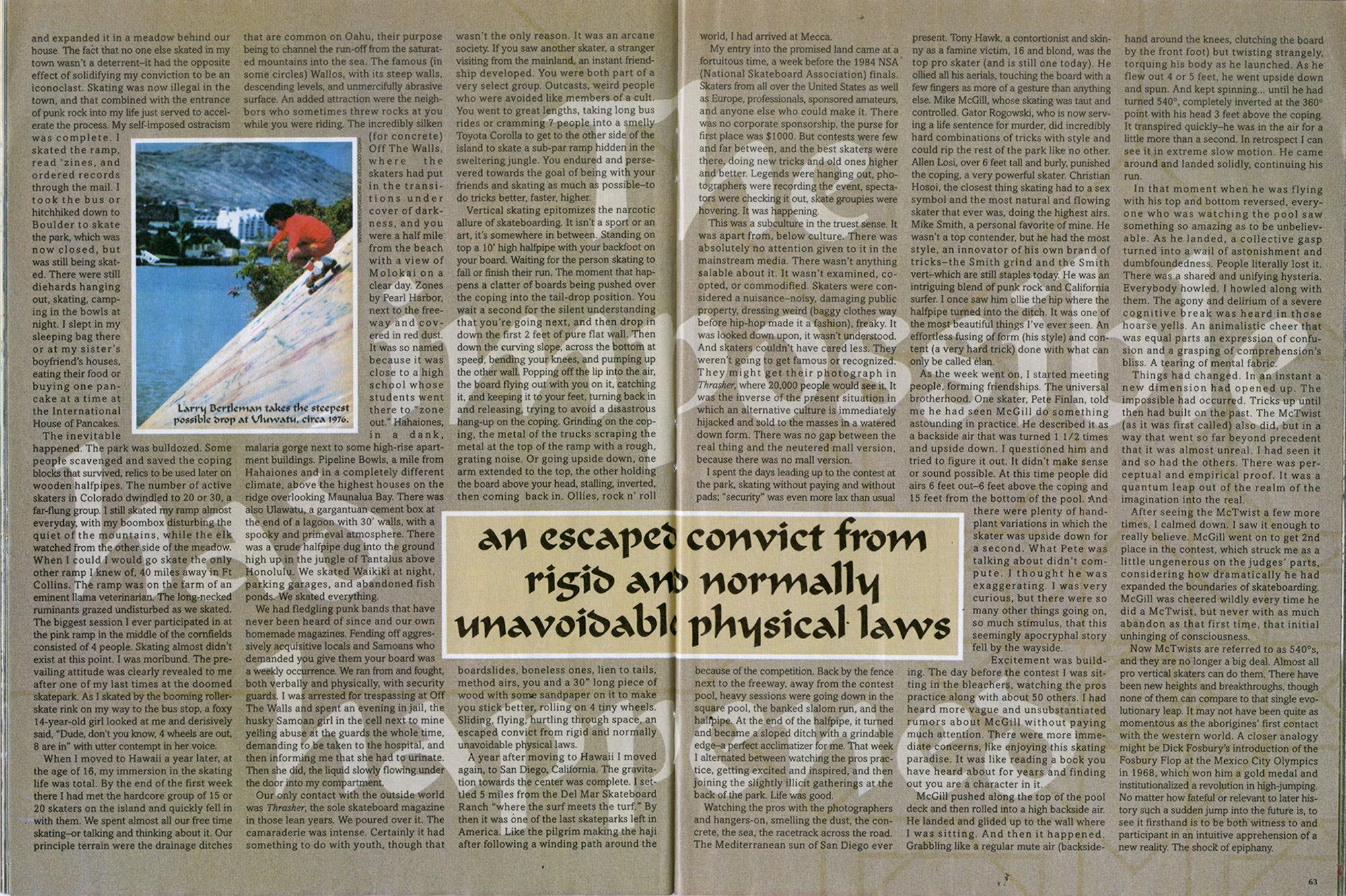
Larry Bertleman takes the steepest
possible drop at Uluwatu, circa 1976.
The inevitable
happened. The park was bulldozed. Some
people scavenged and saved the coping
blocks that survived, relics to be used later on
wooden halfpipes. The number of active
skaters in Colorado dwindled to 20 or 30, a
far-flung group. I still skated my ramp almost
everyday, with my boombox disturbing the
quiet of the mountains, while the elk
watched from the other side of the meadow.
When I could I would go skate the only
other ramp I knew of, 40 miles away in Ft
Collins. The ramp was on the farm of an
eminent llama veterinarian. The long-necked
ruminants grazed undisturbed as we skated.
The biggest session I ever participated in at
the pink ramp in the middle of the cornfields
consisted of 4 people. Skating almost didn't
exist at this point. I was moribund. The pre-
vailing attitude was clearly revealed to me
after one of my last times at the doomed
skatepark. As I skated by the booming roller-
skate rink on my way to the bus stop, a foxy
14-year-old girl looked at me and derisively
said, "Dude, don't you know, 4 wheels are out,
8 are in" with utter contempt in her voice.
When I moved to Hawaii a year later, at
the age of 16, my immersion in the skating
life was total. By the end of the first week
there I had met the hardcore group of 15 or
20 skaters on the island and quickly fell in
with them. We spent almost all our free time
skating-or talking and thinking about it. Our
principle terrain were the drainage ditches
We had fledgling punk bands that have
I never been heard of since and our own
homemade magazines. Fending off aggres-
sively acquisitive locals and Samoans who
demanded you give them your board was
a weekly occurrence. We ran from and fought,
both verbally and physically, with security
guards. I was arrested for trespassing at Off
The Walls and spent an evening in jail, the
husky Samoan girl in the cell next to mine
yelling abuse at the guards the whole time,
demanding to be taken to the hospital, and
then informing me that she had to urinate.
Then she did, the liquid slowly flowing under
the door into my compartment.
Our only contact with the outside world
was Thrasher, the sole skateboard magazine
in those lean years. We poured over it. The
camaraderie was intense. Certainly it had
something to do with youth, though that
wasn't the only reason. It was an arcane
society. If you saw another skater, a stranger
visiting from the mainland, an instant friend-
ship developed. You were both part of a
very select group. Outcasts, weird people
who were avoided like members of a cult.
You went to great lengths, taking long bus
rides or cramming 7 people into a smelly
Toyota Corolla to get to the other side of the
island to skate a sub-par ramp hidden in the
sweltering jungle. You endured and perse-
vered towards the goal of being with your
friends and skating as much as possible-to
do tricks better, faster, higher.
Vertical skating epitomizes the narcotic
allure of skateboarding. It isn't a sport or an
art, it's somewhere in between. Standing on
top a 10' high halfpipe with your backfoot on
your board. Waiting for the person skating to
fall or finish their run. The moment that hap-
pens a clatter of boards being pushed over
the coping into the tail-drop position. You
wait a second for the silent understanding
that you're going next, and then drop in
down the first 2 feet of pure flat wall. Then
down the curving slope, across the bottom at
speed, bending your knees, and pumping up
the other wall. Popping off the lip into the air,
the board flying out with you on it, catching
it, and keeping it to your feet, turning back in
and releasing, trying to avoid a disastrous
hang-up on the coping. Grinding on the cop-
ing, the metal of the trucks scraping the
metal at the top of the ramp with a rough,
grating noise. Or going upside down, one
arm extended to the top, the other holding
the board above your head, stalling, inverted,
then coming back in. Ollies, rock n' roll
world, I had arrived at Mecca.
My entry into the promised land came at a
fortuitous time, a week before the 1984 NSA
(National Skateboard Association) finals.
Skaters from all over the United States as well
as Europe, professionals, sponsored amateurs,
and anyone else who could make it. There
was no corporate sponsorship, the purse for
first place was $1000. But contests were few
and far between, and the best skaters were
there, doing new tricks and old ones higher
and better. Legends were hanging out, pho-
tographers were recording the event, specta-
tors were checking it out, skate groupies were
hovering. It was happening.
present. Tony Hawk, a contortionist and skin-
ny as a famine victim, 16 and blond, was the
top pro skater (and is still one today). He
ollied all his aerials, touching the board with a
few fingers as more of a gesture than anything
else. Mike McGill, whose skating was taut and
controlled. Gator Rogowski, who is now serv-
ing a life sentence for murder, did incredibly
hard combinations of tricks with style and
could rip the rest of the park like no other.
Allen Losi, over 6 feet tall and burly, punished
the coping, a very powerful skater. Christian
Hosoi, the closest thing skating had to a sex
symbol and the most natural and flowing
skater that ever was, doing the highest airs.
Mike Smith, a personal favorite of mine. He
wasn't a top contender, but he had the most
style, an innovator of his own brand of
tricks-the Smith grind and the Smith
intriguing blend of punk rock and California
surfer. I once saw him ollie the hip where the
halfpipe turned into the ditch. It was one of
the most beautiful things I've ever seen. An
effortless fusing of form (his style) and con-
tent (a very hard trick) done with what can
only be called élan.
This was a subculture in the truest sense. It
was apart from, below culture. There was
absolutely no attention given to it in the
mainstream media. There wasn't anything
salable about it. It wasn't examined, co-vert-which are still staples today. He was an
opted, or commodified. Skaters were con-
sidered a nuisance-noisy, damaging public
property, dressing weird (baggy clothes way
before hip-hop made it a fashion), freaky. It
was looked down upon, it wasn't understood.
And skaters couldn't have cared less. They
weren't going to get famous or recognized.
They might get their photograph in
Thrasher, where 20,000 people would see it. It
was the inverse of the present situation in
which an alternative culture is immediately
hijacked and sold to the masses in a watered
down form. There was no gap between the
real thing and the neutered mall version,
because there was no mall version.
I spent the days leading up to the contest at
the park, skating without paying and without
pads; "security" was even more lax than usual
As the week went on, I started meeting
people, forming friendships. The universal
brotherhood. One skater, Pete Finlan, told
me he had seen McGill do something
astounding in practice. He described it as
a backside air that was turned 1 1/2 times
and upside down. I questioned him and
tried to figure it out. It didn't make sense
or sound possible. At this time people did
airs 6 feet out-6 feet above the coping and
15 feet from the bottom of the pool. And
an escaped convict from
rigid and normally
unavoidable physical laws
boardslides, boneless ones, lien to tails,
method airs, you and a 30" long piece of
wood with some sandpaper on it to make
you stick better, rolling on 4 tiny wheels.
Sliding, flying, hurtling through space, an
escaped convict from rigid and normally
unavoidable physical laws.
A year after moving to Hawaii I moved
again, to San Diego, California. The gravita-
tion towards the center was complete. I set-
tled 5 miles from the Del Mar Skateboard
Ranch "where the surf meets the turf." By
then it was one of the last skateparks left in
America. Like the pilgrim making the haji
after following a winding path around the
because of the competition. Back by the fence
next to the freeway, away from the contest
pool, heavy sessions were going down in the
square pool, the banked slalom run, and the
halfpipe. At the end of the halfpipe, it turned
and became a sloped ditch with a grindable
edge-a perfect acclimatizer for me. That week
I alternated between watching the pros prac-
tice, getting excited and inspired, and then
joining the slightly illicit gatherings at the
back of the park. Life was good.
Watching the pros with the photographers
and hangers-on, smelling the dust, the con-
crete, the sea, the racetrack across the road.
The Mediterranean sun of San Diego ever
there were plenty of hand-
plant variations in which the
skater was upside down for
a second. What Pete was
talking about didn't com-
pute. I thought he was
exaggerating. I was very
curious, but there were so
many other things going on,
so much stimulus, that this
seemingly apocryphal story
fell by the wayside.
Excitement was build-
ing. The day before the contest I was sit-
ting in the bleachers, watching the pros
practice along with about 50 others. I had
heard more vague and unsubstantiated
rumors about McGill without paying
much attention. There were more imme-
diate concerns, like enjoying this skating
paradise. It was like reading a book you
have heard about for years and finding
out you are a character in it.
McGill pushed along the top of the pool
deck and then rolled into a high backside air.
He landed and glided up to the wall where
I was sitting. And then it happened.
Grabbling like a regular mute air (backside-
hand around the knees, clutching the board
by the front foot) but twisting strangely,
torquing his body as he launched. As he
flew out 4 or 5 feet, he went upside down.
and spun. And kept spinning... until he had
turned 540°, completely inverted at the 360°
point with his head 3 feet above the coping.
It transpired quickly-he was in the air for a
little more than a second. In retrospect I can
see it in extreme slow motion. He came
around and landed solidly, continuing his
run.
In that moment when he was flying
with his top and bottom reversed, every-
one who was watching the pool saw
something so amazing as to be unbeliev-
able. As he landed, a collective gasp
turned into a wail of astonishment and
dumbfoundedness. People literally lost it.
There was a shared and unifying hysteria.
Everybody howled. I howled along with
them. The agony and delirium of a severe
cognitive break was heard in those
hoarse yells. An animalistic cheer that
was equal parts an expression of confu-
sion and a grasping of comprehension's
bliss. A tearing of mental fabric.
Things had changed. In an instant a
new dimension had opened up. The
impossible had occurred. Tricks up until
then had built on the past. The McTwist
(as it was first called) also did, but in a
way that went so far beyond precedent
that it was almost unreal. I had seen it
and so had the others. There was per-
ceptual and empirical proof. It was a
quantum leap out of the realm of the
imagination into the real.
After seeing the McTwist a few more
times, I calmed down. I saw it enough to
really believe. McGill went on to get 2nd
place in the contest, which struck me as a
little ungenerous on the judges' parts,
considering how dramatically he had
expanded the boundaries of skateboarding.
McGill was cheered wildly every time he
did a McTwist, but never with as much
abandon as that first time, that initial
unhinging of consciousness.
Now McTwists are referred to as 540°s,
and they are no longer a big deal. Almost all
pro vertical skaters can do them. There have
been new heights and breakthroughs, though
none of them can compare to that single evo-
lutionary leap. It may not have been quite as
momentous as the aborigines' first contact
with the western world. A closer analogy
might be Dick Fosbury's introduction of the
Fosbury Flop at the Mexico City Olympics
in 1968, which won him a gold medal and
institutionalized a revolution in high-jumping.
No matter how fateful or relevant to later his-
tory such a sudden jump into the future is, to
see it firsthand is to be both witness to and
participant in an intuitive apprehension of a
new reality. The shock of epiphany.
63