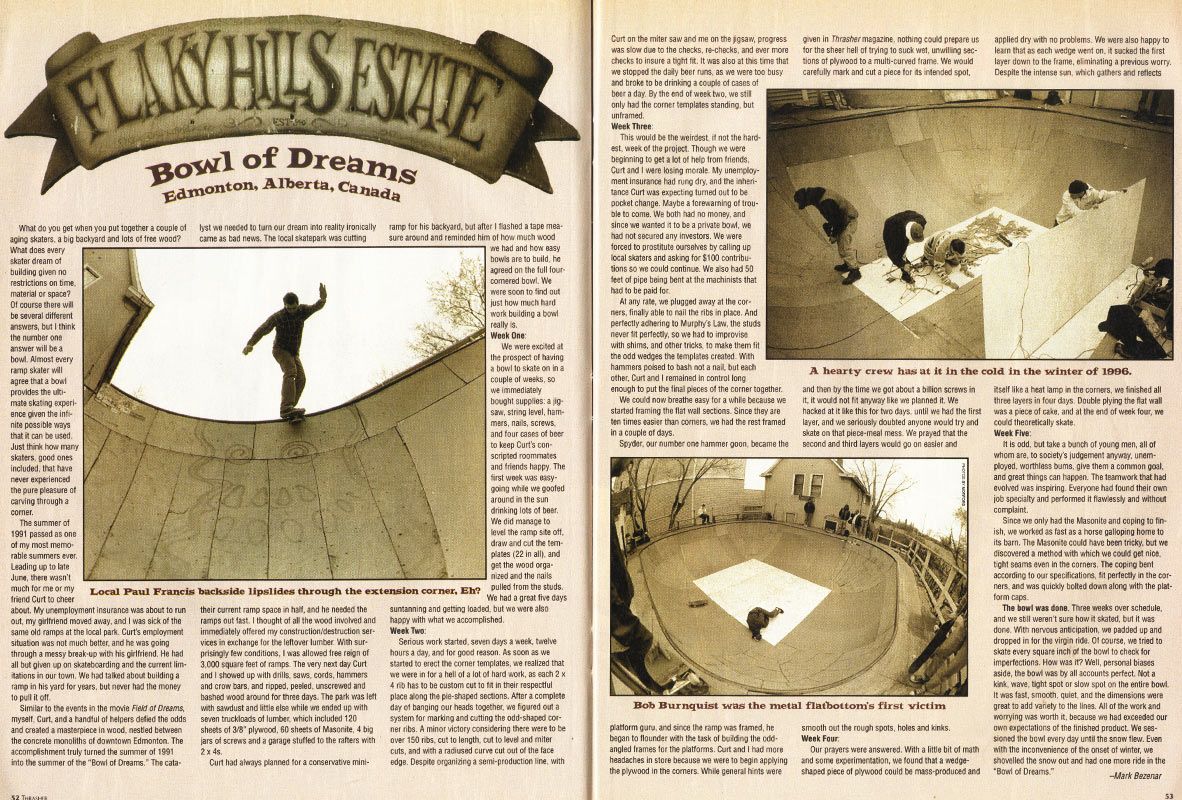
Page Text
            FLAKY HIS ESTATE
Bowl of Dreams
Edmonton, Alberta, Canada
What do you get when you put together a couple of
aging skaters, a big backyard and lots of free wood?
What does every
skater dream of
building given no
restrictions on time.
material or space?
Of course there will
be several different
answers, but I think
the number one
answer will be a
bowl. Almost every
ramp skater will
agree that a bowl
provides the ulti-
mate skating experi-
ence given the infi
nite possible ways
that it can be used.
Just think how many
skaters, good ones
included, that have
never experienced
the pure pleasure of
carving through a
corner.
The summer of
1991 passed as one
of my most memo
rable summers ever..
Leading up to late
June, there wasn't
much for me or my
friend Curt to cheer
lyst we needed to turn our dream into reality ironically
came as bad news. The local skatepark was cutting
ramp for his backyard, but after I flashed a tape mea-
sure around and reminded him of how much wood
we had and how easy
bowls are to build, he
agreed on the full four-
comered bowl. We
were soon to find out
just how much hard
work building a bowl
really is.
Week One:
We were excited at
the prospect of having
a bowl to skate on in a
couple of weeks, so
we immediately
bought supplies: a jig-
saw, string level, ham-
mers, nails, screws.
and four cases of beer
to keep Curt's con-
scripted roommates
and friends happy. The
first week was easy-
going while we goofed
around in the sun
drinking lots of beer.
We did manage to
level the ramp site off,
draw and cut the tem-
plates (22 in all), and
get the wood orga-
nized and the nails
Local Paul Francis backside lipslides through the extension corner, Eh? pulled from the studs.
about. My unemployment insurance was about to run
out, my girlfriend moved away, and I was sick of the
same old ramps at the local park. Curt's employment
situation was not much better, and he was going
through a messy break-up with his girlfriend. He had
all but given up on skateboarding and the current lim-
itations in our town. We had talked about building a
ramp in his yard for years, but never had the money
10 pull it off.
Similar to the events in the movie Field of Dreams,
myself, Curt, and a handful of helpers defied the odds
and created a masterpiece in wood, nestled between
the concrete monoliths of downtown Edmonton. The
accomplishment truly turned the summer of 1991
into the summer of the "Bowl of Dreams." The cata-
their current ramp space in half, and he needed the
ramps out fast. I thought of all the wood involved and
immediately offered my construction/destruction ser-
vices in exchange for the leftover lumber. With sur-
prisingly few conditions, I was allowed free reign of
3,000 square feet of ramps. The very next day Curt
and I showed up with drills, saws, cords, hammers
and crow bars, and ripped, peeled, unscrewed and
bashed wood around for three days. The park was left
with sawdust and little else while we ended up with
seven truckloads of lumber, which included 120
sheets of 3/8" plywood, 60 sheets of Masonite, 4 big
jars of screws and a garage stuffed to the rafters with
2x4s.
Curt had always planned for a conservative mini-
We had a great five days
suntanning and getting loaded, but we were also
happy with what we accomplished.
Week Two:
Serious work started, seven days a week, twelve
hours a day, and for good reason. As soon as we
started to erect the corner templates, we realized that
we were in for a hell of a lot of hard work, as each 2 x
4 rib has to be custom cut to fit in their respectful
place along the pie-shaped sections. After a complete
day of banging our heads together, we figured out a
system for marking and cutting the odd-shaped cor-
ner ribs. A minor victory considering there were to be
over 150 ribs, cut to length, cut to level and miter
cuts, and with a radiused curve cut out of the face
edge. Despite organizing a semi-production line, with
Curt on the miter saw and me on the jigsaw, progress
was slow due to the checks, re-checks, and ever more
checks to insure a tight fit. It was also at this time that
we stopped the daily beer nuns, as we were too busy
and broke to be drinking a couple of cases of
beer a day. By the end of week two, we still
only had the corner templates standing, but
unframed.
Week Three:
This would be the weirdest, if not the hard-
est, week of the project. Though we were
beginning to get a lot of help from friends,
Curt and I were losing morale. My unemploy-
ment insurance had rung dry, and the inheri-
tance Curt was expecting turned out to be
pocket change. Maybe a forewarning of trou-
ble to come. We both had no money, and
since we wanted it to be a private bowl, we
had not secured any investors. We were
forced to prostitute ourselves by calling up
local skaters and asking for $100 contribu-
tions so we could continue. We also had 50
feet of pipe being bent at the machinists that
had to be paid for.
At any rate, we plugged away at the cor-
ners, finally able to nail the ribs in place. And
perfectly adhering to Murphy's Law, the studs
never fit perfectly, so we had to improvise
with shims, and other tricks, to make them fit
the odd wedges the templates created. With
hammers poised to bash not a nail, but each
other, Curt and I remained in control long
enough to put the final pieces of the corner together.
We could now breathe easy for a while because we
started framing the flat wall sections. Since they are
ten times easier than comers, we had the rest framed
in a couple of days.
Spyder, our number one hammer goon, became the
given in Thrasher magazine, nothing could prepare us
for the sheer hell of trying to suck wet, unwilling sec-
tions of plywood to a multi-curved frame. We would
carefully mark and cut a piece for its intended spot,
applied dry with no problems. We were also happy to
learn that as each wedge went on, it sucked the first
layer down to the frame, eliminating a previous worry.
Despite the intense sun, which gathers and reflects
A hearty crew has at it in the cold in the winter of 1996.
and then by the time we got about a billion screws in
it, it would not fit anyway like we planned it. We
hacked at it like this for two days, until we had the first
layer, and we seriously doubted anyone would try and
skate on that piece-meal mess. We prayed that the
second and third layers would go on easier and
Bob Burnquist was the metal flatbottom's first victim
platform guru, and since the ramp was framed, he
began to flounder with the task of building the odd-
angled frames for the platforms. Curt and I had more
headaches in store because we were to begin applying
the plywood in the comers. While general hints were
smooth out the rough spots, holes and kinks.
Week Four
Our prayers were answered. With a little bit of math
and some experimentation, we found that a wedge-
shaped piece of plywood could be mass-produced and
itself like a heat lamp in the corners, we finished all
three layers in four days. Double plying the flat wall
was a piece of cake, and at the end of week four, we
could theoretically skate.
Week Five:
It is odd, but take a bunch of young men, all of
whom are, to society's judgement anyway, unem-
ployed, worthless bums, give them a common goal.
and great things can happen. The teamwork that had
evolved was inspiring. Everyone had found their own
job specialty and performed it flawlessly and without
complaint.
Since we only had the Masonite and coping to fin-
ish, we worked as fast as a horse galloping home to
its barn. The Masonite could have been tricky, but we
discovered a method with which we could get nice.
tight seams even in the corners. The coping bent
according to our specifications, fit perfectly in the cor-
ners, and was quickly bolted down along with the plat-
form caps
The bowl was done. Three weeks over schedule.
and we still weren't sure how it skated, but it was
done. With nervous anticipation, we padded up and
dropped in for the virgin ride. Of course, we tried to
skate every square inch of the bowl to check for
imperfections. How was it? Well, personal biases
aside, the bowl was by all accounts perfect. Not a
kink, wave, tight spot or slow spot on the entire bowl.
It was fast, smooth, quiet, and the dimensions were
great to add variety to the lines. All of the work and
worrying was worth it, because we had exceeded our
own expectations of the finished product. We ses-
sioned the bowl every day until the snow flew. Even
with the inconvenience of the onset of winter, we
shovelled the snow out and had one more ride in the
"Bowl of Dreams."
-Mark Bezenar
52 TH
53