Page Text
            76
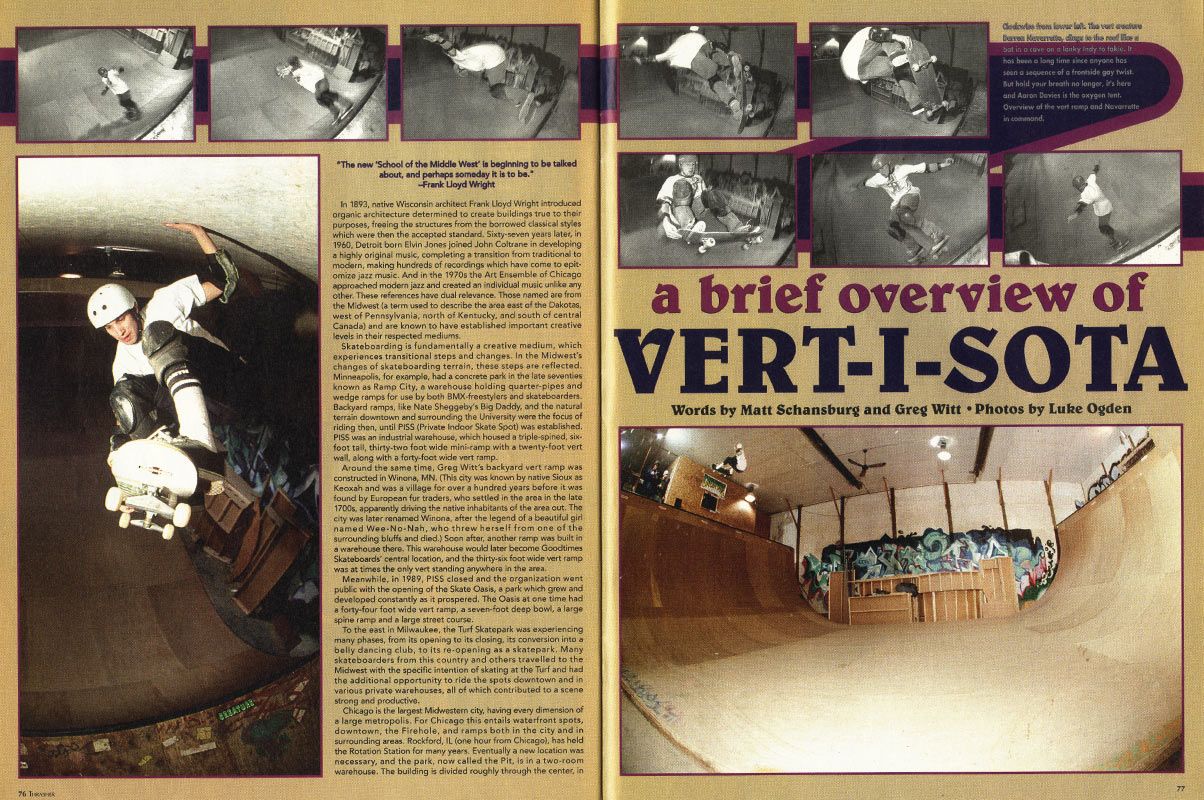
dedoutes from lower lat. The vet sature
Devon Keverrette, dogs to the roof o
bat in a cave on a lanky Indy to fokie. Ir
has been a long time since anyone has
sean a sequence of a frontside gay twist
But hold your breath no longer, ir's here
and Aaron Davies is the oxygen tent.
Overview of the vort romp and Navarrette
in command,
CREATURE
"The new 'School of the Middle West' is beginning to be talked
about, and perhaps someday it is to be."
Frank Lloyd Wright
In 1893, native Wisconsin architect Frank Lloyd Wright introduced
organic architecture determined to create buildings true to their
purposes, freeing the structures from the borrowed classical styles
which were then the accepted standard. Sixty-seven years later, in
1960, Detroit born Elvin Jones joined John Coltrane in developing
a highly original music, completing a transition from traditional to
modern, making hundreds of recordings which have come to epit
omize jazz music. And in the 1970s the Art Ensemble of Chicago
approached modern jazz and created an individual music unlike any
other. These references have dual relevance. Those named are from
the Midwest (a term used to describe the area east of the Dakotas,
west of Pennsylvania, north of Kentucky, and south of central
Canada) and are known to have established important creative
levels in their respected mediums.
Skateboarding is fundamentally a creative medium, which
experiences transitional steps and changes. In the Midwest's
changes of skateboarding terrain, these steps are reflected..
Minneapolis, for example, had a concrete park in the late seventies
known as Ramp City, a warehouse holding quarter-pipes and
wedge ramps for use by both BMX-freestylers and skateboarders.
Backyard ramps, like Nate Sheggeby's Big Daddy, and the natural
terrain downtown and surrounding the University were the focus of
riding then, until PISS (Private Indoor Skate Spot) was established.
PISS was an industrial warehouse, which housed a triple-spined, six-
foot tall, thirty-two foot wide mini-ramp with a twenty-foot vert
wall, along with a forty-foot wide vert ramp.
Around the same time, Greg Witt's backyard vert ramp was
constructed in Winona, MN. (This city was known by native Sioux as
Kecxah and was a village for over a hundred years before it was
found by European fur traders, who settled in the area in the late
1700s, apparently driving the native inhabitants of the area out. The
city was later renamed Winona, after the legend of a beautiful girl
named Wee-No-Nah, who threw herself from one of the
surrounding bluffs and died.) Soon after, another remp was built in
a warehouse there. This warehouse would later become Goodtimes
Skateboards central location, and the thirty-six foot wide vert ramp
was at times the only vert standing anywhere in the area.
Meanwhile, in 1989, PISS closed and the organization went
public with the opening of the Skate Oasis, a park which grew and
developed constantly as it prospered. The Oasis at one time had
a forty-four foot wide vert ramp, a seven-foot deep bowl, a large
spine ramp and a large street course.
To the east in Milwaukee, the Turf Skatepark was experiencing
many phases, from its opening to its closing, its conversion into at
belly dancing club, to its re-opening as a skatepark. Many
skateboarders from this country and others travelled to the
Midwest with the specific intention of skating at the Turf and had
the additional opportunity to ride the spots downtown and in
various private warehouses, all of which contributed to a scene
strong and productive.
Chicago is the largest Midwestern city, having every dimension of
a large metropolis. For Chicago this entails waterfront spots,
downtown, the Firehole, and ramps both in the city and in
surrounding areas. Rockford, IL (one hour from Chicago), has held
the Rotation Station for many years. Eventually a new location was
necessary, and the park, now called the Pit, is in a two-room
warehouse. The building is divided roughly through the center, in
a brief overview of
VERT-I-SOTA
Words by Matt Schansburg and Greg Witt Photos by Luke Ogden