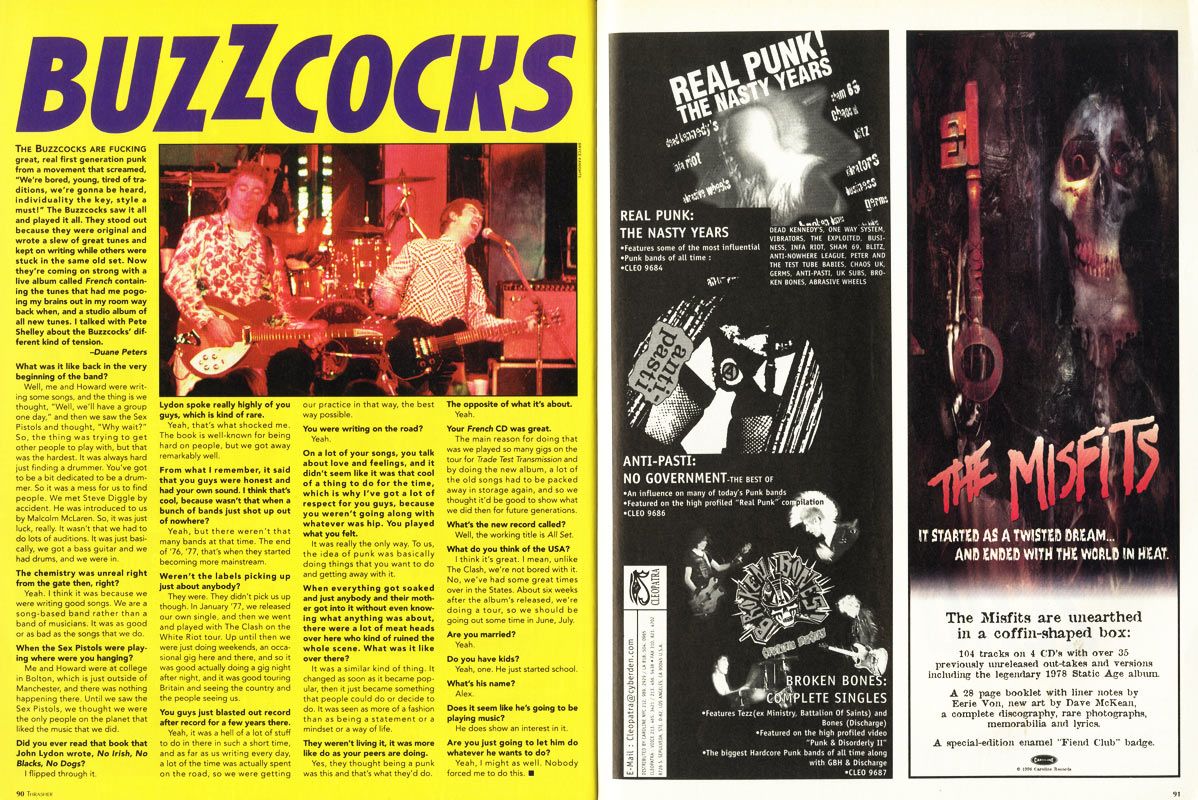
Page Text
            BUZZCOCKS
THE BUZZCOCKS ARE FUCKING
great, real first generation punk
from a movement that screamed,
"We're bored, young, tired of tra-
ditions, we're gonna be heard,
individuality the key, style a
must! The Buzzcocks saw it all
and played it all. They stood out
because they were original and
wrote a slew of great tunes and
kept on writing while others were
stuck in the same old set. Now
they're coming on strong with a
live album called French contain-
ing the tunes that had me pogo-
ing my brains out in my room way
back when, and a studio album of
all new tunes. I talked with Pete
Shelley about the Buzzcocks' dif
ferent kind of tension.
-Duane Peters
What was it like back in the very
beginning of the band?
Well, me and Howard were writ-
ing some songs, and the thing is we
thought, "Well, we'll have a group
one day," and then we saw the Sex
Pistols and thought, "Why wait?"
So, the thing was trying to get
other people to play with, but that
was the hardest. It was always hard
just finding a drummer. You've got
to be a bit dedicated to be a drum
mer. So it was a mess for us to find
people. We met Steve Diggle by
accident. He was introduced to us
by Malcolm McLaren. So, it was just
luck, really. It wasn't that we had to
do lots of auditions. It was just basi-
cally, we got a bass guitar and we
had drums, and we were in.
The chemistry was unreal right
from the gate then, right?
Yeah. I think it was because we
were writing good songs. We are a
song-based band rather than a
band of musicians. It was as good
or as bad as the songs that we do.
When the Sex Pistols were play
ing where were you hanging?
Lydon spoke really highly of you
guys, which is kind of rare.
Yeah, that's what shocked me..
The book is well-known for being
hard on people, but we got away
remarkably well.
From what I remember, it said
that you guys were honest and
had your own sound. I think that's
cool, because wasn't that when a
bunch of bands just shot up out
of nowhere?
Yeah, but there weren't that
many bands at that time. The end
of '76, 77, that's when they started
becoming more mainstream.
Weren't the labels picking up
just about anybody?
They were. They didn't pick us up
though. In January '77, we released
our own single, and then we went
and played with The Clash on the
White Riot tour. Up until then we
were just doing weekends, an occa-
sional gig here and there, and so it
was good actually doing a gig night
after night, and it was good touring
Britain and seeing the country and
the people seeing us.
Me and Howard were at college
in Bolton, which is just outside of
Manchester, and there was nothing
happening there. Until we saw the
Sex Pistols, we thought we were
the only people on the planet that after record for a few years there.
liked the music that we did.
Did you ever read that book that
John Lydon wrote, No Irish, No
Blacks, No Dogs?
I flipped through it.
90 T
You guys just blasted out record
Yeah, it was a hell of a lot of stuff
to do in there in such a short time.
and as far as us writing every day,
a lot of the time was actually spent
on the road, so we were getting
our practice in that way, the best The opposite of what it's about.
way possible.
You were writing on the road?
Yeah.
On a lot of your songs, you talk
about love and feelings, and it
didn't seem like it was that cool
of a thing to do for the time,
which is why I've got a lot of
respect for you guys, because
you weren't going along with
whatever was hip. You played
what you felt.
It was really the only way. To us.
the idea of punk was basically
doing things that you want to do
and getting away with it.
When everything got soaked
and just anybody and their moth
er got into it without even know-
ing what anything was about,
there were a lot of meat heads
over here who kind of ruined the
whole scene. What was it like
over there?
It was a similar kind of thing. It
changed as soon as it became pop-
ular, then it just became something
that people could do or decide to
do. It was seen as more of a fashion
than as being a statement or a
mindset or a way of life.
They weren't living it, it was more
like do as your peers are doing.
Yes, they thought being a punk
was this and that's what they'd do.
Yeah.
Your French CD was great.
The main reason for doing that
was we played so many gigs on the
tour for Trade Test Transmission and
by doing the new album, a lot of
the old songs had to be packed
away in storage again, and so we
thought it'd be good to show what
we did then for future generations.
What's the new record called?
Well, the working title is All Set.
What do you think of the USA?
I think it's great. I mean, unlike
The Clash, we're not bored with it.
No, we've had some great times
over in the States. About six weeks
after the album's released, we're
doing a tour, so we should be
going out some time in June, July.
Are you married?
Yeah.
Do you have kids?
Yeah, one. He just started school.
What's his name?
Alex
Does it seem like he's going to be
playing music?
He does show an interest in it.
Are you just going to let him do
whatever he wants to do?
Yeah, I might as well. Nobody
forced me to do this.
REAL PUNK!
sam 65
THE NASTY YEARS
dedimdy's
a riot
REAL PUNK:
THE NASTY YEARS
Features some of the most influential
Punk bands of all time:
•CLEO 9684
rators
Borm:
DEAD KENNEDY'S, ONE WAY SYSTEM,
VIBRATORS, THE EXPLOITED, BUSI-
NESS, INFA RIOT, SHAM 69, BLITZ.
ANTI-NOWHERE LEAGUE, PETER AND
THE TEST TUBE BABIES, CHAOS UK.
GERMS, ANTI-PASTI, UK SUBS, BRO-
KEN BONES, ABRASIVE WHEELS
pasti
anti-
ANTI-PASTI:
NO GOVERNMENT-THE BEST OF
An influence on many of today's Punk bands
Featured on the high profiled "Real Punk" compilation
•CLEO 9686
BROKEN BONES:
COMPLETE SINGLES
Features Tezz (ex Ministry, Battalion Of Saints) and
Bones (Discharge)
•Featured on the high profiled video
"Punk & Disorderly 11"
The biggest Hardcore Punk bands of all time along
with GBH & Discharge
•CLEO 9687
THE MISFITS
IT STARTED AS A TWISTED DREAM....
AND ENDED WITH THE WORLD IN HEAT.
The Misfits are unearthed
in a coffin-shaped box:
104 tracks on 4 CD's with over 35
previously unreleased out-takes and versions
including the legendary 1978 Static Age album.
A 28 page booklet with liner notes by
Eerie Von, new art by Dave McKean,
a complete discography, rare photographs,
memorabilia and lyrics.
A special-edition enamel "Fiend Club" badge.