Page Text
            40 THRASHER
just future. This makes the skaters
or type of skating promoted at
that time the only view you could
have on skating. This is cool, mak-
ing it totally your sport, activity,
lifestyle. But history has some-
thing to offer all of us. Sometimes
we are asked what was the first
trick we learned: "Was it the
ollie?" First the allie was learned
on vertical in 1978 by Alan
Gelfand. Everyone knows that
now. But there is a lot more.
I would love to see a video or
movie on it. Just learning to
maneuver your board was a trick,
then kickturning and pumping on
transition to keep your speed.
seeing how close to the top of a
pool you could get. It took us a
few weeks to drop in on our half-
pipe. We would just sit up there.
foot on the tail, trying to put the
other foot on to drop our weight
down the transition. One day we
finally just dropped in. It was a
breaking point in learning. Things
came easily after that. There were.
pros before us that we couldn't
relate to until later, when we
could understand what they were
about. We were automatically
close-minded.
TRAVEL: The summer of 1978, my
dad took me to England to show
me his history and a lot of military
museums. I got a list of skate-
parks from the magazines and
visited as many as I could: Mad
Dog, Romford, Gillingham and
Bradford. When I got back, I was
stoked to travel. We started going
to as many skateparks as we
could: Reseda, Glendora, Upland,
Skatopia, Concrete Wave, Marina,
Lakewood, Pomona, they were
everywhere. And skating an old
beat ramp for so long made it
easier to get speed on cement,
tricks started to come easier.
TEAM: I got on Skate City's team
and started to enter ASPO (Ama-
teur Skatepark Organization) con-
tests pitting skatepark against
skatepark. I did really well and
was asked to be sponsored. My
friend Quique was a purist.
Contests, teams and sponsorship
weren't inviting to him. We even
said we'd never get sponsored,
but I always wanted to be one of
the pros, or at least wore hats and
was blamed for trying to be one. I
tried to skate like Alva, Jay Adams,
Bobby Valdez and Darryl Miller. I
went through a period where I
thought I was good, but I had a
lot of shortcomings as a skater.
TOUR: Steve Hirsch got me on
Variflex which had some of the
most progressive trick-learning
skaters of its
time: Hirsch,
Grisham,
Elguera, Losi,
but was always
looked down on
for not having
style. I saw it
both ways as
Steve Olson,
full style, and
Duane Peters
were my
favorite skaters
at this time.
When Steve
Alba first met
me I saw him
before], when I
was on Variflex,
he blew his
nose on me. All
that just makes
you want it.
more. Anyway,
I got to go on
tour in 1980.
think I was the
first amateur
ever to go on a
USA tour. It was
the best. Thanks
everyone.
PRO: Shortly
after that, everyone stopped skat
ing for their own reason. It was a
real dead time. No one older
could make enough money to
keep skating. All the greats, Brad
Bowman, Ray Bones, all disap-
peared. All of a sudden skate-
boarding was ours, it seemed. At
least what was left of it: two or
three skateparks, contests with
eleven pros only and just good
friends. Skating was where it hep-
pened for me, Hago, John Lucero,
Neil Blender, the Whittier locals.
John Lucero was kicked out of the
skatepark for a year for messing
around with Richard Armejo and
imitating all the vertical action on
the flatland and curbs cut front.
We even held the first modern day
street contest out there. Hago,
Louie and I started a band and
played in the top room-the worst
band ever. We even played shows
at the park. Neil Blender is the
inventor of so much in skateboard-
ing art, innovation, tricks and
lifestyle. At this time I got an inter-
view in Thrasher with photos taken
by Glen E Friedman. This along
with Mofo, Neil, Warren Bolster,
Cassimus and Goodrich got me
stoked on taking photos. All these
people brought a lot to skate-
boarding and I thank them.
DECISIONS: In high school came
the normal question from myself
and my parents "What are you
going to do with your life?" I want-
ed to have a car to get around, all
that, so I got a job at the skate-
park, then at Variflex silk-screening
boards. I wanted to be involved in
skating, but not how it was going.
My mom asked Stacy Peralta if he
had any suggestions (since she
knew I liked how and what he had
done with skateboarding after his
skating career). He asked me if I
wanted to skate for Powell Peralta
to learn and move into a working
job with the team and things. I was
burnt on having a model out from
Variflex and didn't mind not having
a model-no more pressure or
relying on it to sell. Skating was
slow. I rode away in my backyard
with Steve Keenan, Steve Coch-
rane and Eric Castro. At this time a
new group of skaters were coming
up: Eric Nash, Jeff Grosso and Ben
Schroeder. I had a union job set-
ting up trade show booths and
made just enough to live on and
get married to Yvette shortly after.
The Bones Brigade video show
came out, and Stacy asked if I
wanted a model again because
people were ask-
ing for it. I said yes
and was excited
about that again. It
changed the plan,
or at least put it on
hold, and skating
was picking up
Boards sold, con-
tests, videos,
demos a lot of
incredible things
happened, just
being with some
of the raddest
skaters: Steve Cab,
Tony Hawk, Mike
McGill, Tommy
Guerrero, Rodney
Mullen, there were
a lot of them on
the team and off.
CHANGE: All of us
had a great time,
and it lasted for a
while. Skateboard-
ing stayed the
same for a long
time, too long, and
it needed a change. Being with
Stacy and Craig Stocyk was the
best school to ever go to, and I
appreciate them so much, I think 1
have moved on to another step,
and the ongoing process is still
going. It's the same now as it ever
was and will always be. We're all in
it at different points, and I love it.
and the people involved.
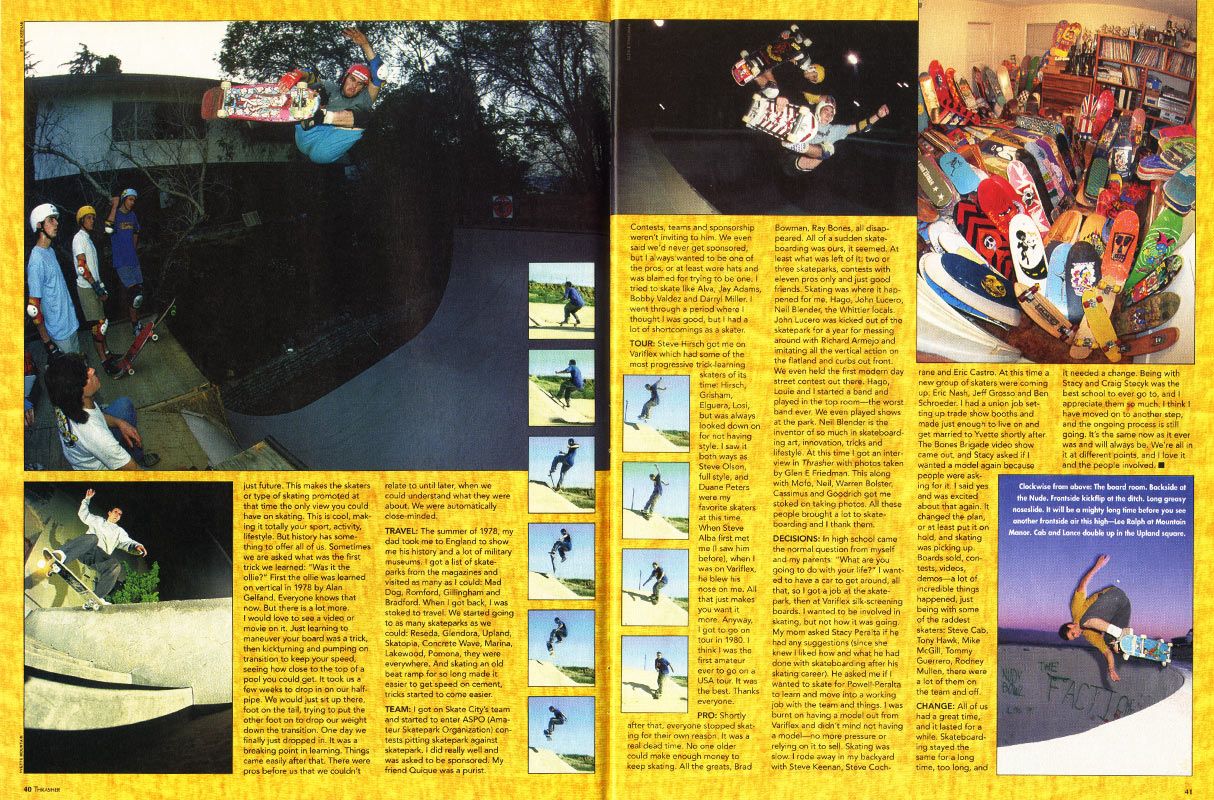
Clockwise from above: The board room. Backside of
the Nude. Frontside kickflip of the ditch. Long greasy
noseslide. It will be a mighty long time before you see
another frontside air this high-lee Ralph at Mountain
Manor, Cab and Lance double up in the Upland square.
L
FACTIO