Page Text
            LANCE
MOUNTAIN
Then & Now
ON HIS FIRST BOARD: My friend Quique Ezparza was
four years older than I was. We grew up on the same
block, playing football, softball, egg-in-the-hole and bicy-
cling. Quique was a natural and a ruler at every sport
activity he did. We would play tag football on a twenty-
foot-wide street and still I would get duked not even
touching him. Whatever he was into, we did. He gave
me his old skateboard one day when he decided to get
a new one: an oak wood board with clay wheels.
ON SKATING TO SCHOOL: Shortly after
that, I got a plastic board with urethane
wheels that still had loose ball bearings. I
had two friends, Tim and David Cragoe,
whose dad was a teacher at our school. He
would give us a ride to school, about five
miles. We would try and leave early and
skate as far as we could until their dad
would catch up to us, or we would make it
all the way. After school we would play the
tic tac tag (tag without pushing off with
our feet) until it was time to head home.
OUR HILL: Living on a hill in Alhambra,
CA, is what provided the activity; a refrig-
erator box placed on our three or fourt
boards, we all climbed in, up to five peo-
ple sometimes. At the bottom of the hill
was an ivy patch that would stop the
boards and send the box and its contents
flying. We would also catamaran (two peo-
ple on two boards) and race back up the
hill without pushing, sometimes taking
turns, sometimes somebody would push
his board as far up the hill as he could and
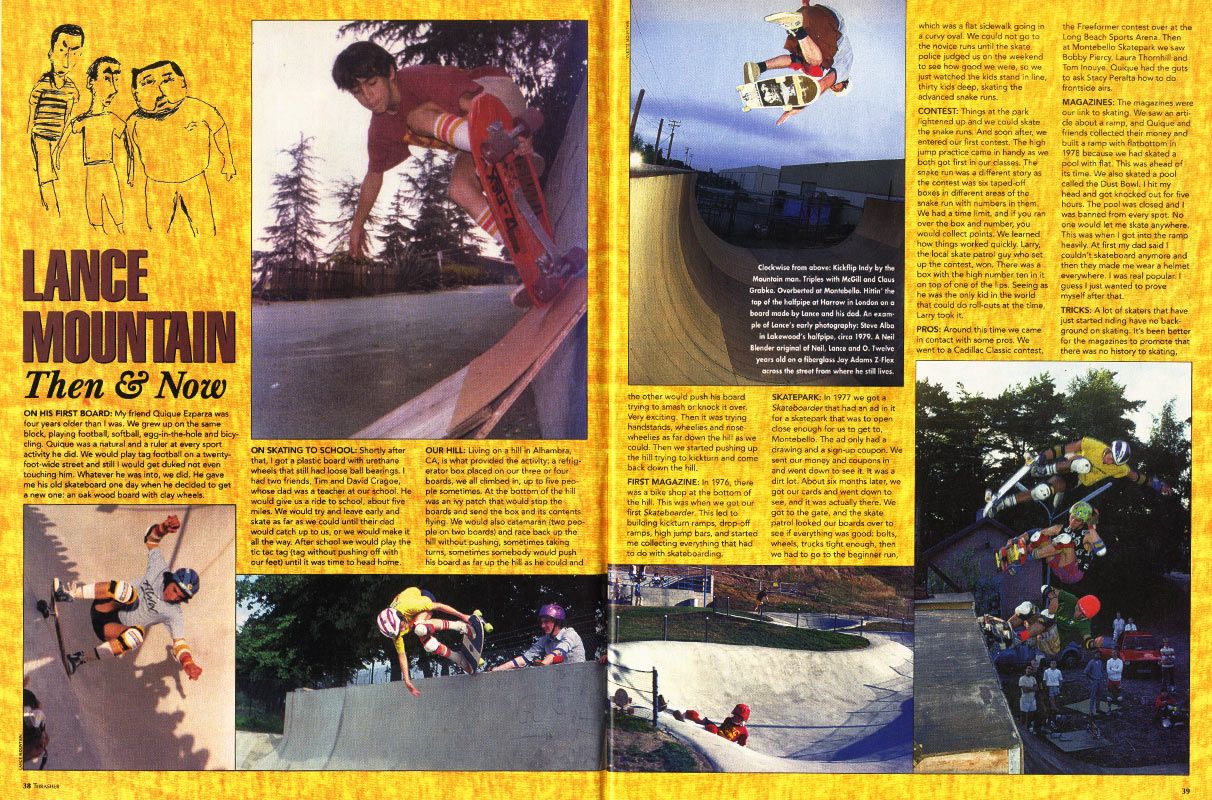
Clockwise from above: Kickflip Indy by the
Mountain man. Triples with McGill and Claus
Grabke. Overberted at Montebello. Hittin' the
top of the halfpipe at Harrow in London on a
board made by Lance and his ded. An exam
ple of Lance's early photography: Steve Alba
in Lakewood's halfpipe, circa 1979. A Neil
Blender original of Neil, Lance and O. Twelve
years old on a fiberglass Jay Adams Z-Flex
across the street from where he still lives.
the other would push his board
trying to smash or knock it over.
Very exciting. Then it was trying
handstands, wheelies and nose
wheelies as far down the hill as we
could. Then we started pushing up
the hill trying to kickturn and come
back down the hill.
FIRST MAGAZINE: In 1976, there
was a bike shop at the bottom of
the hill. This was when we got our
first Skateboarder. This led to
building kickturn ramps, drop off
ramps, high jump bars, and started
me collecting everything that had
to do with skateboarding.
SKATEPARK: In 1977 we got a
Skateboarder that had an ad in it
for a skatepark that was to open
close enough for us to get to,
Montebello. The ad only had a
drawing and a sign-up coupon. We
sent our money and coupons in
and went down to see it. It was a
dirt lot. About six months later, we
got our cards and went down to
see, and it was actually there. We
got to the gate, and the skate
patrol looked our boards over to
see if everything was good: bolts,
wheels, trucks tight enough, then
we had to go to the beginner run,
which was a flat sidewalk going in
a curvy oval. We could not go to
the novice runs until the skate
police judged us on the weekend
to see how good we were, so we
just watched the kids stand in line,
thirty kids deep, skating the
advanced snake runs.
CONTEST: Things at the park
lightened up and we could skate
the snake runs. And soon after, we
entered our first contest. The high
jump practice came in handy as we
both got first in our classes. The
snake run was a different story as
the contest was six taped-off
boxes in different areas of the
snake run with numbers in them
We had a time limit, and if you ran
over the box and number, you
would collect points. We learned
how things worked quickly. Larry,
the local skate patrol guy who set
up the contest, won. There was a
box with the high number ten in it
on top of one of the lips. Seeing as
he was the only kid in the world
that could do roll-outs at the time,
Larry took it.
PROS: Around this time we came
in contact with some pros. We
went to a Cadillac Classic contest,
the Freeformer contest over at the
Long Beach Sports Arena. Then
at Montebello Skatepark we saw
Bobby Piercy, Laura Thornhill and
Tom Inouye Quique had the guts
to ask Stacy Peralta how to do
frontside airs.
MAGAZINES: The magazines were
our link to skating. We saw an arti
cle about a ramp, and Quique and
friends collected their money and
built a ramp with flatbottom in
1978 because we had skated a
pool with flat. This was ahead of
its time. We also skated a pool
called the Dust Bowl. I hit my
head and got knocked out for five
hours. The pool was closed and I
was banned from every spot. No
one would let me skate anywhere..
This was when I got into the ramp
heavily. At first my dad said!
couldn't skateboard anymore and
then they made me wear a helmet
everywhere, I was real popular. I
guess I just wanted to prove
myself after that.
TRICKS: A lot of skaters that have
just started riding have no back-
ground on skating. It's been better
for the magazines to promote that
there was no history to skating,
38 THR