Page Text
            FUGGGS
AN ODE TO JOHN COLTRANE
by Page Hamilton of Helmet
It is easy to close oneself off from a wide
variety of musical forms and genres. For many,
personal identity is tied up in a particular peer
group centered around a seemingly broad
movement which is actually fairly defined as
exclusive. As example I cite, in broad terms
and conveniently dubbed, punk rock, a musical
ethic of passion, purity and honesty, or so one
would hope.
Unfortunately, the recent mass exposure of
the scene seems to have become an invasion
capable of ruining the music for money. In my
opinion, music should not be so restricted,
because the enjoyment and enlightenment it
provides can never be destroyed or replaced. I
maintain that one should simply drop the needle
(or laserbeam, for those with CDs) and experi-
ence every form of music for him or herself.
That said, the intense passion and constant
progression in the music of John Coltrane
exposes a spiritually driven man who seemed to
play every note as though it would be his last. A
tireless work ethic of constant practice at the
tenor and soprano saxophones, an ever evolving
experimentation with different compositional
forms, a thorough and still revolutionary com
mand of harmonic substitution and chord exten
sions, and a deep devotion to God give us a
fair amount of insight into one of the most
important and influential musicians of the
twentieth century.
Coltranes's music is generally divided into
three different periods:
1) Hard-bop experimentation with lots of
chord changes.
2) Modal improvisation centered around kay
centers and utilizing few chord changes.
3) Free period, where collective improvisa-
tion and interplay based on more loosely
constructed forms was the focus.
These periods are merely convenient divi-
sions for music historians.
Each so-called musical period of John
Coltrane, starting in about 1955, when he
joined the Miles Davis Group, to the later
free improvised recordings done in 1966
and 1967 (he died July 17, 1967 at forty),
seem not exclusive or separate, but rather a
constant growth of the techniques he was
developing. The early harmonic exploration
and multi-note passages dubbed "sheets of
sound" by many jazz critics appear in the
free forms he used later on. The structure
and discipline remain throughout while the
forms are constantly evolving
From a purely inspirational standpoint, the
entire body of Caltrane's music remains, for
me, unmatched. The other more analyzable
aspects present a lifetime of study which will
reap immeasurable musical benefits.
For a focused and accessible introduction
to Coltrane which might expose you to one
incredible man's life process through music,
I suggest starting with a small section of his
work: Soultrane (Prestige). Kind of Blue
(Columbia), Giant Steps (Atlantic), My
Favorite Things (Atlantic), A Love Supreme
(impulse), Africa Brass (Impulse), Ascension
Ompulse) and Interstellar Space (Impulse).
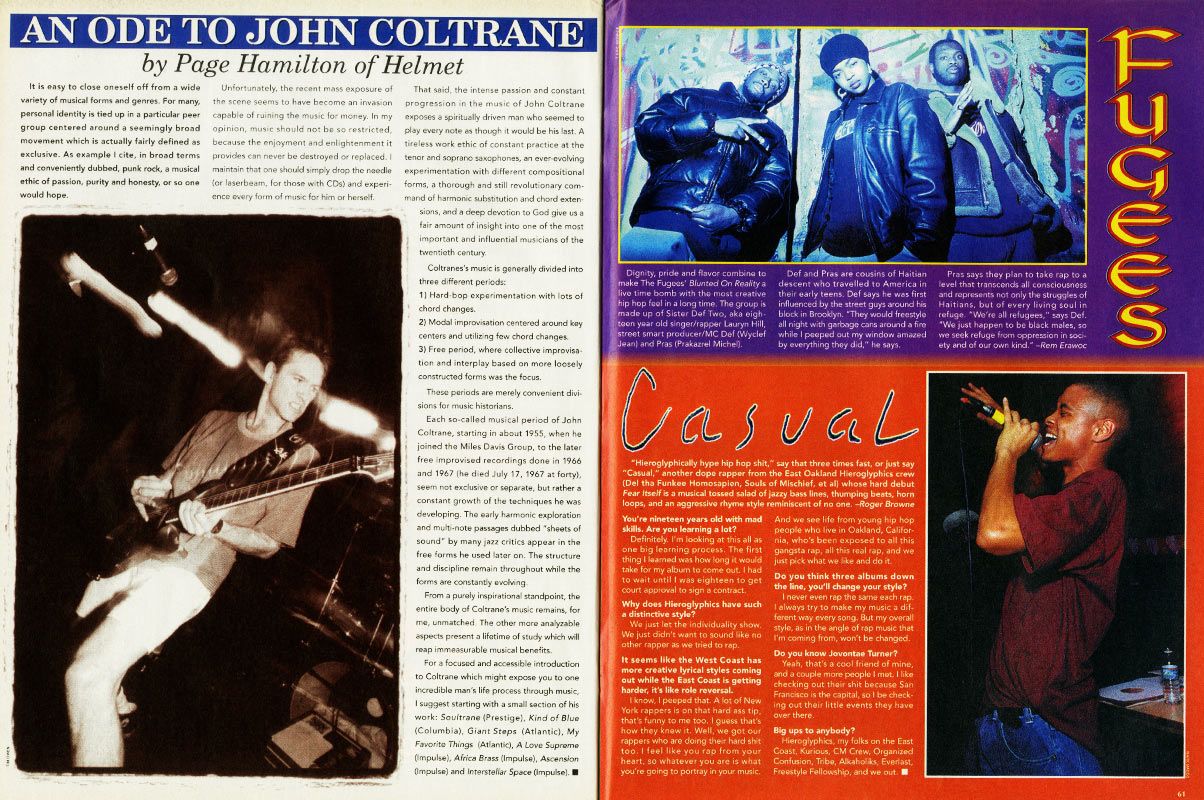
Dignity, pride and flavor combina to
make The Fugees' Blunted On Reality a
live time bomb with the most creative.
hip hop feel in a long time. The group is
made up of Sister Def Two, aka eigh-
teen year old singer/rapper Lauryn Hill,
street smart producer/MC Def (Wyclef
Jean) and Pras (Prakazrel Michel).
Def and Pras are cousins of Haitian
descent who travelled to America in
their early teens. Def says he was first
influenced by the street guys around his
block in Brooklyn. "They would freestyle
all night with garbage cans around a fire
while I peeped out my window amazed
by everything they did," he says.
Ca
Vasual
"Hieroglyphically hype hip hop shit," say that three times fast, or just say
"Casual," another dope rapper from the East Oakland Hieroglyphics crew
(Del the Funkee Homosapien, Souls of Mischief, et al) whose hard debut
Fear Itself is a musical tossed salad of jazzy bass lines, thumping beats, horn
loops, and an aggressive rhyme style reminiscent of no one. -Roger Browne
You're nineteen years old with mad
skills. Are you learning a lot?
Definitely. I'm looking at this all as
one big learning process. The first
thing I leamed was how long it would
take for my album to come out. I had
to wait until I was eighteen to get
court approval to sign a contract.
Why does Hieroglyphics have such
a distinctive style?
We just let the individuality show.
We just didn't want to sound like no
other rapper as we tried to rap.
It seems like the West Coast has
more creative lyrical styles coming
out while the East Coast is getting
harder, it's like role reversal.
I know, I peeped that. A lot of New
York rappers is on that hard ass tip.
that's funny to me too, I guess that's
how they knew it. Well, we got our
rappers who are doing their hard shit
too. I feel like you rap from your
heart, so whatever you are is what
you're going to portray in your music.
And we see life from young hip hop
people who live in Oakland, Califor-
nia, who's been exposed to all this
gangsta rap, all this real rap, and we
just pick what we like and do it.
Do you think three albums down
the line, you'll change your style?
I never even rap the same each rap.
I always try to make my music a dif-
ferent way every song. But my overall
style, as in the angle of rap music that
I'm coming from, won't be changed.
Do you know Jovontae Turner?
Yeah, that's a cool friend of mine,
and a couple more people I met. I like
checking out their shit because San
Francisco is the capital, so I be check-
ing out their little events they have
over there.
Big ups to anybody?
Hieroglyphics, my folks on the East
Coast, Kurious, CM Crew, Organized
Confusion, Tribe, Alkaholiks, Everlast,
Freestyle Fellowship, and we out.
Pras says they plan to take rap to a
level that transcends all consciousness
and represents not only the struggles of
Haitians, but of every living soul in
refuge. "We're all refugees," says Def.
"We just happen to be black males, so
we seek refuge from oppression in soci
ety and of our own kind." -Rem Erawoc