Page Text
            BLACK
TRAIN
JACK
JUSTICE
PEACE
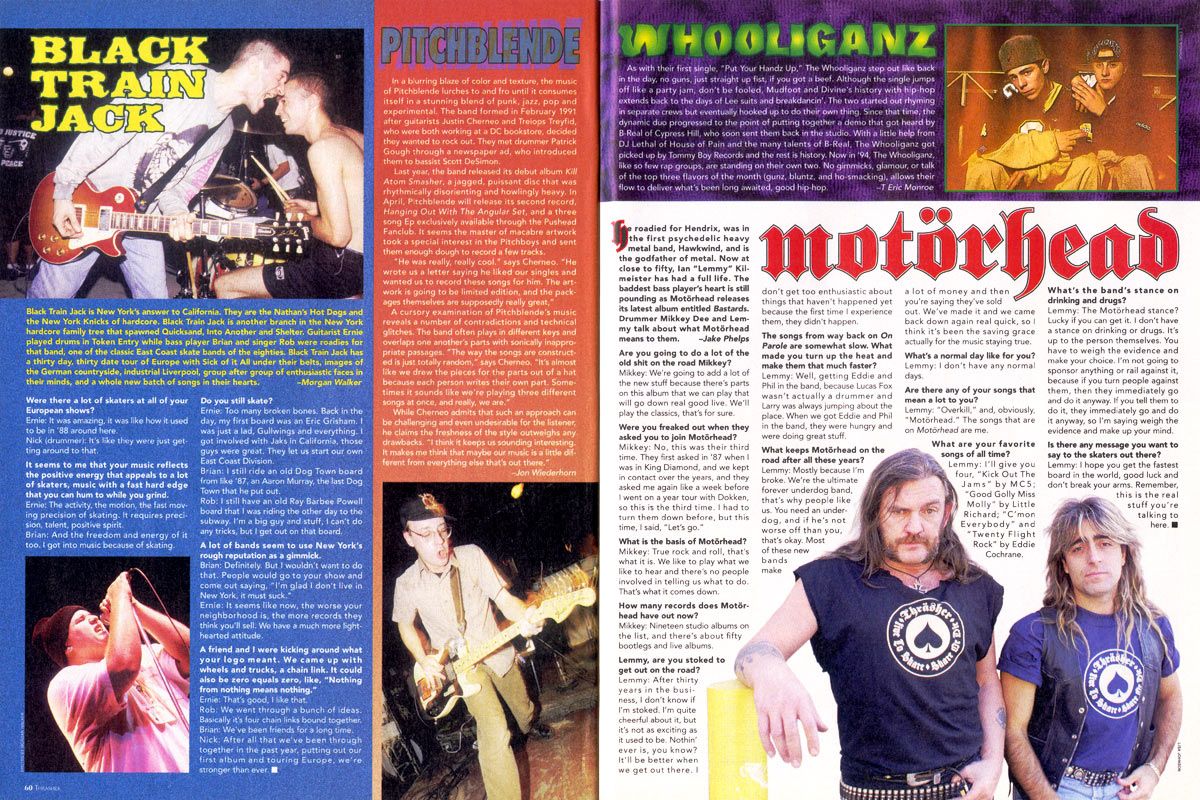
Black Train Jack is New York's answer to California. They are the Nathan's Hot Dogs and
the New York Knicks of hardcore. Black Train Jack is another branch in the New York
hardcore family tree that spawned Quicksand, Into Another and Shelter. Guitarist Ernie
played drums in Token Entry while bass player Brian and singer Rob were roadies for
that band, one of the classic East Coast skate bands of the eighties. Black Train Jack has
a thirty day, thirty date tour of Europe with Sick of it All under their belts, images of
the German countryside, industrial Liverpool, group after group of enthusiastic faces in
their minds, and a whole new batch of songs in their hearts.
-Morgan Walker
Were there a lot of skaters at all of your
European shows?
Do you still skate?
Ernie: Too many broken bones. Back in the
Emie: It was amazing, it was like how it used day, my first board was an Eric Grisham. I
to be in '88 around here.
Nick (drummer): It's like they were just get-
ting around to that.
It seems to me that your music reflects
the positive energy that appeals to a lot
of skaters, music with a fast hard edge
that you can hum to while you grind.
Ernie: The activity, the motion, the fast mov-
ing precision of skating. It requires preci-
sion, talent, positive spirit.
Brian: And the freedom and energy of it
too. I got into music because of skating.
60 T
was just a lad, Gullwings and everything. I
got involved with Jaks in California, those
guys were great. They let us start our own
East Coast Division.
Brian: I still ride an old Dog Town board
from like '87, an Aaron Murray, the last Dog
Town that he put out.
Rob: I still have an old Ray Barbee Powell
board that I was riding the other day to the
subway. I'm a big guy and stuff, 1 can't do
any tricks, but I get out on that board.
A lot of bands seem to use New York's
rough reputation as a gimmick.
Brian: Definitely. But I wouldn't want to do
that. People would go to your show and
come out saying, "I'm glad I don't live in
New York, it must suck."
Ernie: It seems like now, the worse your
neighborhood is, the more records they
think you'll sell. We have a much more light-
hearted attitude.
A friend and I were kicking around what
your logo meant. We came up with
wheels and trucks, a chain link. It could
also be zero equals zero, like. "Nothing
from nothing means nothing."
Ernie: That's good, I like that.
Rob: We went through a bunch of ideas.
Basically it's four chain links bound together.
Brian: We've been friends for a long time.
Nick: After all that we've been through
together in the past year, putting out our
first album and touring Europe, we're
stronger than ever.
PIRCHBIENDE WHOOLIGANZ
In a blurring blaze of color and texture, the music
of Pitchblende lurches to and fro until it consumes
itself in a stunning blend of punk, jazz, pop and
experimental. The band formed in February 1991
after guitarists Justin Cherneo and Treiops Treyfid,
who were both working at a DC bookstore, decided
they wanted to rock out. They met drummer Patrick
Gough through a newspaper ad, who introduced
them to bassist Scott DeSimon,
Last year, the band released its debut album Kill
Atom Smasher, a jagged, puissant disc that was
rhythmically disorienting and howlingly heavy. In
April, Pitchblende will release its second record,
Hanging Out With The Angular Set, and a three
song Ep exclusively available through the Pushead
Fanclub. It seems the master of macabre artwork
took a special interest in the Pitchboys and sent
them enough dough to record a few tracks.
"He was really, really cool." says Cherneo. "He
wrote us a letter saying he liked our singles and
wanted us to record these songs for him. The art-
work is going to be limited edition, and the pack-
ages themselves are supposedly really great,"
A cursory examination of Pitchblende's music
reveals a number of contradictions and technical
glitches. The band often plays in different keys and
overlaps one another's parts with sonically inappro
priate passages. "The way the songs are construct-
ed is just totally random," says Cherneo. "It's almost
like we drew the pieces for the parts out of a hat
because each person writes their own part. Some-
times it sounds like we're playing three different
songs at once, and really, we are."
While Cherneo admits that such an approach can
be challenging and even undesirable for the listener,
he claims the freshness of the style outweighs any
drawbacks. "I think it keeps us sounding interesting.
It makes me think that maybe our music is a little dif
ferent from everything else that's out there."
-Jon Wiederhorn
As with their first single, "Put Your Handz Up." The Whooliganz step out like back
in the day, no guns, just straight up fist, if you got a beef. Although the single jumps
off like a party jam, don't be fooled, Mudfoot and Divine's history with hip-hop
extends back to the days of Lee suits and breakdancin'. The two started out rhyming
in separate crews but eventually hooked up to do their own thing. Since that time, the
dynamic duo progressed to the point of putting together a demo that got heard by
B-Real of Cypress Hill, who soon sent them back in the studio. With a little help from
DJ Lethal of House of Pain and the many talents of B-Real, The Whooliganz got
picked up by Tommy Boy Records and the rest is history. Now in '94, The Whooliganz,
like so few rap groups, are standing on their own two. No gimmicks, glamour, or talk
of the top three flavors of the month (gunz, bluntz, and ho-smacking), allows their
flow to deliver what's been long awaited, good hip-hop.
roadied for Hendrix, was in
the first psychedelic heavy
metal band, Hawkwind, and is
the godfather of metal. Now at
close to fifty, lan "Lemmy" Kil-
meister has had a full life. The
baddest bass player's heart is still
pounding as Motörhead releases
its latest album entitled Bastards.
Drummer Mikkey Dee and Lem-
my talk about what Motörhead
means to them.
-Jake Phelps
Are you going to do a lot of the
old shit on the road Mikkey?
Mikkey: We're going to add a lot of
the new stuff because there's parts
on this album that we can play that
will go down real good live. We'll
play the classics, that's for sure.
Were you freaked out when they
asked you to join Motörhead?
Mikkey: No, this was their third
time. They first asked in '87 when I
was in King Diamond, and we kept
in contact over the years, and they
asked me again like a week before
I went on a year tour with Dokken,
so this is the third time. I had to
turn them down before, but this
time, I said, "Let's go."
What is the basis of Motörhead?
Mikkey: True rock and roll, that's
what it is. We like to play what we
like to hear and there's no people
involved in telling us what to do.
That's what it comes down.
How many records does Motör-
head have out now?
Mikkey: Nineteen studio albums on
the list, and there's about fifty
bootlegs and live albums.
Lemmy, are you stoked to
get out on the road?
Lemmy: After thirty.
years in the busi-
ness, I don't know if
I'm stoked. I'm quite
cheerful about it, but
it's not as exciting as
it used to be. Nothin
ever is, you know?
It'll be better when
we get out there. I
-T Eric Monroe
A
motörhead
don't get too enthusiastic about
things that haven't happened yet
because the first time I experience
them, they didn't happen.
The songs from way back on On
Parole are somewhat slow. What
made you turn up the heat and
make them that much faster?
Lemmy: Well, getting Eddie and
Phil in the band, because Lucas Fox
wasn't actually a drummer and
Larry was always jumping about the
place. When we got Eddie and Phil
in the band, they were hungry and
were doing great stuff.
What keeps Motörhead on the
road after all these years?
Lemmy: Mostly because I'm
broke. We're the ultimate
forever underdog band,
that's why people like
us. You need an under-
dog, and if he's not
worse off than you.
that's okay. Most
of these new
bands
make
a lot of money and then
you're saying they've sold
out. We've made it and we came
back down again real quick, so |
think it's been the saving grace
actually for the music staying true.
What's a normal day like for you?
Lemmy: I don't have any normal
days.
Are there any of your songs that
mean a lot to you?
Lemmy: "Overkill," and, obviously,
"Motörhead." The songs that are
on Motörhead are me.
Lo Bhart
What are your favorite
songs of all time?
Lemmy: I'll give you
four, "Kick Out The
Jams by MC5;
Bhart
"Good Golly Miss
Molly" by Little
Richard; "C'mon
Everybody" and
"Twenty Flight
Rock" by Eddie
Cochrane.
What's the band's stance on
drinking and drugs?
Lemmy: The Motörhead stance?
Lucky if you can get it. I don't have.
a stance on drinking or drugs. It's
up to the person themselves. You
have to weigh the evidence and
make your choice. I'm not going to
sponsor anything or rail against it,
them, then they immediately go
because if you turn people against
do it, they immediately go and do
it anyway, so I'm saying weigh the
and do it anyway. If you tell them to
evidence and make up your mind.
Is there any message you want to
say to the skaters out there?
Lemmy: I hope you get the fastest
board in the world, good luck and
don't break your arms. Remember,
this is the real
stuff you're
talking to
here.
Slatt