Page Text
            PHOTOS
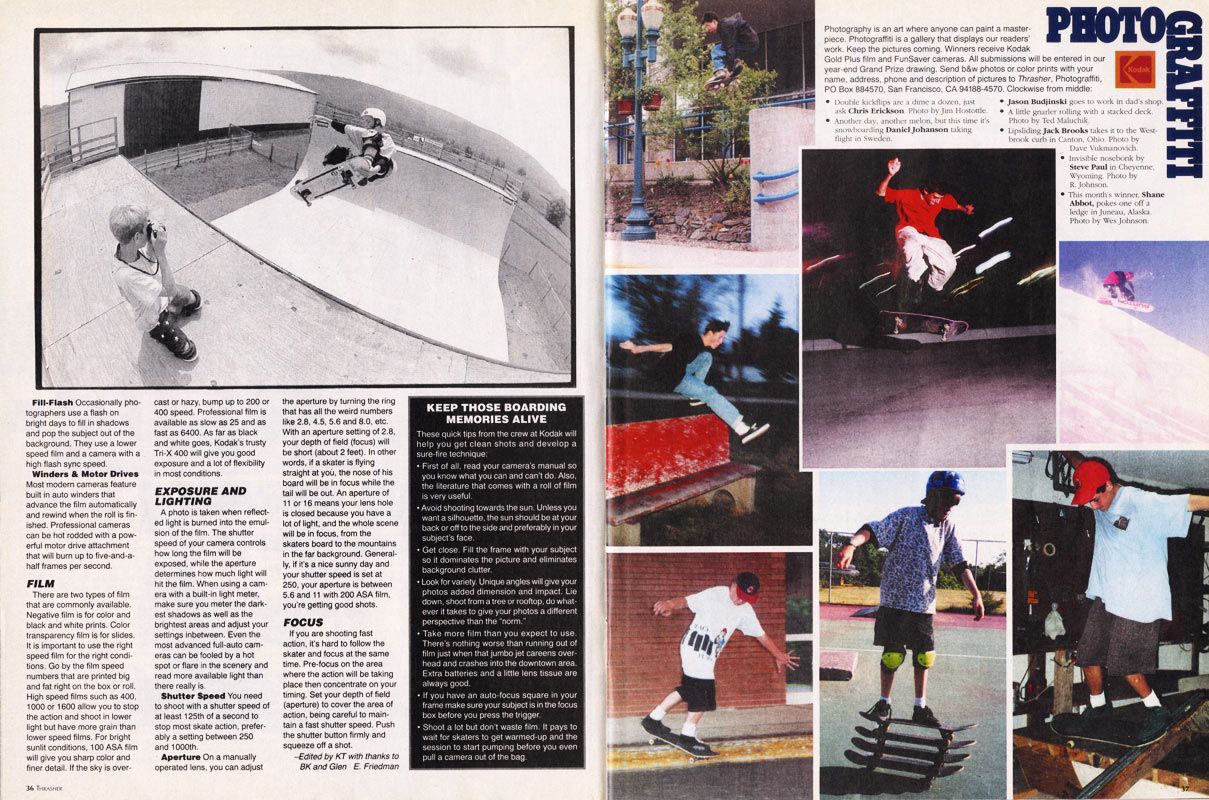
Photography is an art where anyone can paint a master-
piece. Photograffiti is a gallery that displays our readers
work. Keep the pictures coming. Winners receive Kodak
Gold Plus film and FunSaver cameras. All submissions will be entered in our
year-end Grand Prize drawing. Send b&w photos or color prints with your
name, address, phone and description of pictures to Thrasher, Photograffiti,
PO Box 884570, San Francisco, CA 94188-4570. Clockwise from middle:
Double kickflips are a dime a dozen, just
ask Chris Erickson. Photo by Jim Hostotle
Another day, another melon, but this time it's
snowboarding Daniel Johanson taking
flight in Sweden.
Kodak
⚫ Jason Budjinski goes to work in dad's shop.
A little gnarler rolling with a stacked deck.
Photo by Ted Maluchik
Lipsliding Jack Brooks takes it to the West-
brook curb in Canton, Ohio. Photo by
Dave Vukmanovich
Invisible nosebonk by
Steve Paul in Cheyenne,
Wyoming. Photo by
R. Johnson
This month's winner, Shane
Abbot, pokes one off a
ledge in Juneau, Alaska.
Photo by Wes Johnson
GRAFFITI
Fill-Flash Occasionally pho-
tographers use a flash on
bright days to fill in shadows.
and pop the subject out of the
background. They use a lower
speed film and a camera with a
high flash sync speed.
Winders & Motor Drives
Most modern cameras feature
built in auto winders that
advance the film automatically
and rewind when the roll is fin-
ished. Professional cameras
can be hot rodded with a pow
erful motor drive attachment
that will burn up to five-and-a-
half frames per second.
FILM
There are two types of film
that are commonly available.
Negative film is for color and
black and white prints. Color
transparency film is for slides.
It is important to use the right
speed film for the right condi
tions. Go by the film speed
numbers that are printed big
and fat right on the box or roll.
High speed films such as 400.
1000 or 1600 allow you to stop
the action and shoot in lower
light but have more grain than
lower speed films. For bright
sunlit conditions, 100 ASA fim
will give you sharp color and
finer detail. If the sky is over-
36 THRASHER
cast or hazy, bump up to 200 or
400 speed. Professional film is
available as slow as 25 and as
fast as 6400. As far as black
and white goes, Kodak's trusty
Tri-X 400 will give you good
exposure and a lot of flexibility
in most conditions.
EXPOSURE AND
LIGHTING
A photo is taken when reflect-
ed light is burned into the emul-
sion of the film. The shutter
speed of your camera controls
how long the film will be
exposed, while the aperture
determines how much light will
hit the film. When using a cam-
era with a built-in light meter,
make sure you meter the dark-
est shadows as well as the
brightest areas and adjust your
settings inbetween. Even the
most advanced full-auto cam-
eras can be fooled by a hot
spot or flare in the scenery and
read more available light than
there really is.
Shutter Speed You need
to shoot with a shutter speed of
at least 125th of a second to
stop most skate action, prefer-
ably a setting between 250
and 1000th.
Aperture On a manually
operated lens, you can adjust
the aperture by turning the ring
that has all the weird numbers
like 2.8, 4.5, 5.6 and 8.0, etc.
With an aperture setting of 2.8,
your depth of field (focus) will
be short (about 2 feet). In other
words, if a skater is flying
straight at you, the nose of his
board will be in focus while the
tail will be out. An aperture of
11 or 16 means your lens hole
is closed because you have a
lot of light, and the whole scene
will be in focus, from the
skaters board to the mountains
in the far background. General-
ly, if it's a nice sunny day and
your shutter speed is set at
250, your aperture is between
5.6 and 11 with 200 ASA film,
you're getting good shots.
FOCUS
If you are shooting fast
action, it's hard to follow the
skater and focus at the same
time. Pre-focus on the area
where the action will be taking
place then concentrate on your
timing. Set your depth of field
(aperture) to cover the area of
action, being careful to main-
tain a fast shutter speed. Push
the shutter button firmly and
squeeze off a shot.
-Edited by KT with thanks to
BK and Glen E. Friedman
KEEP THOSE BOARDING
MEMORIES ALIVE
These quick tips from the crew at Kodak will
help you get clean shots and develop a
sure-fire technique:
First of all, read your camera's manual so
you know what you can and can't do. Also,
the literature that comes with a roll of film
is very useful.
• Avoid shooting towards the sun. Unless you
want a silhouette, the sun should be at your
back or off to the side and preferably in your
subject's face.
Get close. Fill the frame with your subject
so it dominates the picture and eliminates
background clutter.
•Look for variety. Unique angles will give your
photos added dimension and impact. Lie
down, shoot from a tree or rooftop, do what-
ever it takes to give your photos a different
perspective than the "norm."
Take more film than you expect to use.
There's nothing worse than running out of
film just when that jumbo jet careens over-
head and crashes into the downtown area.
Extra batteries and a little lens tissue are
always good.
If you have an auto-focus square in your
frame make sure your subject is in the focus
box before you press the trigger.
•Shoot a lot but don't waste film. It pays to
wait for skaters to get warmed-up and the
session to start pumping before you even
pull a camera out of the bag.
O