Page Text
            ride it. Mike Conroy, Neal Hendrix and
Buster Halterman all applaud it with a
passion. "The ramp is perfect," Con-
roy says, "probably because Tim
Payne built it." The Eastern Vert half-
pipe has 9 1/2 transitions, 1 1/2' ver-
tical, and is 32' wide with extensions.
It features the ever-popular metal cop-
ing lip surface and according to Hen-
drix, "always has a good surface,
super smooth transitions, vert that
won't fall back and a nice boink on
top. Killer sessions, too."
Yet another popular Masonite/ply-
wood/2x4 construction is the Vision
ramp, with its 10' trannies, 1 1/2' of
vert, corners and hip. Both Bod Boyle
and Mark Cernicky endorse it whole-
heartedly. "It has nice, wide facewalls
with a bowled out end and hip," says
Boyle, "It's not just back and forth,
because of the corners and hip. You
can really move around."
Cernicky agrees; "It's really fun to go.
whippin' through the corners."
On the other truck, Mike
Youssefpour, Mike Frazier and Lance
Conklin all hail the Jonesville ramp in
Gainesville, Florida, designed by Roller
Dave, as their favorite construction
over the past year or so. Frazier out-
lines the pertinent details: "It has 11"
3" trannys with 1 1/2' vert and it's 32'
wide. The ramp has a small part 8
wide that's 9 1/2', then the rest is 12
1/2', then there's an extension in the
corner that is 1 1/2" higher than the
12 1/2' section. And it's all steel!"
Lest we forget Christian Hosoi's fine
backyard construction, Eddie Elguera
reminds us that it's 32" wide, with 9
1/2 transition and 1 1/2' vert, not to
mention that "the coping and the vert
are perfect for lip tricks and airs."
Bucky Lasek considers the Cheap-
skates ramp the most praiseworthy,
rideable surface he knows. Not only
does it have big transitions for smooth
landings, he says, "it's only two and a
half hours from my house."
Deep in the heart of Texas, Jeff
Phillip's big ramp is favored by both
Lori Rigsby and Mike Crum. Said
ramp's transitions are 9 1/2" with a
foot of vert and it's 40' wide with
escalators. "It's a good-sized ramp for
learning tricks on," says Rigsby. "It's
nice and smooth too." Crum concurs,
"It's good with good coping, it's fun
to go fast on."
I DON'T JUST SKATE A RAMP
I MAKE LOVE TO A RAMP
Everyone has an idea of a perfect
mate and most skaters have an idea
of the perfect ramp, one that's warm,
kind and luxurious, with all the curves
in the right places. For Mark Cernicky.
the ideal ramp would be 800' long
54 THRASHER MAGAZINE
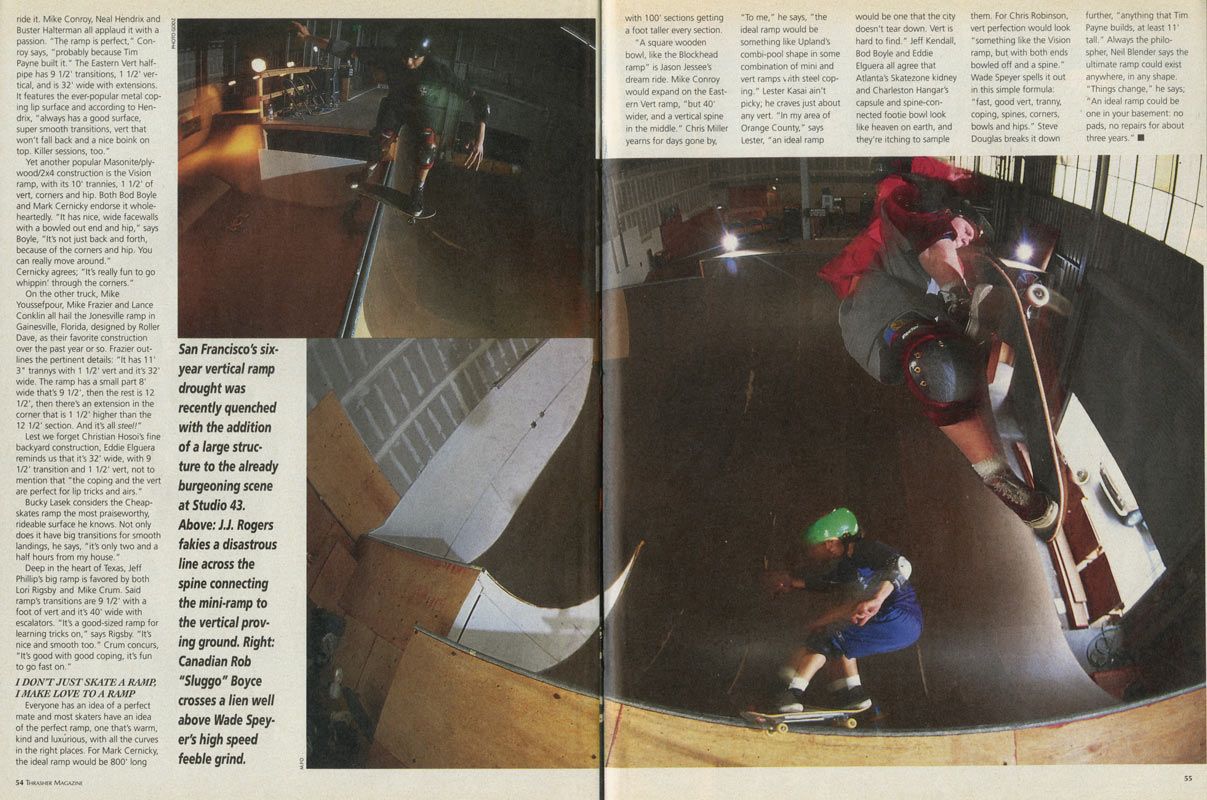
San Francisco's six-
year vertical ramp
drought was
recently quenched
with the addition
of a large struc-
ture to the already
burgeoning scene
at Studio 43.
Above: J.J. Rogers
fakies a disastrous
line across the
spine connecting
the mini-ramp to
the vertical prov-
ing ground. Right:
Canadian Rob
"Sluggo" Boyce
crosses a lien well
above Wade Spey-
er's high speed
feeble grind.
with 100' sections getting
a foot taller every section.
"A square wooden
bowl, like the Blockhead
ramp" is Jason Jessee's
dream ride. Mike Conroy
would expand on the East-
ern Vert ramp, "but 40"
wider, and a vertical spine
in the middle." Chris Miller
yearns for days gone by.
"To me," he says, "the
ideal ramp would be
something like Upland's
combi-pool shape in some
combination of mini and
vert ramps with steel cop-
ing." Lester Kasai ain't
picky; he craves just about
any vert. "In my area of
Orange County," says
Lester, "an ideal ramp
would be one that the city
doesn't tear down. Vert is
hard to find." Jeff Kendall,
Bod Boyle and Eddie
Elguera all agree that
Atlanta's Skatezone kidney
and Charleston Hangar's
capsule and spine-con-
nected footie bowl look
like heaven on earth, and
they're itching to sample
them. For Chris Robinson,
vert perfection would look
"something like the Vision
ramp, but with both ends
bowled off and a spine."
Wade Speyer spells it out
in this simple formula:
"fast, good vert, tranny,
coping, spines, corners,
bowls and hips." Steve
Douglas breaks it down
further, "anything that Tim
Payne builds, at least 11
tall. Always the philo-
spher, Neil Blender says the
ultimate ramp could exist
anywhere, in any shape.
"Things change," he says;
"An ideal ramp could be
one in your basement: no
pads, no repairs for about
three years." I