Page Text
            indoor facility near Vancouver, BC in Canada.
Kevin got his start in October 1986. The World
Expo contest left him with a good ramp, so
he found a warehouse and put it indoors. He
has since moved to a new location in subur-
ban Richmond. With design help from ramp
vet Lance Mountain, Kev's Skate Ranch
features 8,000 square feet of rideable surface
with wall height varying from four to ten feet,
all joined together in a maze of hips and
spines, even a half bowl. At press time the
Harris family was getting ready to start a new
park in nearby Langley.
Many similar facilities have sprung up.
throughout the land using a similar strategy
of building with wood and keeping in stride
with what's popular to skate: i.e. mini-ramps,
street areas, etc. Many are indoors for
weather reasons. A lot of today's parks are
the extension of an already established
skateboard shop such as Melvin Milton's
Skatetime in Dallas or Bill Danforth's Pro
Shop's in Dayton Ohio. Also noticeably dif
ferent about parks of today are the locations
where you find them. Some are at the YM-
CA such as Redding, CA. Some are out in
the boonies like Thrasherland and Tower in
Phoenix, AZ and Splash in Webster Grove,
MO. Swinney Skatepark in Fort Wayne,
Indiana lies in a city park. On the legal front,
this country is still as screwed up as ever.
Most skaters find it rather ironic that while
liability hassles are slowly being ironed out
and many communities are considering
public (free!) facilities, some communities
have leftover cement from the seventies that
doesn't seem to pose any problems. Derby
Park in Santa Cruz, The Dish in S.F. and Bro
Bowl in Tampa, Fl. are good examples of the
double standard. Meanwhile countries like
Australia and Germany continue to build and
pour bitchin' bowls.
WHAT MAKES THIS "PARK ERA"
DIFFERENT THAN THAT OF THE 70's?
Obviously the biggest difference between
then and now is the practicality and eco-
nomic benefits of building with wood versus
cement. But there are other factors, including
common sense and an understanding of
skating-concepts few park developers in
the seventies had a grasp on. As Kevin says,
"Most park owners and mangers are skaters
themselves or have been involved for many
years so they are more behind it." Like Kevin,
some park owners are still active pro riders
who are aware that skaters require a cons-
tant influx of new terrain. Mike McGill's parks -
are sensitive to changing skater needs.
"Being able to change the ramps around
means the kids progress faster. Also, the
safety equipment is better than when I
started." says Mike. Down at Jeff Phillips A TALE OF TWO SKATEPARKS
Indoor in Dallas, you've got an ultra-modern
wooden facility that includes a bowl, street,
mini and pro ramp facilities so you wouldn't
expect any changes for a while, but if we
know Jeff, he may decide to throw up a full-
pipe one day.
HAVE PARENTS BEEN SUPPORTIVE?
Most park owners agree that skateboard
ing has evolved into more of a sport now and
parents are getting more involved at the park
and contest level. Some moms and dads are
supporting their kids' fight for public facilities
all the way to City Hall and that's where a
lot of power for changing attitudes lies. Still,
when it comes right down to the atmosphere
at the park itself, you'll find, as Rich Misterka,
manager of Underground in Huntsville,
Alabama, says, "The parents don't hang
around that much-after all it's a skatepark,
not a church. Another point of enthusiasm
brought up by Jim Miracle at The Edge in
Largo, Florida is that the parents "at least
know where their kids are." Kevin Harris
agrees, "Even if the parents don't support
skating, they love the babysitting service."
HOW MUCH DOES IT COST?
Running a park is not without it's problems
and is definitely not a sure thing when it
comes to investment dollars. In fact, most
park owners and managers agree that the
most valuable thing you must put into a park
is time. If you're thinking of opening a
modern skatepark in the nineties, time, in-
surance, rent or lease of space, etc. are all
on top of the list of worries and priorities.
Building ramps and street obstacles is the
fun part and on a cost-per-skater basis, one
of you lowest overhead expenses. Kevin
Harris said his biggest bill (Continued on pages)
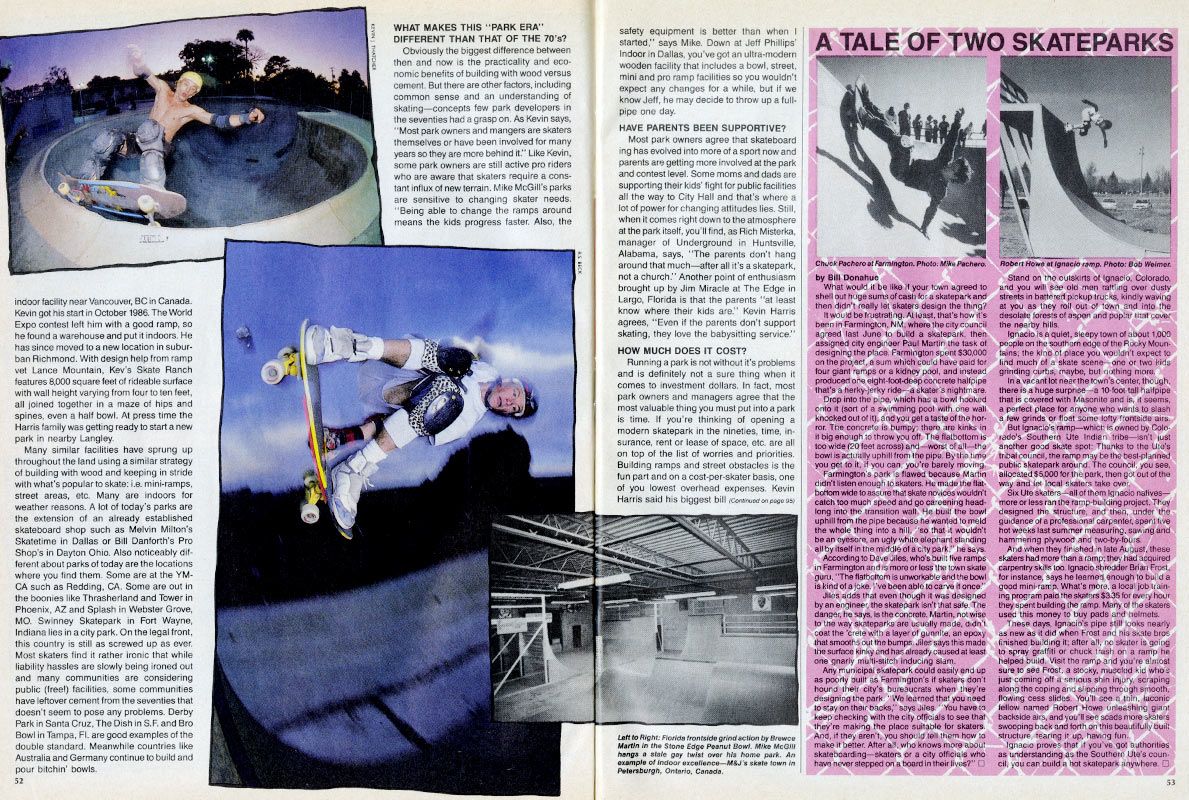
Left to Right: Floride frontside grind action by Brewce
Martin in the Stone Edge Peanut Bowl. Mike McGill
hangs a stale gay twist over his home park. An
example of indoor excellence-M&J's skate town in
Petersburgh, Ontario, Canada.
Chuck Pachero at Farmington. Photo: Mike Pachero.
by Bill Donahue
What would it be like if your town agreed to
shell out huge sums of cash for a skatepark and
then didn't really let skaters design the thing?
It would be frustrating. Al least, that's how it's
been in Farmington, NM, where the city council
agreed last June to build a skatepark, then
assigned city engineer Paul Martin the task of
designing the place. Farmington spent $30,000
on the project, a sum which could have paid for
four giant ramps or a kidney pool, and instead,
produced one eight-foot-deep concrete halfpipe
that's a herky-jerky ride a skater's nightmare.
Drop into the pipe, which has a bowl hooked
onto it (sort of a swimming pool with one wall.
knocked out of it), and you get a taste of the hor-
ror. The concrete is bumpy, there are kinks in
it big enough to throw you off. The flatbottom is
too wide (20 feet across) and worst of all the
bowl is actually uphill from the pipe. By the time
you get to it, if you can you're barely moving
Farmington's park is flawed because Martin
didn't listen enough to skaters. He made the flat-
bottom wide to assure that skate novices wouldn't
catch too much speed and go careening head-
long into the transition wall. He built the bowl
uphill from the pipe because he wanted to meld
the whole thing into a hill. so that it wouldn't
be an eyesore, an ugly white elephant standing
all by itself in the middle of a city park." he says.
According to Dave Giles, who's built five ramps
in Farmington and is more or less the town skate
guru. "The flatbottom is unworkable and the bowl
is kind of a joke. I've been able to carve it once"
Jiles adds that even though it was designed
by an engineer the skatepark isn't that safe. The
danger, he says, is the concrete. Martin, not wise
to the way skateparks are usually made, didn't
coat the 'crete with a layer of gunnite, an epoxy
that smooths out the bumps Jiles says this made
the surface kinky and has already caused at least
one gnarly multi-stitch inducing slam.
Any municipal skatepark could easily end up
as poorly built as Farmington's if skaters don't
hound their city's bureaucrats when they're
designing the park "We learned that you need
to stay on their backs," says Jiles. You have co
keep checking with the city officials to see that
they're making the place suitable for skaters
And, if they aren't, you should tell them how to
make it better. After a, who knows more about
skateboarding-skaters or a city officials who
have never stepped on a board in their lives?"
Robert Howe at Ignacio ramp. Photo: Bob Weimer.
Stand on the outskirts of Ignacio, Colorado.
and you will see old men rattling over dusty
streets in battered pickup trucks, kindly waving
at you as they roll out of town and into the
desolate forests of aspen and poplar tat cover
the nearby hills.
Ignacio is a quiet, sleepy town of about 1,000
people on the southern edge of the Rocky Moun
tains; the kind of place you wouldn't expect to
lind much of a skate scene one or two kids
grinding curbs, maybe, but nothing more.
In a vacant lot near the town's center, though,
there is a huge surprise a 10-foot tall halfpipe
that is covered with Masonite and is, it seems,
a perfect place for anyone who wants to slash
a few grinds or float some lofty frontside airs.
But Ignacio's ramp-which is owned by Colo-
rado's Southern Ute Indian tribe isn't just
another good skate spot: Thanks to the Ute's
tribal council, the ramp may be the best-planned
public skatepark around. The council, you see,
allocated $5,000 for the park, then got out of the
way and let local skaters take over
Six Ute skaters-all of them Ignacio natives-
more or less ran the ramp-building project. Thay
designed the structure, and then, under the
guidance of a professional carpenter, spent five
hot weeks last summer measuring, sawing and
hammering plywood and two-by-fours
And when they finished in late August, these
skaters had more than a ramp; they had acquired
carpentry skills too. Ignacio shredder Brian Frost,
for instance, says he leames enough to build a
good mini-ramp. What's more, a local job train-
ing program paid the skaters $3.35 for every hour
they spent building the ramp. Many of the skaters
used this money to buy pads and helmets.
These days, Ignacio's pipe still looks nearly
as new as it did when Frost and his skate bros
finished building it; after all, no skater is going
to spray graffiti or chuck trash on a ramp he
helped build. Visit the ramp and you're almost
sure to see Frost, a stocky, muscled kid whos
just coming off a serious shin injury, scraping
along the coping and slipping through smooth,
flowing cess slides. You'll see a thin, laconic
fellow named Robert Howe unleashing giant
backside airs, and you'll see scads more skaters
swooping back and forth on this beautifully built
structure, tearing it up, having fun.
Ignacio proves that if you've got authorities
as understanding as the Southern Ute's coun
cil, you can build a hot skatepark anywhere.
53