Page Text
            to find out what kind of skate facilities they offer and how the response manager or contractor would say, "Hey, now what if we add a thirty
from their four wheeled-clients has been.
A LITTLE HISTORY LESSON
The sour taste left in the mouths of many a veteran boarder by
the park boom of the late seventies is due to the poor quality of most
parks that were built at that time. Skateparks were seen as a good
investment, a quick money-making scheme. All you had to do was
get a plot of land, dump cement all over it, let it set, build a pro shop
or just use an old trailer, add some pinball machines and video
games, and the skaters would flock. At least they did for a while.
Something went wrong though. A kink developed in the transi-
tion of skatepark evolution. The original idea of perfect skatopia's
and rollermania's was lost in the shuffle. The money men and lan-
downers wanted more say in the design and skater ideas were swept
under the carpet. Or the skater laid down a basic idea, a simple
design like a keyhole pool, and as soon as he left the owner or
50
foot wall over here and a jump over there and a whoopty-doo over
here, now wouldn't that make it better?" Sometimes even the skater
hired to design a park took the money and ran.
A big feature at most parks was a large mountain of cement with
snakeruns flowing off it into harshly banked bowls or reservoirs. Most
snakeruns of the day were small with no flatbottom at all, so you
slammed into the opposite wall if you went down. Or the bra cup
design that was made famous at Oxnard's Endless Wave: two bowls,
side by side, that were so small they'd fit inside most backyard pools.
Most parks were either vast glacier fields of useless cement or tight,
skinny little snake runs and U-pipes.
During the eighties, park development was virtually at a stand-
still. In fact, the destruction of many good parks didn't take place
until long after interest in skateboarding had come back on the rise.
Street skating revitalized the thrill of cruising, freestyling, exploring
and just hanging out. It was fun and free. Pools and drainage ditches
didn't exactly become extinct either. Did the plowing under of the
cement at Upland and Del Mar pass unnoticed? Not quite. There
are many skaters who will lament long hours about the drag down.
sessions at those spots and the ones that went down to the the blade
before them. Many of the top pro's honed their skills at parks that
the new ramp rippers will only dream about.
It was inevitable that as soon as there were virtually no parks left
standing, the craving for new terrain would start over. One of the
first of the modern parks was, ironically, opened on the same pro-
perty that started it all. Mike McGill managed a lease on the proper-
ty that housed the old Carlsbad Bowls and added a state of the art
vert ramp and a slew of minis. Portions of the old bowls are even
still rideable. Mike and his Mom also run an indoor facility near Tampa
that features several minis and an intermediate sized near-vert ramp.
PARKS OF TODAY
The forerunner of the modern day skateparks is Kevin Harris'
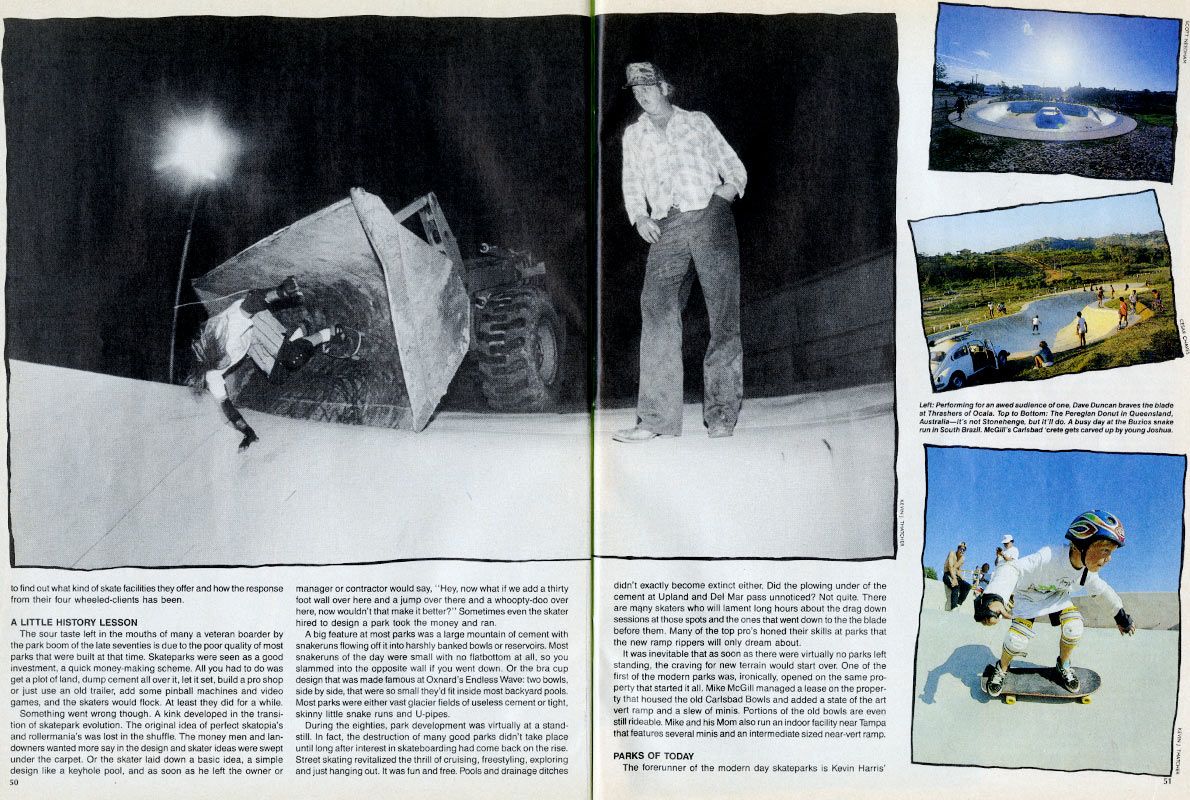
Left: Performing for an awed audience of one, Dave Duncan braves the blade
at Thrashers of Ocala. Top to Bottom: The Pereglan Donut in Queensland,
Australia-it's not Stonehenge, but it'll do. A busy day at the Buzios snake
run in South Brazil. McGill's Carlsbad 'crete gets carved up by young Joshua.
51