Page Text
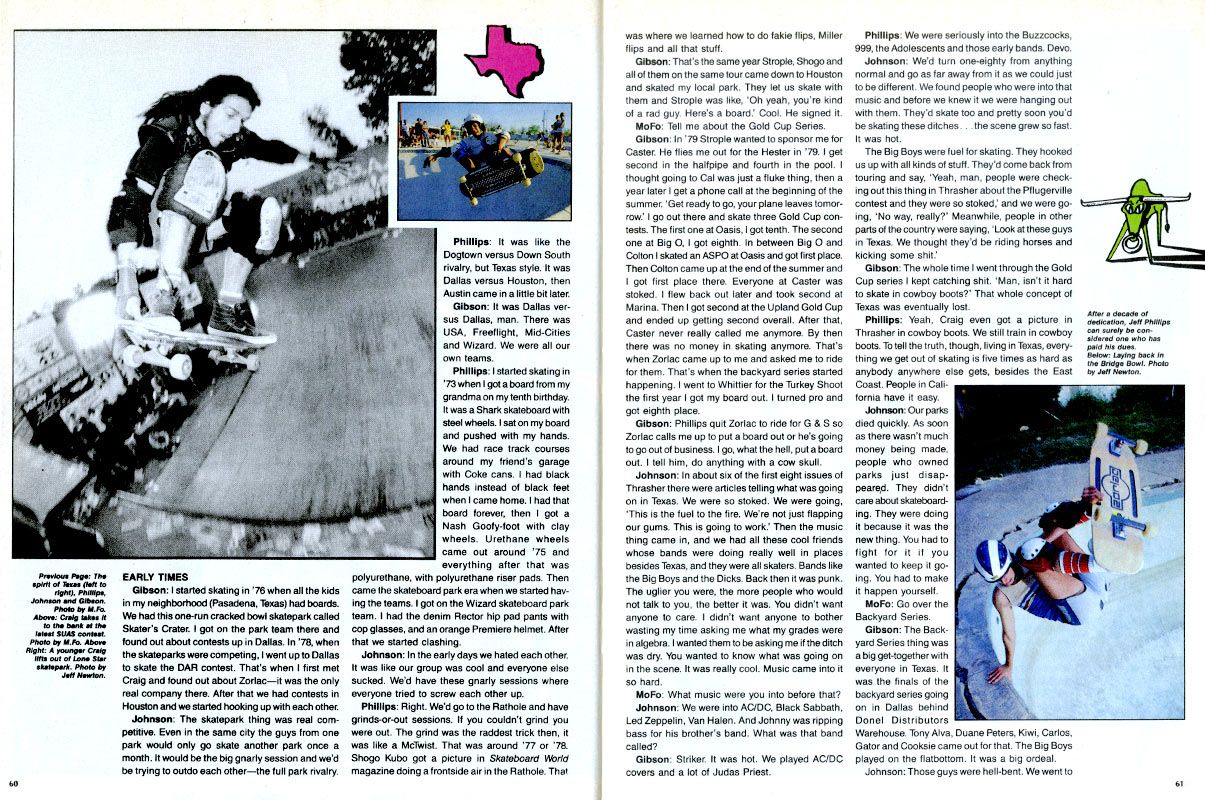
            Previous Page: The
spirit of Texas (left to
right), Philips,
Johnson and Gibeon.
Photo by M.Fo
Above: Craig takes
to the bank at the
latest SUAS contest.
Photo by M.Fo. Above
Right: A younger Craig
lifts out of Lone Star
skatepark. Photo by
Jeff Newton.
EARLY TIMES
Gibson: I started skating in '76 when all the kids
in my neighborhood (Pasadena, Texas) had boards.
We had this one-run cracked bowl skatepark called
Skater's Crater. I got on the park team there and
found out about contests up in Dallas. In '78, when
the skateparks were competing, I went up to Dallas
to skate the DAR contest. That's when I first met
Craig and found out about Zorlac-it was the only
real company there. After that we had contests in
Houston and we started hooking up with each other.
Johnson: The skatepark thing was real com-
petitive. Even in the same city the guys from one
park would only go skate another park once a
month. It would be the big gnarly session and we'd
be trying to outdo each other-the full park rivalry.
Phillips: It was like the
Dogtown versus Down South
rivalry, but Texas style. It was
Dallas versus Houston, then
Austin came in a little bit later.
Gibson: It was Dallas ver-
sus Dallas, man. There was
USA, Freeflight, Mid-Cities
and Wizard. We were all our
own teams.
Phillips: I started skating in
'73 when I got a board from my
grandma on my tenth birthday.
It was a Shark skateboard with
steel wheels. I sat on my board
and pushed with my hands.
We had race track courses
around my friend's garage
with Coke cans. I had black
hands instead of black feet
when I came home. I had that
board forever, then I got a
Nash Goofy-foot with clay
wheels. Urethane wheels
came out around '75 and
everything after that was
polyurethane, with polyurethane riser pads. Then
came the skateboard park era when we started hav-
ing the teams. I got on the Wizard skateboard park
team. I had the denim Rector hip pad pants with
cop glasses, and an orange Premiere helmet. After
that we started clashing.
Johnson: In the early days we hated each other.
It was like our group was cool and everyone else
sucked. We'd have these gnarly sessions where
everyone tried to screw each other up.
Phillips: Right. We'd go to the Rathole and have
grinds-or-out sessions. If you couldn't grind you
were out. The grind was the raddest trick then, it
was like a McTwist. That was around '77 or '78.
Shogo Kubo got a picture in Skateboard World
magazine doing a frontside air in the Rathole. That
was where we learned how to do fakie flips, Miller
flips and all that stuff..
Gibson: That's the same year Strople, Shogo and
all of them on the same tour came down to Houston
and skated my local park. They let us skate with
them and Strople was like, 'Oh yeah, you're kind
of a rad guy. Here's a board. Cool. He signed it.
MoFo: Tell me about the Gold Cup Series.
Gibson: In '79 Strople wanted to sponsor me for
Caster. He flies me out for the Hester in '79. I get
second in the halfpipe and fourth in the pool. I
thought going to Cal was just a fluke thing, then a
year later I get a phone call at the beginning of the
summer. 'Get ready to go, your plane leaves tomor-
row.' I go out there and skate three Gold Cup con-
tests. The first one at Oasis, I got tenth. The second
one at Big O, I got eighth. In between Big O and
Colton I skated an ASPO at Oasis and got first place.
Then Colton came up at the end of the summer and
I got first place there. Everyone at Caster was
stoked. I flew back out later and took second at
Marina. Then I got second at the Upland Gold Cup
and ended up getting second overall. After that,
Caster never really called me anymore. By then
there was no money in skating anymore. That's
when Zorlac came up to me and asked me to ride
for them. That's when the backyard series started
happening. I went to Whittier for the Turkey Shoot
the first year I got my board out. I turned pro and
got eighth place.
Gibson: Phillips quit Zorlac to ride for G & S so
Zorlac calls me up to put a board out or he's going
to go out of business. I go, what the hell, put a board
out. I tell him, do anything with a cow skull.
Johnson: In about six of the first eight issues of
Thrasher there were articles telling what was going
on in Texas. We were so stoked. We were going,
'This is the fuel to the fire. We're not just flapping
our gums. This is going to work.' Then the music.
thing came in, and we had all these cool friends
whose bands were doing really well in places
besides Texas, and they were all skaters. Bands like
the Big Boys and the Dicks. Back then it was punk.
The uglier you were, the more people who would
not talk to you, the better it was. You didn't want
anyone to care. I didn't want anyone to bother
wasting my time asking me what my grades were
in algebra. I wanted them to be asking me if the ditch
was dry. You wanted to know what was going on
in the scene. It was really cool. Music came into it
so hard.
Phillips: We were seriously into the Buzzcocks,
999, the Adolescents and those early bands. Devo.
Johnson: We'd turn one-eighty from anything
normal and go as far away from it as we could just
to be different. We found people who were into that
music and before we knew it we were hanging out
with them. They'd skate too and pretty soon you'd
be skating these ditches...the scene grew so fast.
It was hot.
The Big Boys were fuel for skating. They hooked
us up with all kinds of stuff. They'd come back from
touring and say, 'Yeah, man, people were check-
ing out this thing in Thrasher about the Pflugerville
contest and they were so stoked, and we were go-
ing. 'No way, really?" Meanwhile, people in other
parts of the country were saying, "Look at these guys
in Texas. We thought they'd be riding horses and
kicking some shit."
Gibson: The whole time I went through the Gold
Cup series I kept catching shit. 'Man, isn't it hard
to skate in cowboy boots?" That whole concept of
Texas was eventually lost.
Phillips: Yeah, Craig even got a picture in
Thrasher in cowboy boots. We still train in cowboy
boots. To tell the truth, though, living in Texas, every-
thing we get out of skating is five times as hard as
anybody anywhere else gets, besides the East
Coast. People in Cali-
fornia have it easy.
Johnson: Our parks
died quickly. As soon
as there wasn't much
money being made.
people who owned
parks just disap-
peared. They didn't
care about skateboard-
ing. They were doing
it because it was the
new thing. You had to
fight for it if you
wanted to keep it go-
ing. You had to make
it happen yourself.
MoFo: Go over the
Backyard Series.
Gibson: The Back-
yard Series thing was
a big get-together with
everyone in Texas. It
was the finals of the
backyard series going
on in Dallas behind
Donel Distributors
Warehouse. Tony Alva, Duane Peters, Kiwi, Carlos,
Gator and Cooksie came out for that. The Big Boys
Gibson: Striker. It was hot. We played AC/DC played on the flatbottom. It was a big ordeal.
covers and a lot of Judas Priest.
MoFo: What music were you into before that?
Johnson: We were into AC/DC, Black Sabbath,
Led Zeppelin, Van Halen. And Johnny was ripping
bass for his brother's band. What was that band
called?
After a decade of
dedication, Jeff Phillips
can surely be con-
sidered one who has
paid his dues.
Below: Laying back in
the Bridge Bowl. Photo
by Jeff Newton.
Johnson: Those guys were hell-bent. We went to
61