Page Text
            THE HANGMEN
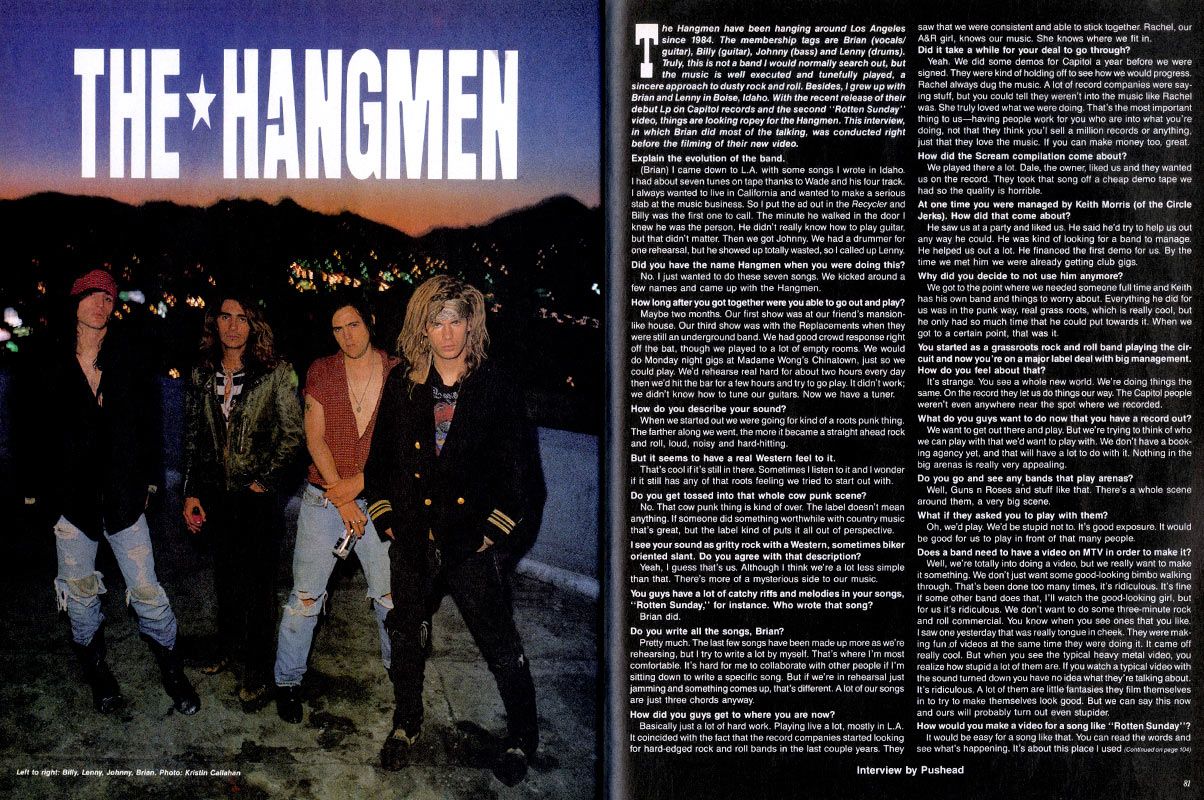
Left to right: Billy, Lenny, Johnny, Brian. Photo: Kristin Callahan
T
he Hangmen have been hanging around Los Angeles
since 1984. The membership tags are Brian (vocals/
guitar), Billy (guitar), Johnny (bass) and Lenny (drums).
Truly, this is not a band I would normally search out, but
the music is well executed and tunefully played, a
sincere approach to dusty rock and roll. Besides, I grew up with
Brian and Lenny in Boise, Idaho. With the recent release of their
debut Lp on Capitol records and the second "Rotten Sunday"
video, things are looking ropey for the Hangmen. This interview,
in which Brian did most of the talking, was conducted right
before the filming of their new video.
Explain the evolution of the band.
(Brian) I came down to L.A. with some songs I wrote in Idaho.
I had about seven tunes on tape thanks to Wade and his four track.
I always wanted to live in California and wanted to make a serious
stab at the music business. So I put the ad out in the Recycler and
Billy was the first one to call. The minute he walked in the door |
knew he was the person, He didn't really know how to play guitar,
but that didn't matter. Then we got Johnny. We had a drummer for
one rehearsal, but he showed up totally wasted, so I called up Lenny.
Did you have the name Hangmen when you were doing this?
No. I just wanted to do these seven songs. We kicked around a
few names and came up with the Hangmen.
How long after you got together were you able to go out and play?
Maybe two months. Our first show was at our friend's mansion-
like house. Our third show was with the Replacements when they
were still an underground band. We had good crowd response right
off the bat, though we played to a lot of empty rooms. We would
do Monday night gigs at Madame Wong's Chinatown, just so we
could play. We'd rehearse real hard for about two hours every day
then we'd hit the bar for a few hours and try to go play. It didn't work;
we didn't know how to tune our guitars. Now we have a tuner.
How do you describe your sound?
When we started out we were going for kind of a roots punk thing.
The farther along we went, the more it became a straight ahead rock
and roll, loud, noisy and hard-hitting.
But it seems to have a real Western feel to it.
That's cool if it's still in there. Sometimes I listen to it and I wonder
if it still has any of that roots feeling we tried to start out with.
Do you get tossed into that whole cow punk scene?
No. That cow punk thing is kind of over. The label doesn't mean
anything. If someone did something worthwhile with country music
that's great, but the label kind of puts it all out of perspective.
I see your sound as gritty rock with a Western, sometimes biker
oriented slant. Do you agree with that description?
Yeah, I guess that's us. Although I think we're a lot less simple
than that. There's more of a mysterious side to our music.
You guys have a lot of catchy riffs and melodies in your songs,
"Rotten Sunday," for instance. Who wrote that song?
Brian did.
Do you write all the songs, Brian?
saw that we were consistent and able to stick together. Rachel, our
A&R girl, knows our music. She knows where we fit in.
Did it take a while for your deal to go through?
Yeah. We did some demos for Capitol a year before we were
signed. They were kind of holding off to see how we would progress.
Rachel always dug the music. A lot of record companies were say-
ing stuff, but you could tell they weren't into the music like Rachel
was. She truly loved what we were doing. That's the most important
thing to us-having people work for you who are into what you're
doing, not that they think you'l sell a million records or anything.
just that they love the music. If you can make money too, great.
How did the Scream compilation come about?
We played there a lot. Dale, the owner, liked us and they wanted
us on the record. They took that song off a cheap demo tape we
had so the quality is horrible.
At one time you were managed by Keith Morris (of the Circle
Jerks). How did that come about?
He saw us at a party and liked us. He said he'd try to help us out
any way he could. He was kind of looking for a band to manage.
He helped us out a lot. He financed the first demo for us. By the
time we met him we were already getting club gigs.
Why did you decide to not use him anymore?
We got to the point where we needed someone full time and Keith
has his own band and things to worry about. Everything he did for
us was in the punk way, real grass roots, which is really cool, but
he only had so much time that he could put towards it. When we
got to a certain point, that was it.
You started as a grassroots rock and roll band playing the cir-
cuit and now you're on a major label deal with big management.
How do you feel about that?
It's strange. You see a whole new world. We're doing things the
same. On the record they let us do things our way. The Capitol people
weren't even anywhere near the spot where we recorded.
What do you guys want to do now that you have a record out?
We want to get out there and play. But we're trying to think of who
we can play with that we'd want to play with. We don't have a book-
ing agency yet, and that will have a lot to do with it. Nothing in the
big arenas is really very appealing.
Do you go and see any bands that play arenas?
Well, Guns n Roses and stuff like that. There's a whole scene
around them, a very big scene.
What if they asked you to play with them?
Oh, we'd play. We'd be stupid not to. It's good exposure. It would
be good for us to play in front of that many people.
Does a band need to have a video on MTV in order to make it?
Well, we're totally into doing a video, but we really want to make
it something. We don't just want some good-looking bimbo walking
through. That's been done too many times, it's ridiculous. It's fine
if some other band does that, I'll watch the good-looking girl, but
for us it's ridiculous. We don't want to do some three-minute rock
and roll commercial. You know when you see ones that you like.
I saw one yesterday that was really tongue in cheek. They were mak-
ing fun of videos at the same time they were doing it. It came off
really cool. But when you see the typical heavy metal video, you
realize how stupid a lot of them are. If you watch a typical video with
the sound turned down you have no idea what they're talking about.
It's ridiculous. A lot of them are little fantasies they film themselves
in to try to make themselves look good. But we can say this now
and ours will probably turn out even stupider.
Basically just a lot of hard work. Playing live a lot, mostly in L.A. How would you make a video for a song like "Rotten Sunday"?
It coincided with the fact that the record companies started looking It would be easy for a song like that. You can read the words and
for hard-edged rock and roll bands in the last couple years. They see what's happening. It's about this place I used continued on page 104)
Interview by Pushead
Pretty much. The last few songs have been made up more as we're
rehearsing, but I try to write a lot by myself. That's where I'm most
comfortable. It's hard for me to collaborate with other people if I'm
sitting down to write a specific song. But if we're in rehearsal just
jamming and something comes up, that's different. A lot of our songs
are just three chords anyway.
How did you guys get to where you are now?
81