Page Text
            throwing
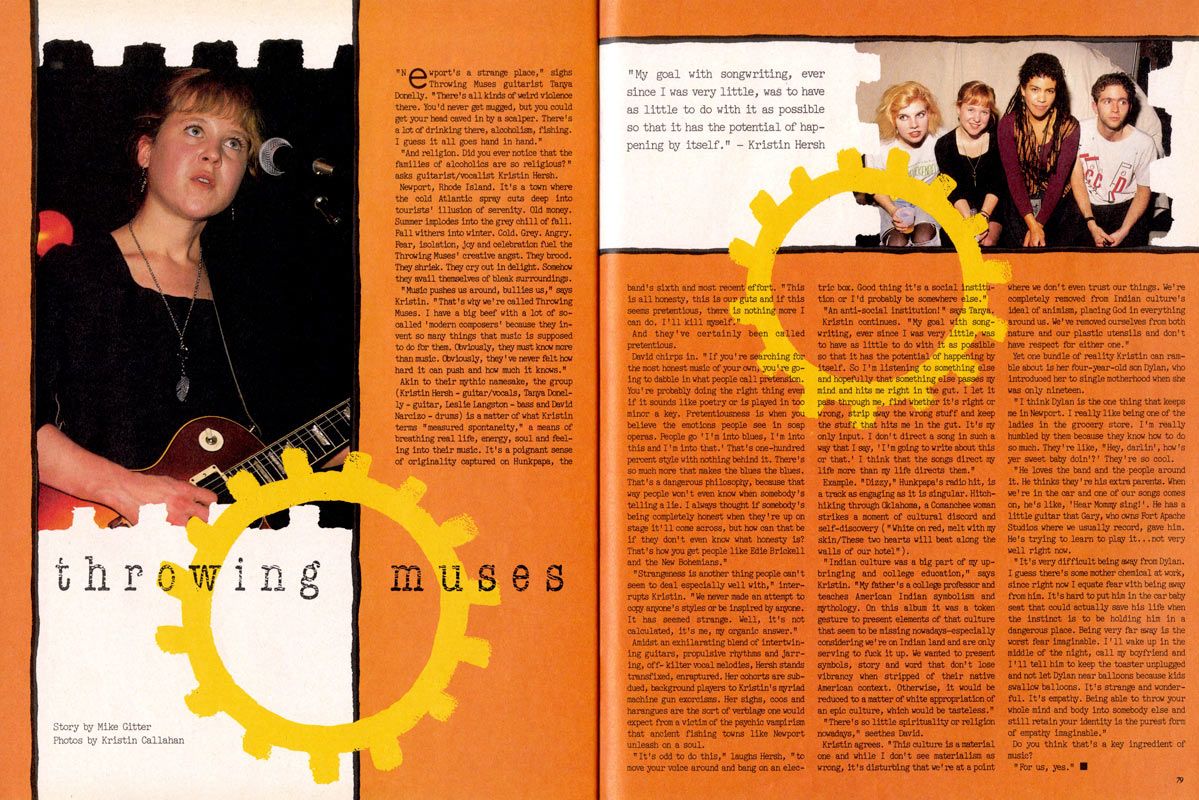
Story by Mike Gitter
Photos by Kristin Callahan
"Nero strange place," sighs
Throwing Muses guitarist Tanya
Donelly. "There's all kinds of weird violence
there. You'd never get mugged, but you could
get your head caved in by a scalper. There's
a lot of drinking there, alcoholism, fishing.
I guess it all goes hand in hand."
"And religion. Did you ever notice that the
families of alcoholics are so religious?"
asks guitarist/vocalist Kristin Hersh.
Newport, Rhode Island. It's a town where
the cold Atlantic spray cuts deep into
tourists' illusion of serenity. Old money.
Sunner implodes into the grey chill of fall.
Fall withers into winter. Cold. Grey. Angry.
Fear, isolation, Joy and celebration fuel the
Throwing Muses' creative angst. They brood.
They shriek. They cry out in delight. Somehow
they avail themselves of bleak surroundings.
"Music pushes us around, bullies us," says
Kristin. "That's why we're called Throwing
Muses. I have a big beef with a lot of so-
called 'modern composers' because they in-
vent so many things that music is supposed
to do for them. Obviously, they must know more
than music. Obviously, they've never felt how
hard it can push and how much it knows."
Akin to their mythic namesake, the group
(Kristin Hersh-guitar/vocals, Tarya Donel-
ly-guitar, Leslie Langston - bass and David
Narcizo- drums) is a matter of what Kristin
terms measured spontaneity," a means of
breathing real life, energy, soul and feel-
ing into their music. It's a poignant sense
of originality captured on Hunkpapa, the
muses
"My goal with songwriting, ever
since I was very little, was to have
as little to do with it as possible
so that it has the potential of hap-
pening by itself." - Kristin Hersh
band's sixth and most recent effort. "This
is all honesty, this is our guts and if this
seems pretentious, there is nothing more I
can do. I'll kill myself."
David chirps in. "If you're searching for
the most honest music of your own, you're go-
Ing to dabble in what people call pretension.
You're probably doing the right thing even
if it sounds like poetry or is played in too
minor a key. Pretentiousness is when you
believe the emotions people see in scap
operas. People go 'I'a into blues, I'm into
tric box. Good thing it's a social institu-
tion or I'd probably be somewhere else."
"An anti-social institution!" says Taryn.
Kristin continues. "My goal with song-
And they've certainly been called writing, ever since I was very little, was
pretentious.
to have as little to do with it as possible
so that it has the potential of happening by
itself. So I'm listening to something else
and hopefully that something else passes my
mind and hits me right in the gut. I let it
pass through ne, find whether it's right or
wrong, strip away the wrong stuff and keep
the stuff that hits me in the gut. It's my
only input. I don't direct a song in such a
way that I say, 'I'm going to write about this a
or that. I think that the songs direct my
life more than my life directs them."
Example. "Dizzy," Hunkpapa's radio hit, is
a track as engaging as it is singular. Hitch-
hiking through Oklahoma, a Comanchee woman
strikes a nonent of cultural discord and
self-discovery ("White on red, melt with my
skin/These two hearts will beat along the
walls of our hotel").
this and I'm into that.' That's one-hundred
percent style with nothing behind it. There's
so much more that makes the blues the blues.
That's a dangerous philosophy, because that
way people won't even know when somebody's
telling a lie. I always thought if somebody's
being completely honest when they're up on
stage it'11 come across, but how can that be
if they don't even know what honesty is?
That's how you get people like Edie Brickell
and the New Bobenians."
"Strangeness is another thing people can't
seem to deal especially well with," inter-
rupts Kristin. "We never made an attempt to
copy anyone's styles or be inspired by anyone.
It has seened strange. Well, it's not
calculated, it's me, my organic answer."
Amidst an exhilarating blend of intertwin-
ing guitars, propulsive rhythms and jarr-
ing, off-kilter vocal melodies, Hersh stands
transfixed, enraptured. Her cohorts are sub-
dued, background players to Kristin's myriad
machine gun exorcisms. Her sighs, coos and
harangues are the sort of vertilage one would
expect from a victim of the psychic vampirism
that ancient fishing towns like Newport
unleash on a soul.
"It's odd to do this," laughs Hersh, "to
move your voice around and bang on an elec-
"Indian culture was a big part of my up-
bringing and college education," says
Kristin. "My father's a college professor and
teaches American Indian symbolism and
mythology. On this album it was a token
gesture to present elements of that culture
that seen to be missing nowadays-especially
considering we're on Indian land and are only
serving to fuck it up. We wanted to present
symbols, story and word that don't lose
vibrancy when stripped of their native
Anerican context. Otherwise, it would be
reduced to a matter of white appropriation of
an epic culture, which would be tasteless."
"There's so little spirituality or religion
nowadays," seethes David.
Kristin agrees. This culture is a material
one and while I don't see materialism as
wrong, it's disturbing that we're at a point
where we don't even trust our things. We're
completely removed from Indian culture's
ideal of animism, placing God in everything
around us. We've removed ourselves from both
nature and our plastic utensils and don't
have respect for either one."
Yet one bundle of reality Kristin can ran-
ble about is her four-year-old son Dylan, who
introduced her to single motherhood when she
vas only nineteen.
"I think Dylan is the one thing that keeps
me in Newport. I really 11ke being one of the
ladies in the grocery store. I'm really
humbled by them because they know how to do
so much. They're like, "Hey, darlin', how's
yer sweet baby doln'?' They're so cool..
"He loves the band and the people around
it. He thinks they're his extra parents. When
we're in the car and one of our songs comes
on, he's like, 'Hear Mommy sing!'. He has a
little guitar that Gary, who owns Fort Apache
Studios where we usually record, gave hin.
He's trying to learn to play it...not very
well right now.
"It's very difficult being any from Dylan.
I guess there's some mother chemical at work,
since right now I equate fear with being ay
from him. It's hard to put him in the car baby
seat that could actually save his life when
the instinct is to be holding him in a
dangerous place. Being very far away is the
worst fear imaginable. I'11 wake up in the
middle of the night, call my boyfriend and
I'll tell him to keep the toaster unplugged
and not let Dylan near balloons because kids
swallow balloons. It's strange and wonder-
ful. It's empathy. Being able to throw your
whole mind and body into somebody else and
still retain your identity is the purest form
of empathy imaginable."
Do you think that's a key ingredient of
music?
*For us, yes."
79