Page Text
            RAMP EDGE
by Don Fisher
RAMPS WITH VERTEBRAE- THE EVOLUTION OF THE SPECIES
T
The mini spine ramp has opened the
doors of on-board progress faster
than any other ramp variation. In
fact, the skating seems to adapt as
quickly as the terrain changes.
The mini-ramp in itself is the found link be-
tween the big balls verticalists and the wiley
street urchins. Streetsters adapt quickly to
mini-ramps with the relief of having a transi-
tion instead of slamming walls and curbs all
the time. Vert men ride them for amusement
and to scale down their skating to develop
new tricks and rehabilitate from injuries.
The addition of a spine in your design adds
a new dimension to halfpipe skating. Board-
slides of every description are what a spine
is all about and tricks to revert and fakie are
a snap when you can go both ways.
Most ramp innovations start in the back-
yards, and the spine design is no exception.
However, the most celebrated application of
the backbone was the Schmitt-built structure
at the 1986 NSA Pro Finals in Anaheim.
Hellbow, built by Rob-O in Westminster, CA,
is a classic small backyard ramp with a spine,
decks, a hip and an extension. Variations on
the theme seem to be flourishing all over the
skate world-in parks and yards alike. Here
are some tips on designing and building.
Before you build, remember to plan out the
most effective use of space, creating the
largest skateable area possible with the
space available. If you already have a mini-
ramp and you plan to add onto it, the amount
of space at your disposal is probably limited.
A spine ramp is constructed just like a mini-
ramp-times two. This means twice the tem-
plates, twice the two-by-fours, twice the
masonite, twice the work and twice the cash.
Get my drift?
Save extra hours of agony by planning
ahead. Plot out what you're about to build.
Even loosely worked sketches on the back
of a shoe box are better than just plugging
in the Skillsaw and cutting away.
First off, you must decide how your cop-
ing is going to sit atop your spine. I prefer
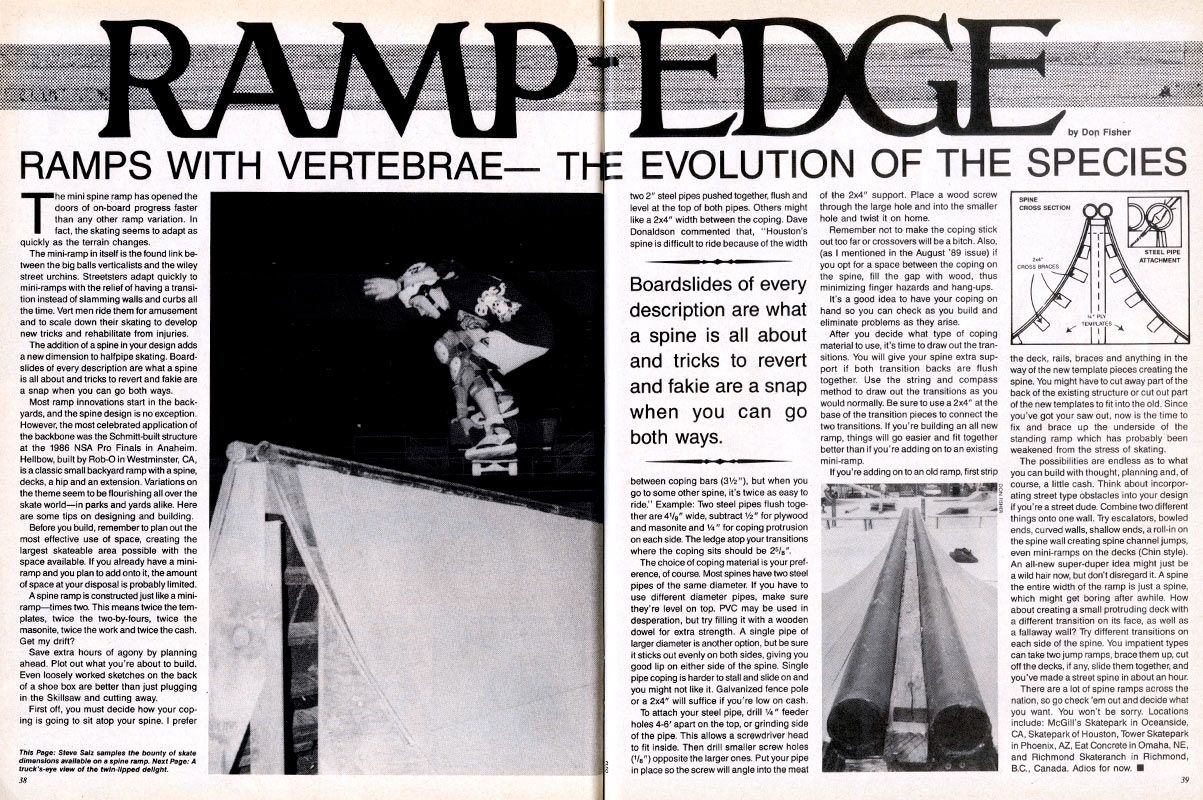
This Page: Steve Salz samples the bounty of skate
dimensions available on a spine ramp. Next Page: A
truck's-eye view of the twin-Nipped delight.
38
two 2" steel pipes pushed together, flush and
level at the top of both pipes. Others might
like a 2x4" width between the coping. Dave
Donaldson commented that, "Houston's
spine is difficult to ride because of the width
Boardslides of every
description are what
a spine is all about
and tricks to revert
and fakie are a snap
when you can go
both ways.
between coping bars (3½"), but when you
go to some other spine, it's twice as easy to
ride." Example: Two steel pipes flush toge-
ther are 4" wide, subtract 1/2" for plywood
and masonite and 14" for coping protrusion
on each side. The ledge atop your transitions
where the coping sits should be 2%".
The choice of coping material is your pref-
erence, of course. Most spines have two steel
pipes of the same diameter. If you have to
use different diameter pipes, make sure
they're level on top. PVC may be used in
desperation, but try filling it with a wooden
dowel for extra strength. A single pipe of
larger diameter is another option, but be sure
it sticks out evenly on both sides, giving you
good lip on either side of the spine. Single
pipe coping is harder to stall and slide on and
you might not like it. Galvanized fence pole
or a 2x4" will suffice if you're low on cash.
To attach your steel pipe, drill 14" feeder
holes 4-6' apart on the top, or grinding side
of the pipe. This allows a screwdriver head
to fit inside. Then drill smaller screw holes
("") opposite the larger ones. Put your pipe
in place so the screw will angle into the meat
of the 2x4" support. Place a wood screw
through the large hole and into the smaller
hole and twist it on home.
Remember not to make the coping stick
out too far or crossovers will be a bitch. Also,
(as I mentioned in the August '89 issue) if
you opt for a space between the coping on
the spine, fill the gap with wood, thus
minimizing finger hazards and hang-ups.
It's a good idea to have your coping on
hand so you can check as you build and
eliminate problems as they arise.
After you decide what type of coping
material to use, it's time to draw out the tran-
sitions. You will give your spine extra sup-
SPINE
CROSS SECTION
CROSS BRADES
TEMPLATES
IN
STEEL PIPE
ATTACHMENT
the deck, rails, braces and anything in the
port if both transition backs are flush way of the new template pieces creating the
together. Use the string and compass spine. You might have to cut away part of the
method to draw out the transitions as you back of the existing structure or cut out part
would normally. Be sure to use a 2x4" at the of the new templates to fit into the old. Since
base of the transition pieces to connect the
two transitions. If you're building an all new
ramp, things will go easier and fit together
better than if you're adding on to an existing
mini-ramp.
you've got your saw out, now is the time to
fix and brace up the underside of the
standing ramp which has probably been
weakened from the stress of skating.
The possibilities are endless as to what
If you're adding on to an old ramp, first strip you can build with thought, planning and, of
course, a little cash. Think about incorpor-
ating street type obstacles into your design
if you're a street dude. Combine two different
things onto one wall. Try escalators, bowled
ends, curved walls, shallow ends, a roll-in on
the spine wall creating spine channel jumps,
even mini-ramps on the decks (Chin style).
An all-new super-duper idea might just be
a wild hair now, but don't disregard it. A spine
the entire width of the ramp is just a spine,
which might get boring after awhile. How
about creating a small protruding deck with
a different transition on its face, as well as
a fallaway wall? Try different transitions on
each side of the spine. You impatient types
can take two jump ramps, brace them up, cut
off the decks, if any, slide them together, and
you've made a street spine in about an hour.
There are a lot of spine ramps across the
nation, so go check 'em out and decide what
you want. You won't be sorry. Locations:
include: McGill's Skatepark in Oceanside,
CA, Skatepark of Houston, Tower Skatepark
in Phoenix, AZ, Eat Concrete in Omaha, NE,
and Richmond Skateranch in Richmond,
B.C., Canada. Adios for now.