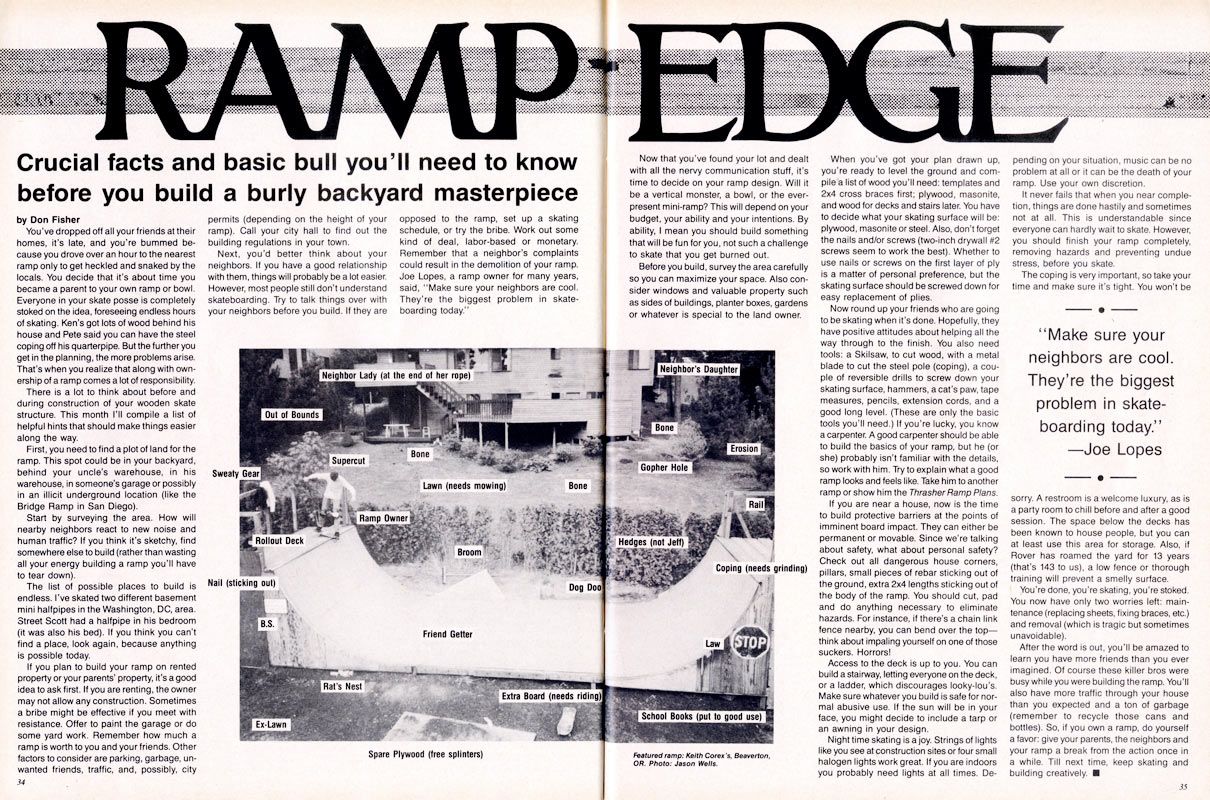
Page Text
            RAMP EDGE
Crucial facts and basic bull you'll need to know
before you build a burly backyard masterpiece
by Don Fisher
You've dropped off all your friends at their
homes, it's late, and you're bummed be-
cause you drove over an hour to the nearest
ramp only to get heckled and snaked by the
locals. You decide that it's about time you
became a parent to your own ramp or bowl.
Everyone in your skate posse is completely
stoked on the idea, foreseeing endless hours
of skating. Ken's got lots of wood behind his
house and Pete said you can have the steel
coping off his quarterpipe. But the further you
get in the planning, the more problems arise.
That's when you realize that along with own-
ership of a ramp comes a lot of responsibility.
There is a lot to think about before and
during construction of your wooden skate.
structure. This month I'll compile a list of
helpful hints that should make things easier
along the way.
First, you need to find a plot of land for the
ramp. This spot could be in your backyard,
permits (depending on the height of your
ramp). Call your city hall to find out the
building regulations in your town.
Next, you'd better think about your
neighbors. If you have a good relationship
with them, things will probably be a lot easier.
However, most people still don't understand
skateboarding. Try to talk things over with
your neighbors before you build. If they are
behind your uncle's warehouse, in his Sweaty Gear
warehouse, in someone's garage or possibly
in an illicit underground location (like the
Bridge Ramp in San Diego).
Start by surveying the area. How will
nearby neighbors react to new noise and
human traffic? If you think it's sketchy, find
somewhere else to build (rather than wasting
all your energy building a ramp you'll have
to tear down).
Out of Bounds
opposed to the ramp, set up a skating
schedule, or try the bribe. Work out some
kind of deal, labor-based or monetary.
Remember that a neighbor's complaints
could result in the demolition of your ramp.
Joe Lopes, a ramp owner for many years,
said, "Make sure your neighbors are cool.
They're the biggest problem in skate-
boarding today.""
Neighbor Lady (at the end of her rope)
Now that you've found your lot and dealt
with all the nervy communication stuff, it's
time to decide on your ramp design. Will it
be a vertical monster, a bowl, or the ever-
present mini-ramp? This will depend on your
budget, your ability and your intentions. By
ability, I mean you should build something
that will be fun for you, not such a challenge
to skate that you get burned out.
Before you build, survey the area carefully
so you can maximize your space. Also con
sider windows and valuable property such
as sides of buildings, planter boxes, gardens
or whatever is special to the land owner.
Neighbor's Daughter
Bone
Erosion
Bone
Supercut
Gopher Hole
Lawn (needs mowing)
Bone
Rail
Ramp Owner
Rollout Deck
The list of possible places to build is Nail (sticking out)
endless. I've skated two different basement
mini halfpipes in the Washington, DC, area.
Street Scott had a halfpipe in his bedroom
(it was also his bed). If you think you can't
find a place, look again, because anything
is possible today.
If you plan to build your ramp on rented.
property or your parents' property, it's a good
idea to ask first. If you are renting, the owner
may not allow any construction. Sometimes
a bribe might be effective if you meet with
resistance. Offer to paint the garage or do
some yard work. Remember how much a
ramp is worth to you and your friends. Other
factors to consider are parking, garbage, un-
wanted friends, traffic, and, possibly, city
34
B.S.
Ex-Lawn
Rat's Nest
Broom
Friend Getter
Spare Plywood (free splinters)
Dog Doo
Extra Board (needs riding)
Hedges (not Jeff)
When you've got your plan drawn up,
you're ready to level the ground and com-
pile a list of wood you'll need: templates and
2x4 cross braces first; plywood, masonite,
and wood for decks and stairs later. You have
to decide what your skating surface will be:
plywood, masonite or steel. Also, don't forget
the nails and/or screws (two-inch drywall #2
screws seem to work the best). Whether to
use nails or screws on the first layer of ply
is a matter of personal preference, but the
skating surface should be screwed down for
easy replacement of plies.
Now round up your friends who are going
to be skating when it's done. Hopefully, they
have positive attitudes about helping all the
way through to the finish. You also need
tools: a Skilsaw, to cut wood, with a metal
blade to cut the steel pole (coping), a cou-
ple of reversible drills to screw down your
skating surface, hammers, a cat's paw, tape
measures, pencils, extension cords, and a
good long level. (These are only the basic
tools you'll need.) If you're lucky, you know
a carpenter. A good carpenter should be able
to build the basics of your ramp, but he (or
she) probably isn't familiar with the details.
so work with him. Try to explain what a good
ramp looks and feels like. Take him to another
ramp or show him the Thrasher Ramp Plans.
If you are near a house, now is the time
to build protective barriers at the points of
imminent board impact. They can either be
permanent or movable. Since we're talking
about safety, what about personal safety?
Check out all dangerous house corners,
Coping (needs grinding) pillars, small pieces of rebar sticking out of
Law STOP
School Books (put to good use)
Featured ramp: Keith Corex's, Beaverton,
OR. Photo: Jason Wells.
the ground, extra 2x4 lengths sticking out of
the body of the ramp. You should cut, pad
and do anything necessary to eliminate
hazards. For instance, if there's a chain link
fence nearby, you can bend over the top-
think about impaling yourself on one of those
suckers. Horrors!
Access to the deck is up to you. You can
build a stairway, letting everyone on the deck,
or a ladder, which discourages looky-lou's.
Make sure whatever you build is safe for nor
mal abusive use. If the sun will be in your
face, you might decide to include a tarp or
an awning in your design.
Night time skating is a joy. Strings of lights
like you see at construction sites or four small
halogen lights work great. If you are indoors
you probably need lights at all times. De
pending on your situation, music can be no
problem at all or it can be the death of your
ramp. Use your own discretion.
It never fails that when you near comple-
tion, things are done hastily and sometimes
not at all. This is understandable since
everyone can hardly wait to skate. However,
you should finish your ramp completely,
removing hazards and preventing undue
stress, before you skate."
The coping is very important, so take your
time and make sure it's tight. You won't be
"Make sure your
neighbors are cool.
They're the biggest
problem in skate-
boarding today"
-Joe Lopes
sorry. A restroom is a welcome luxury, as is
a party room to chill before and after a good.
session. The space below the decks has
been known to house people, but you can
at least use this area for storage. Also, if
Rover has roamed the yard for 13 years.
training will prevent a smelly surface.
(that's 143 to us), a low fence or thorough
You're done, you're skating, you're stoked.
You now have only two worries left: main-
tenance (replacing sheets, fixing braces, etc.)
and removal (which is tragic but sometimes
unavoidable).
After the word is out, you'll be amazed to
learn you have more friends than you ever
imagined. Of course these killer bros were
busy while you were building the ramp. You'll
also have more traffic through your house
than you expected and a ton of garbage
(remember to recycle those cans and
bottles). So, if you own a ramp, do yourself
a favor: give your parents, the neighbors and
your ramp a break from the action once in
a while. Till next time, keep skating and
building creatively.