Page Text
            CH-STREET
H-STREET
best at it. I've done well at other things. I
never looked at it as whether I was talented
or not talented, I just went and did it. I never
questioned myself and I never questioned
skateboarding. It was my life from very early
on, whether I realized it or not. I never really
thought about it; I just knew it. Once you get
hurt, you suffer an injury for about a month
or so. That's when you really find out how
much you're into it.
How did you start out with competition?
You buy a skateboard; you start skate-
boarding; the next logical step is you want
to see how good you are.
What's your favorite type of skating?
I'm a vertical skater. I'm not a street skater.
I'm not going to pretend to be one, although
I skate streets. I beat Matt Hensley in a street
contest lately, and Ron Allen. They were so
pissed. It was funny. I really just skate,
though. I take vert skating seriously. I train.
I purposely go out and I purposely make
myself learn stuff. I don't just accidentally
stumble on a trick. I look at something that's
that's valuable to learn, I go and I don't leave
until I learn it. Some people say I'm too
methodical. I don't know if that's true or not.
I am a vert skater. I'm systematic. I won't.
leave, I'll just stay. I was learning this trick
the other day and I just wouldn't commit.
myself. I tried it about fifty times. I had just
had it. All I wanted to do was either make it
or slam because I hate walking off the ramp.
and not even having the guts to go for it. So
I went for it and I slammed hard; it hurt for
days, but I felt better by doing that. I can't
stand walking off the ramp without even try-
ing to make a trick. When it comes to street.
skating and jump ramp skating, that's a lot.
of fun and games, just screwing around. I
don't plan to win a pro street contest. I don't
practice for it. I just have fun.
You had a son six years ago. Did that affect
your skating?
Yeah. Shane is going to be six by the time
you read this. I won't pretend and say that
I planned to have a kid when I was nineteen.
It was an accident, no big deal. But I adapted
to it, and it's become one of the greatest
things in my life. I'm now divorced, so I see
my kid a week out of the month and I try to
travel with him. In the beginning there was
a lot of father responsibilities. It probably held
my skating back for about a year. But now,
for the last two or three years, it's been fun.
It's a lot of fun to take the kid around. He's
getting pretty rad. Sometimes he does
demos with me. We made Shane a little
model at H-Street and he drew the graphics,
it's really funny. We haven't really released
it yet. It's a small board with a pro shape, for
kids who are about five to nine years old.
Now that he's older are you able to put
aside time to be with him, or time to relax?
To tell you the truth, I don't like vacations.
I was just in Florida, and I had to do the
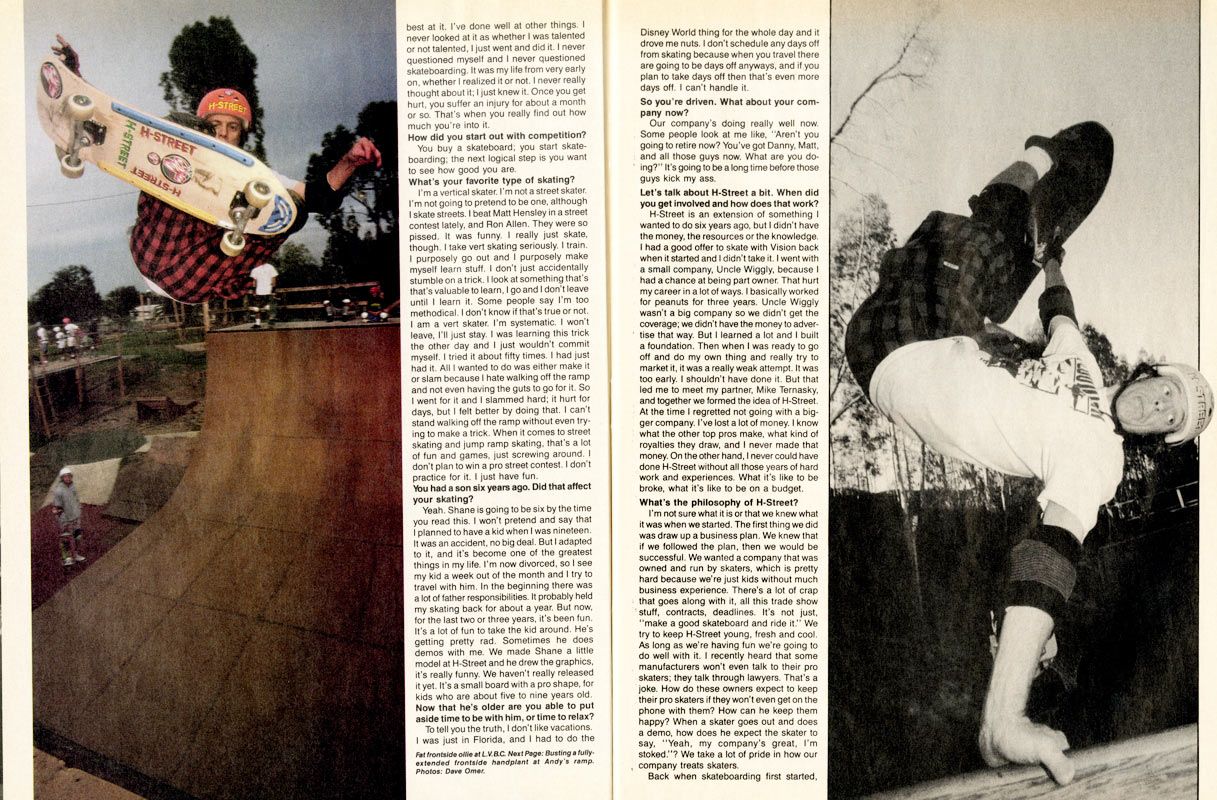
Fat frontside ollie at LVBC Next Page: Busting a fully-
extended frontside handplant at Andy's ramp.
Photos: Dave Omer
Disney World thing for the whole day and it
drove me nuts. I don't schedule any days off
from skating because when you travel there.
are going to be days off anyways, and if you
plan to take days off then that's even more
days off. I can't handle it.
So you're driven. What about your com-
pany now?
Our company's doing really well now.
Some people look at me like, "Aren't you
going to retire now? You've got Danny, Matt,
and all those guys now. What are you do-
ing?" It's going to be a long time before those
guys kick my ass.
Let's talk about H-Street a bit. When did
you get involved and how does that work?
H-Street is an extension of something I
wanted to do six years ago, but I didn't have
the money, the resources or the knowledge.
I had a good offer to skate with Vision back.
when it started and I didn't take it. I went with
a small company, Uncle Wiggly, because I
had a chance at being part owner. That hurt
my career in a lot of ways. I basically worked
for peanuts for three years. Uncle Wiggly
wasn't a big company so we didn't get the
coverage; we didn't have the money to adver
tise that way. But I learned a lot and I built
a foundation. Then when I was ready to go:
off and do my own thing and really try to
market it, it was a really weak attempt. It was
too early. I shouldn't have done it. But that
led me to meet my partner, Mike Ternasky,
and together we formed the idea of H-Street.
At the time I regretted not going with a big-
ger company. I've lost a lot of money. I know
what the other top pros make, what kind of
royalties they draw, and I never made that
money. On the other hand, I never could have
done H-Street without all those years of hard
work and experiences. What it's like to be
broke, what it's like to be on a budget.
What's the philosophy of H-Street?
I'm not sure what it is or that we knew what
it was when we started. The first thing we did
was draw up a business plan. We knew that
if we followed the plan, then we would be
successful. We wanted a company that was
owned and run by skaters, which is pretty.
hard because we're just kids without much
business experience. There's a lot of crap
that goes along with it, all this trade show
stuff, contracts, deadlines. It's not just,
"make a good skateboard and ride it." We
try to keep H-Street young, fresh and cool.
As long as we're having fun we're going to
do well with it. I recently heard that some
manufacturers won't even talk to their pro
skaters; they talk through lawyers. That's a
joke. How do these owners expect to keep
their pro skaters if they won't even get on the
phone with them? How can he keep them
happy? When a skater goes out and does
a demo, how does he expect the skater to
say, "Yeah, my company's great, I'm
stoked."? We take a lot of pride in how our
company treats skaters.
Back when skateboarding first started,