Page Text
            What was it like growing up in Sweden?
When we were kids we used to raise a lot
of hell in our neighborhood. In Sweden you
never have to worry about police because
it's not the same situation, it's a socialist
country. Kids are really protected until they're
eighteen years old. But we never really did
anything bad; we just used to raise hell-go
into people's yards, steal their fruit...
Why are kids more protected? Does the
Swedish government trust you more?
I don't know if it's that they trust you more.
I guess the constitution says that almost
anything is an infringement on your private
life. Yet Sweden is also known for having the
most amount of personal data on people in
government files. So it's a weird country.
Everything moves slow there. It's a good
country; one of the wealthiest countries in
the world, with one of the highest standards
of living. But there are no rich people in
Sweden, and there are no poor people.
Did you realize before you left that you
didn't want to stay there?
Not really, not when I was young. When
I was ten years old I used to be the hellraiser
on my block. We used to climb things and
I played a lot of sports in school. I was good
in table tennis, which they call ping pong
here. Then I started skateboarding when I
was fourteen. It was a fad then. In Sweden,
if something happens in the States, even if
it's going to turn into a sport here, in Europe.
it's a fad. Everybody had a skateboard.
Skateboarding merchants were making
millions in Sweden. I bought a skateboard
and became one of the better Swedes right
away. Of course, it wasn't anything to know
then. It was slalom, which is not that hard
to learn. We didn't have pools there because
all the pools in Sweden are square. But we
used to slalom at night. We always used to
meet around eleven and skate until five in
the morning slalom at this place called the
Galleria. There were these stairs and we
came there one night and somebody had
gone to a construction site and stolen a
bunch of plywood and laid it on the stairs.
Everyone was skating this plywood. It was
dangerous, with cracks everywhere. Things
would go flying apart. That's basically how
ramp riding started in Sweden. Six months
after that some entrepreneur who had been
over to the States and seen American.
skateparks bought an indoor movie theater
in Stockholm and built a bowl, a full-pipe, a
half-pipe and a couple quarter-pipes. It was
small and pretty sketchy, but it was indoors,
which, if you're European, you know what
that means. It was a really cool place, called
Newsport House. Back then Per Viking and
I were the locals. Per Viking is the ruler.
Anytime anybody asks about him I say her
is the ruler. I was just back there and I saw
Per. I'm trying to get him back into skateboar-
ding. I told him I wanted to make a model
for him. Because he's rad. He'll just go out
and learn a trick. He learned 540°s in a day.
He called me up the other day and asked me
what tricks I was doing lately and I told him
about this 540° shove-it varial. He calls me
back the next day and says, "I didn't quite
understand it, but I'm making it. I'm throw-
ing it over my head and coming in... The
guy is crazy. He's probably the reason why
I'm even good. He was always better than
me. Per would do things and I would look at
him like, "How did you do that?" But I was i
more persistent than he was. I would stay out
there longer and skate harder. I stayed with
it and he didn't. If he would have stayed with
it, he would have been one of the best.
Do you think that's been your story, your
persistence and drive?
Yeah, I would say so. I don't have as much
natural talent as guys like Tony Hawk. He's
just unreal. Danny Way is the same way. He's
exactly like Tony Hawk was when he was 14
or 15. And I never had that; I just had per-
sistence. You can see that even more in a
skater like Ken Park. He doesn't look like he's
real liquid or smooth when he skates, but he's
damn good because he stays at it. But I at-
tribute a lot of my skating to Per Viking.
Everybody has had a story like that; they had
a good friend they were always skating with.
How did you find your way to San Diego?
Basically, I skated everything there was in
Sweden. I won the championships that were
there. We had been on tour all summer and
I was coming back. It was fall and I was going
to go to college; I went there one day and
I decided I couldn't do that. I was ready to
skateboard and keep going with it. I had a
really strong taste for it and I wanted to go
to the States. I went home and convinced my
mom, and got a friend to go with me. I was
16. We bought a ticket, had some money, and
left. We went to L.A. I didn't know anybody
there, which was really kind of stupid
because I didn't realize I would actually get
there and have to deal with, "Where do we
go now?" I didn't know where any skateparks
were or anything. I met someone on the
plane. We shared a hotel in downtown L.A.
Real smart. This guy knew some girl in San
Diego he wanted to see. You know how those
things go. We ended up going to San Diego,
which was lucky for us, because we came
down to the beach where things were more
mellow, people were friendlier and more will
ing to help us out. We met some bum on the
beach who helped us buy a car and taught
me how to drive. He knew where Oasis was,
so he took me up there and that's how I
started in the skate scene. This was in 1981.
I knew I was going to be here for three
months. I skated an amateur contest at Del
Mar and won. I met Eddie Elguera and got
sponsored.
When did you start realizing your talent?
I never really looked at myself as talented
or not talented; I just knew that was what I
was going to do and I was going to do my
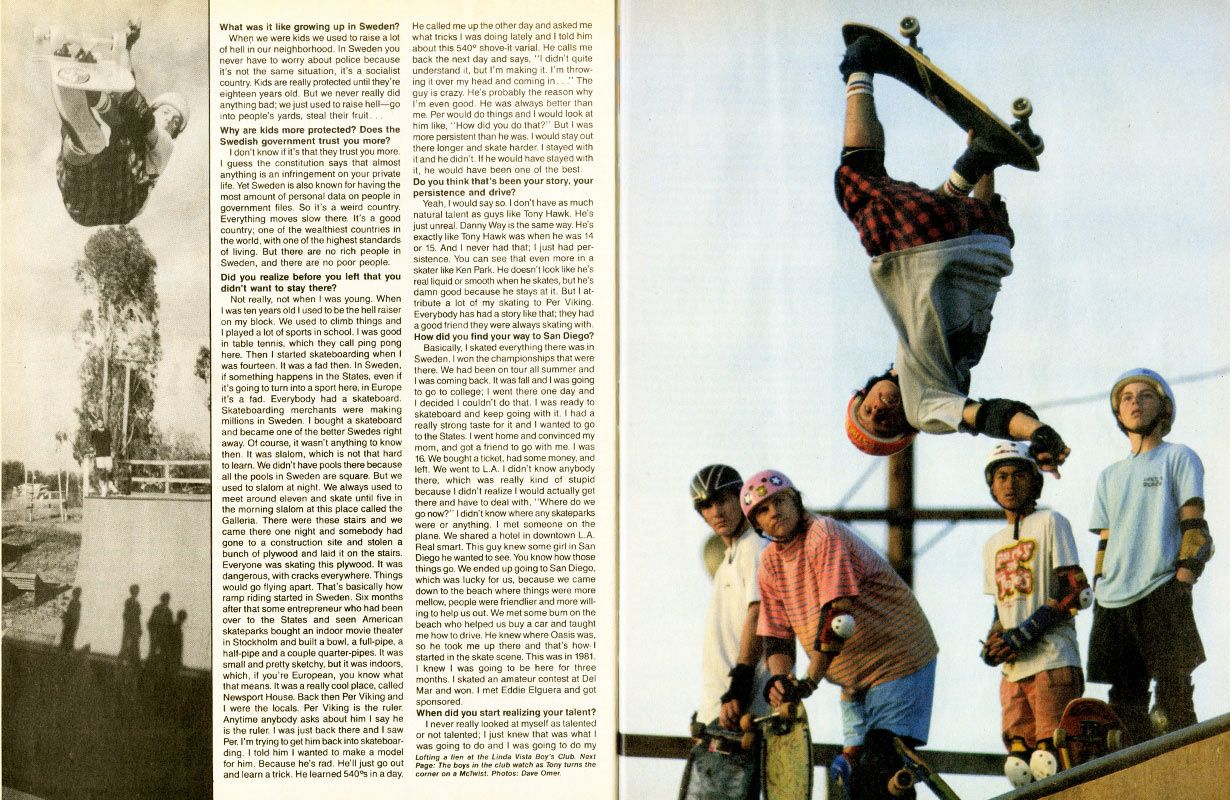
Lofting a lien at the Linda Vista Boy's Club Next
Page: The boys in the club watch as Tony turns the
corner on a McTwist. Photos: Dave Omer