Page Text
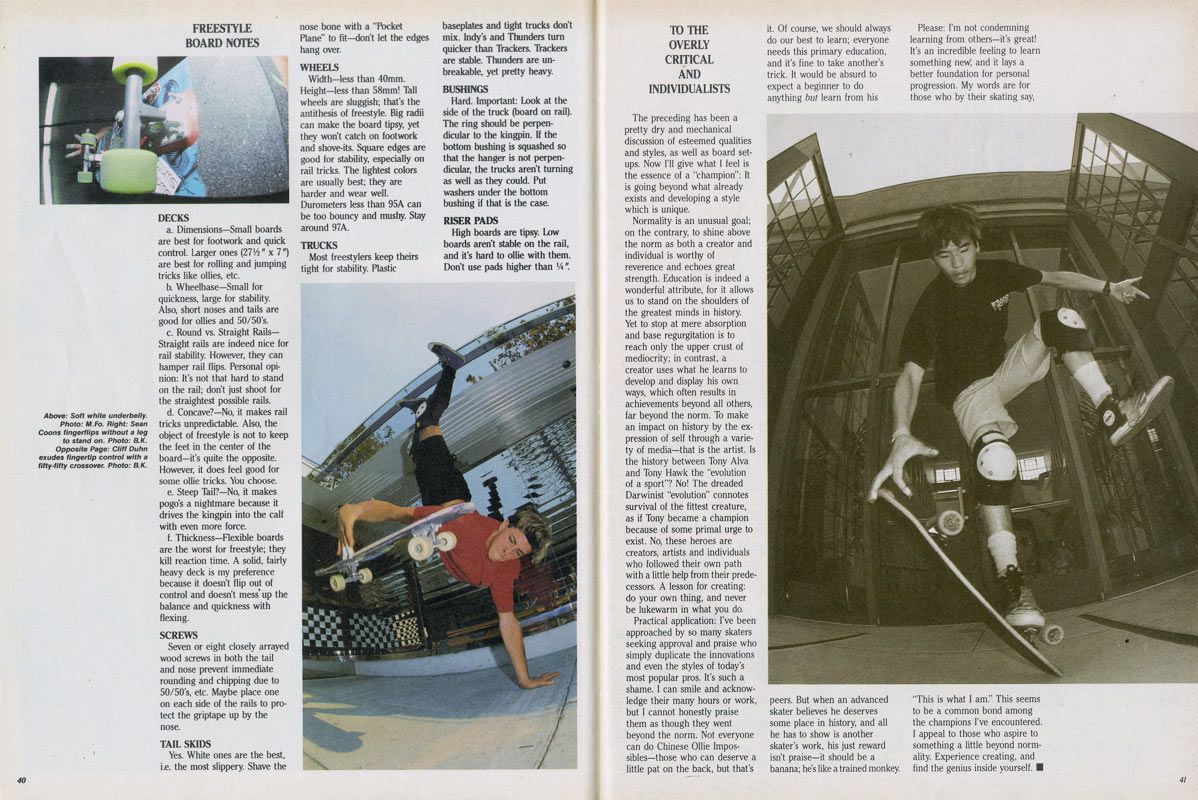
            Above: Soft while underbelly.
Photo: M.Fo. Right: Sean
Coons fingertips without a leg
to stand on. Photo: B.K.
Opposite Page: Cliff Duhn
exudes fingertip control with a
fifty-fifty crossover. Photo: B.K.
DECKS
FREESTYLE
BOARD NOTES
a. Dimensions-Small boards
are best for footwork and quick
control. Larger ones (27½" x 7")
are best for rolling and jumping
tricks like ollies, etc.
b. Wheelbase-Small for
quickness, large for stability.
Also, short noses and tails are
good for ollies and 50/50's.
c. Round vs. Straight Rails-
Straight rails are indeed nice for
rail stability. However, they can
hamper rail flips. Personal opi-
nion: It's not that hard to stand
on the rail; don't just shoot for
the straightest possible rails.
d. Concave?-No, it makes rail
tricks unpredictable. Also, the
object of freestyle is not to keep
the feet in the center of the
board-it's quite the opposite.
However, it does feel good for
some ollie tricks. You choose.
e. Steep Tail?-No, it makes
pogo's a nightmare because it
drives the kingpin into the calf
with even more force.
f. Thickness-Flexible boards
are the worst for freestyle; they
kill reaction time. A solid, fairly
heavy deck is my preference.
because it doesn't flip out of
control and doesn't mess up the
balance and quickness with
flexing.
SCREWS
Seven or eight closely arrayed
wood screws in both the tail
and nose prevent immediate
rounding and chipping due to
50/50's, etc. Maybe place one
on each side of the rails to pro-
tect the griptape up by the
nose.
TAIL SKIDS
Yes. White ones are the best,
ie. the most slippery. Shave the
nose bone with a "Pocket
baseplates and tight trucks don't
Plane" to fit-don't let the edges mix. Indy's and Thunders turn
hang over.
WHEELS
Width-less than 40mm.
Height-less than 58mm! Tall
wheels are sluggish; that's the
antithesis of freestyle. Big radii
can make the board tipsy, yet
they won't catch on footwork
and shove-its. Square edges are
good for stability, especially on
rail tricks. The lightest colors
are usually best; they are
harder and wear well.
Durometers less than 95A can
be too bouncy and mushy. Stay
around 97A.
TRUCKS
Most freestylers keep theirs
tight for stability. Plastic
quicker than Trackers. Trackers
are stable. Thunders are un-
breakable, yet pretty heavy.
BUSHINGS
Hard. Important: Look at the
side of the truck (board on rail).
The ring should be perpen-
dicular to the kingpin. If the
bottom bushing is squashed so
that the hanger is not perpen-
dicular, the trucks aren't turning
as well as they could. Put
washers under the bottom
bushing if that is the case.
RISER PADS
High boards are tipsy. Low
boards aren't stable on the rail,
and it's hard to ollie with them.
Don't use pads higher than "
TO THE
OVERLY
CRITICAL
AND
INDIVIDUALISTS
The preceding has been a
pretty dry and mechanical
discussion of esteemed qualities
and styles, as well as board set-
ups. Now I'll give what I feel is
the essence of a "champion": It
is going beyond what already
exists and developing a style
which is unique.
Normality is an unusual goal;
on the contrary, to shine above
the norm as both a creator and
individual is worthy of
reverence and echoes great.
strength. Education is indeed at
wonderful attribute, for it allows
us to stand on the shoulders of
the greatest minds in history.
Yet to stop at mere absorption
and base regurgitation is to
reach only the upper crust of
mediocrity; in contrast, a
creator uses what he learns to
develop and display his own
ways, which often results in
achievements beyond all others,
far beyond the norm. To make
an impact on history by the ex-
pression of self through a varie-
ty of media-that is the artist. Is
the history between Tony Alva
and Tony Hawk the "evolution
of a sport"? No! The dreaded
Darwinist "evolution" connotes
survival of the fittest creature,
as if Tony became a champion,
because of some primal urge to
exist. No, these heroes are
creators, artists and individuals
who followed their own path
with a little help from their prede-
cessors. A lesson for creating:
do your own thing, and never
be lukewarm in what you do.
Practical application: I've been
approached by so many skaters
seeking approval and praise who
simply duplicate the innovations
and even the styles of today's
most popular pros. It's such a
shame. I can smile and acknow-
ledge their many hours or work,
but I cannot honestly praise
them as though they went
beyond the norm. Not everyone
can do Chinese Ollie Impos-
sibles-those who can deserve a
little pat on the back, but that's
it. Of course, we should always
do our best to learn; everyone
needs this primary education,
and it's fine to take another's
trick. It would be absurd to
expect a beginner to do
anything but learn from his
peers. But when an advanced
skater believes he deserves
some place in history, and all
he has to show is another
skater's work, his just reward
isn't praise-it should be a
banana; he's like a trained monkey
Please: I'm not condemning
learning from others-it's great!
It's an incredible feeling to learn
something new, and it lays a
better foundation for personal
progression. My words are for
those who by their skating say,
"This is what I am." This seems
to be a common bond among
the champions I've encountered.
I appeal to those who aspire to
something a little beyond norm-
ality. Experience creating, and
find the genius inside yourself. I
41