Page Text
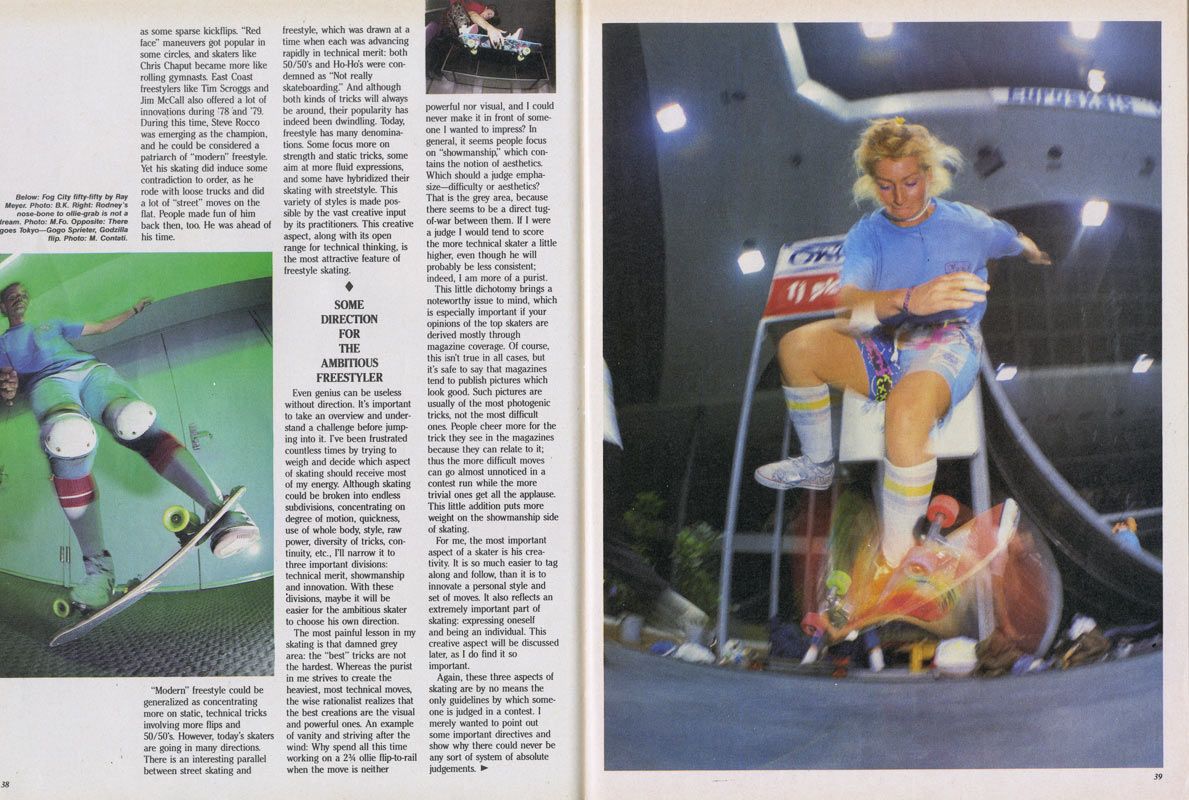
            Below: Fog City fifty-fifty by Ray
Meyer. Photo: BK. Right: Rodney's
nose-bone to ollie-grab is not a
tream. Photo: M.Fo. Opposite: There
goes Tokyo-Gogo Sprieter, Godzilla
flip. Photo: M. Contati.
as some sparse kickflips. "Red
face" maneuvers got popular in
some circles, and skaters like
Chris Chaput became more like
rolling gymnasts. East Coast
freestylers like Tim Scroggs and
Jim McCall also offered a lot of
innovations during '78 and '79.
During this time, Steve Rocco
was emerging as the champion,
and he could be considered a
patriarch of "modern" freestyle.
Yet his skating did induce some
contradiction to order, as he
rode with loose trucks and did
a lot of "street" moves on the
flat. People made fun of him
back then, too. He was ahead of
his time.
"Modern" freestyle could be
generalized as concentrating
more on static, technical tricks
involving more flips and
50/50's. However, today's skaters
are going in many directions.
There is an interesting parallel
between street skating and
freestyle, which was drawn at a
time when each was advancing
rapidly in technical merit: both
50/50's and Ho-Ho's were con-
demned as "Not really
skateboarding" And although
both kinds of tricks will always
be around, their popularity has
indeed been dwindling. Today,
freestyle has many denomina-
tions. Some focus more on
strength and static tricks, some
aim at more fluid expressions,
and some have hybridized their
skating with streetstyle. This
variety of styles is made pos
sible by the vast creative input
by its practitioners. This creative
aspect, along with its open
range for technical thinking, is
the most attractive feature of
freestyle skating.
SOME
DIRECTION
FOR
THE
AMBITIOUS
FREESTYLER
Even genius can be useless
without direction. It's important
to take an overview and under-
stand a challenge before jump-
ing into it. I've been frustrated
countless times by trying to
weigh and decide which aspect
of skating should receive most
of my energy. Although skating
could be broken into endless
subdivisions, concentrating on
degree of motion, quickness,
use of whole body, style, raw
power, diversity of tricks, con-
tinuity, etc., I'll narrow it to
three important divisions:
technical merit, showmanship
and innovation. With these
divisions, maybe it will be
easier for the ambitious skater
to choose his own direction.
The most painful lesson in my
skating is that damned grey
area: the "best" tricks are not
the hardest. Whereas the purist
in me strives to create the
heaviest, most technical moves,
the wise rationalist realizes that
the best creations are the visual
and powerful ones. An example
of vanity and striving after the
wind: Why spend all this time
working on a 2% ollie flip-to-rail
when the move is neither
powerful nor visual, and I could
never make it in front of some-
one I wanted to impress? In
general, it seems people focus
on "showmanship" which con-
tains the notion of aesthetics.
Which should a judge empha-
size-difficulty or aesthetics?
That is the grey area, because
there seems to be a direct tug-
of-war between them. If I were
a judge I would tend to score
the more technical skater a little
higher, even though he will
probably be less consistent;
indeed, I am more of a purist.
This little dichotomy brings a
noteworthy issue to mind, which
is especially important if your
opinions of the top skaters are
derived mostly through
magazine coverage. Of course,
this isn't true in all cases, but
it's safe to say that magazines
tend to publish pictures which
look good. Such pictures are
usually of the most photogenic
tricks, not the most difficult
ones. People cheer more for the
trick they see in the magazines
because they can relate to it;
thus the more difficult moves
can go almost unnoticed in a
contest run while the more
trivial ones get all the applause.
This little addition puts more
weight on the showmanship side
of skating.
For me, the most important
aspect of a skater is his crea-
tivity. It is so much easier to tag.
along and follow, than it is to
innovate a personal style and
set of moves. It also reflects an
extremely important part of
skating: expressing oneself
and being an individual. This
creative aspect will be discussed
later, as I do find it so
important.
Again, these three aspects of
skating are by no means the
only guidelines by which some-
one is judged in a contest. I
merely wanted to point out
some important directives and
show why there could never be
any sort of system of absolute
judgements.➤