Page Text
            GUNS & ROSES
Interview by Mike Gitter
10
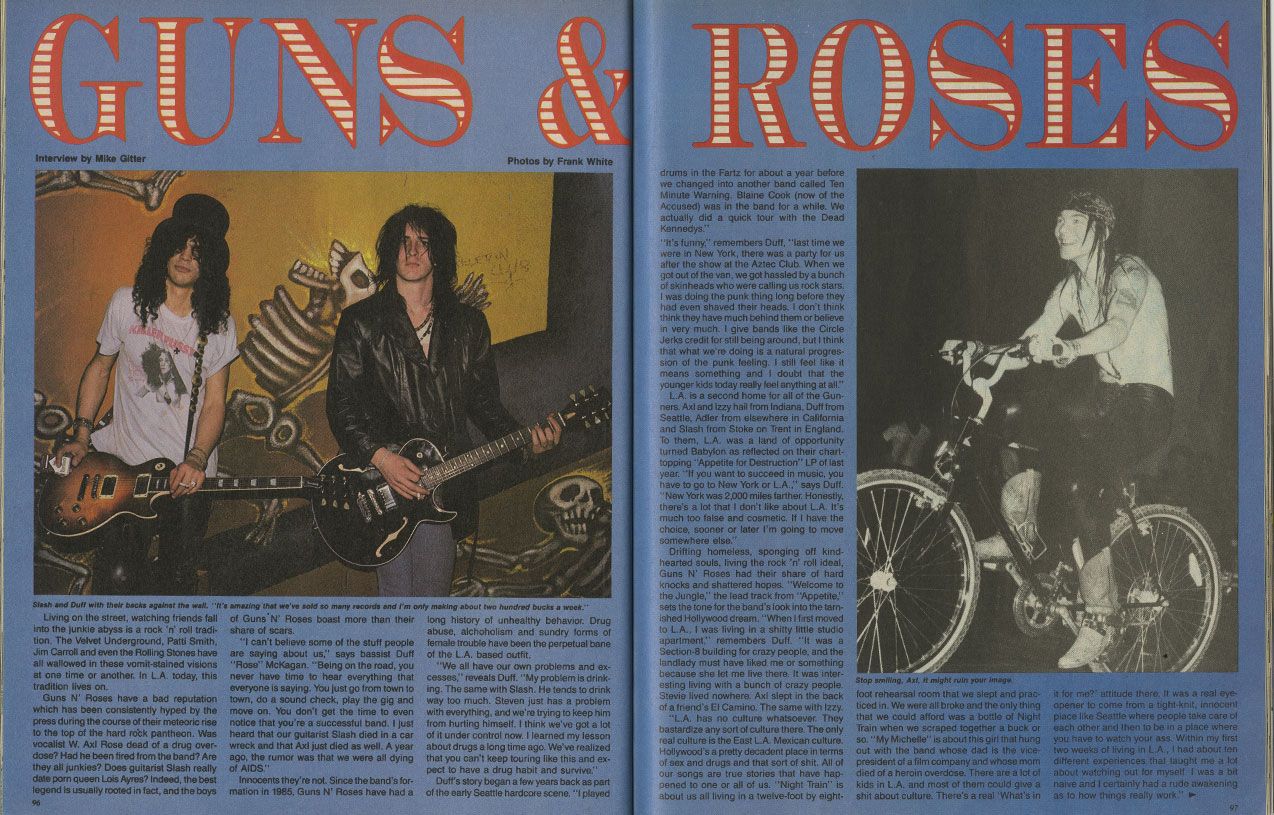
Slash and Duff with their backs against the wall.
Living on the street, watching friends fall
into the junkie abyss is a rock 'n' roll tradi-
tion. The Velvet Underground, Patti Smith,
Jim Carroll and even the Rolling Stones have
all wallowed in these vomit-stained visions
at one time or another. In L.A. today, this
tradition lives on.
Guns N' Roses have a bad reputation
which has been consistently hyped by the
press during the course of their meteoric rise
to the top of the hard rock pantheon. Was
vocalist W. Axl Rose dead of a drug over-
dose? Had he been fired from the band? Are
they all junkies? Does guitarist Slash really
date porn queen Lois Ayres? Indeed, the best
legend is usually rooted in fact, and the boys
96
It's
Photos by Frank White
amazing that we've sold so many records and I'm only making about two hundred bucks a week."
of Guns N' Roses boast more than their
share of scars.
"I can't believe some of the stuff people
are saying about us," says bassist Duff
"Rose" McKagan. "Being on the road, you
never have time to hear everything that
everyone is saying. You just go from town to
town, do a sound check, play the gig and
move on. You don't get the time to even
notice that you're a successful band. I just
heard that our guitarist Slash died in a car
wreck and that Axl just died as well. A year
ago, the rumor was that we were all dying
of AIDS."
Innocents they're not. Since the band's for-
mation in 1985, Guns N' Roses have had a
long history of unhealthy behavior. Drug
abuse, alchoholism and sundry forms of
female trouble have been the perpetual bane
of the L.A. based outfit.
"We all have our own problems and ex-
cesses," reveals Duff. "My problem is drink-
ing. The same with Slash. He tends to drink
way too much. Steven just has a problem
with everything, and we're trying to keep him
from hurting himself. I think we've got a lot
of it under control now. I learned my lesson
about drugs a long time ago. We've realized.
that you can't keep touring like this and ex-
pect to have a drug habit and survive."
Duff's story began a few years back as part
of the early Seattle hardcore scene. "I played
drums in the Fartz for about a year before
we changed into another band called Ten
Minute Warning. Blaine Cook (now of the
Accused) was in the band for a while. We
actually did a quick tour with the Dead
Kennedys."
"It's funny," remembers Duff, "last time we
were in New York, there was a party for us
after the show at the Aztec Club. When we
got out of the van, we got hassled by a bunch
of skinheads who were calling us rock stars.
I was doing the punk thing long before they
had even shaved their heads. I don't think
think they have much behind them or believe
in very much. I give bands like the Circle
Jerks credit for still being around, but I think
that what we're doing is a natural progres-
sion of the punk feeling. I still feel like it
means something and I doubt that the
younger kids today really feel anything at all."
L.A. is a second home for all of the Gun-
ners. Axl and Izzy hail from Indiana, Duff from
Seattle, Adler from elsewhere in California
and Slash from Stoke on Trent in England.
To them, L.A. was a land of opportunity
turned Babylon as reflected on their chart-
topping "Appetite for Destruction" LP of last
year. "If you want to succeed in music, you
have to go to New York or L.A.," says Duff.
"New York was 2,000 miles farther. Honestly,
there's a lot that I don't like about L.A. It's
much too false and cosmetic. If I have the
choice, sooner or later I'm going to move
somewhere else."
Drifting homeless, sponging off kind-
hearted souls, living the rock 'n' roll ideal,
Guns N' Roses had their share of hard
knocks and shattered hopes. "Welcome to
the Jungle," the lead track from "Appetite."
sets the tone for the band's look into the tarn-
ished Hollywood dream. "When I first moved
to L.A., I was living in a shitty little studio
apartment," remembers Duff. "It was a
Section-8 building for crazy people, and the
landlady must have liked me or something
because she let me live there. It was inter-
esting living with a bunch of crazy people.
Stevie lived nowhere. Axl slept in the back
of a friend's El Camino. The same with Izzy.
"L.A. has no culture whatsoever. They
bastardize any sort of culture there. The only
real culture is the East L.A. Mexican culture.
Hollywood's a pretty decadent place in terms
of sex and drugs and that sort of shit. All of
our songs are true stories that have hap-
pened to one or all of us. "Night Train" is
about us all living in a twelve-foot by eight-
Stop smiling, Axt, it might ruin your image
foot rehearsal room that we slept and prac-
ticed in. We were all broke and the only thing
that we could afford was a bottle of Night
Train when we scraped together a buck or
so. "My Michelle" is about this girl that hung
out with the band whose dad is the vice-
president of a film company and whose mom
died of a heroin overdose. There are a lot of
kids in L.A. and most of them could give a
shit about culture. There's a real 'What's in
it for me? attitude there. It was a real eye-
opener to come from a tight-knit, innocent
place like Seattle where people take care of
each other and then to be in a place where
you have to watch your ass. Within my first
two weeks of living in LA, I had about ten
different experiences that taught me a lot
about watching out for myself I was a bit
naive and I certainly had a rude awakening
as to how things really work."