Page Text
            SKATE
Die
ALBUQUE BBQ
Prefab "fun places" like The Beach have
been built. It cost oodles of money to build,
and it is fully equipped with timed mechan-
ical waves. What they didn't realize is that
people here would rather run in the sprink-
lers, take a two-hour drive to Elephant Butte
Lake, or spend $50 to go to the real beach
instead of paying $9.50 for a fake one. It's
already losing money badly, so they got
Joey Mulbergher to design a 54-foot half-
pipe, which may or may not go up. The irony
is that skateboarding may save their ass! It's
not a crime here (yet), but leave it to the law
makers to see what's happening elswhere
and they're likely to ban it without seeing that
we aren't destroying the city, just using it..
Within the past two years the number of
kids with boards in Albuquerque has increa-
sed in direct relation to how many Big Macs
were sold. It's probably the hot topic at local
P.T.A. meetings: "Is it good? Is it bad? How
do you discipline your little skater? Do you
take them to ditches like you take them to
soccer practice?"
"I can't imagine what Albuquerque will
be like in ten years," I wondered outloud.
"I don't know," said Sonny, "but if skaters
keep spray painting and trashing the ditches,
they'll put up "No Skateboarding" signs in
all of them."
Not too long ago, things didn't look so
hectic for skaters. How did the action ever.
hit this city anyway? In the past, the people
of Albuquerque were not interested in the
latest craze, with the exception of a few
things, namely skateboarding. Why skate-
boarding? Because no matter what the city
doesn't have, it does have concrete and
individuals.
SKATE BUDS
Gordy Johnson, 31, is the memory bank
for the history of skateboarding in Albuquer-
que. With his enthusiastic help, and that of
Kevin Crookshank, 25, I got the low-down.
If you were a seven-year-old in 1964,
would you care that Kennedy was shot and
people were being sent to war, or would you
be stoked that your grandmother sent you
your first pair of rollerskates? As with lots
of kids all over the country, Gordy's roller-
skates held his attention for a while, but were
eventually dismantled, and, with the help of
an older buddy, made to work under a piece
of wood. Like most anywhere else, the first
few years were spent marking up hated
neighbors' driveways, bombing the nearest
hill and gorilla-gripping barefoot. Baby-
sitters told stories of the tragedies in the park.
ing garage at Kistler Collister, a wannabe
upper middle class clothing store. Skaters
slammed into concrete pylons, rode on the
shoulders of others and were almost in-
evitably scarred in one way or another
because of the nasty grate at the bottom
where it starts to level off.
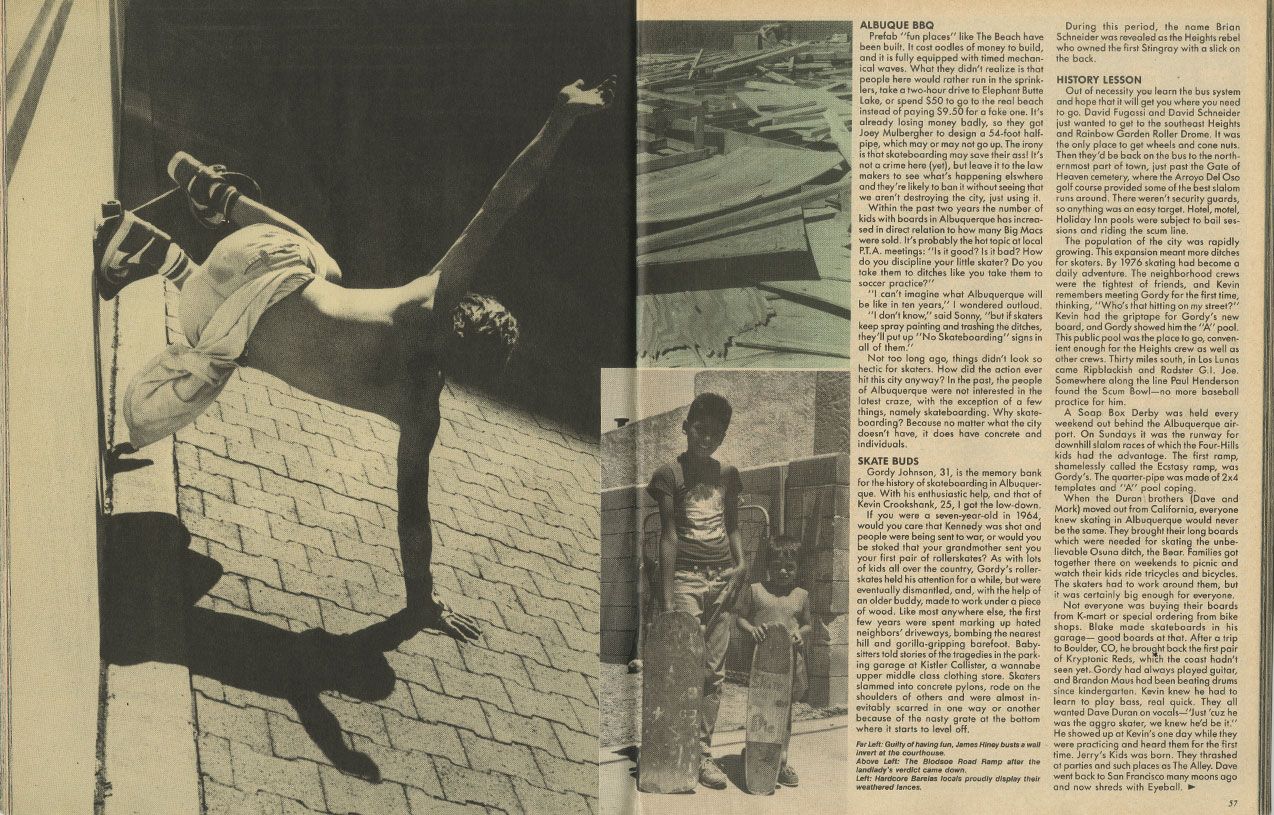
Far Left: Guilty of having fun, James Hiney busts a wall
invert at the courthouse.
Above Left: The Blodsoe Road Ramp after the
landlady's verdict came down.
Left: Hardcore Barelas locals proudly display their
weathered lances.
During this period, the name Brian
Schneider was revealed as the Heights rebel
who owned the first Stingray with a slick on
the back.
HISTORY LESSON
Out of necessity you learn the bus system
and hope that it will get you where you need
to go. David Fugassi and David Schneider
just wanted to get to the southeast Heights
and Rainbow Garden Roller Drome. It was
the only place to get wheels and cone nuts.
Then they'd be back on the bus to the north-
ernmost part of town, just past the Gate of
Heaven cemetery, where the Arroyo Del Oso
golf course provided some of the best slalom
runs around. There weren't security guards,
so anything was an easy target. Hotel, motel,
Holiday Inn pools were subject to bail ses-
sions and riding the scum line.
The population of the city was rapidly
growing. This expansion meant more ditches
for skaters. By 1976 skating had become a
daily adventure. The neighborhood crews
were the tightest of friends, and Kevin
remembers meeting Gordy for the first time,
thinking, "Who's that hitting on my street?"
Kevin had the griptape for Gordy's new
board, and Gordy showed him the "A" pool.
This public pool was the place to go, conven-
ient enough for the Heights crew as well as
other crews. Thirty miles south, in Los Lunas
came Ripblackish and Radster G.I. Joe.
Somewhere along the line Paul Henderson
found the Scum Bowl-no more baseball
practice for him.
A Soap Box Derby was held every
weekend out behind the Albuquerque air-
port. On Sundays it was the runway for
downhill slalom races of which the Four-Hills
kids had the advantage. The first ramp,
shamelessly called the Ecstasy ramp, was
Gordy's. The quarter-pipe was made of 2x4
templates and "A" pool coping.
When the Duran brothers (Dave and
Mark) moved out from California, everyone
knew skating in Albuquerque would never
be the same. They brought their long boards
which were needed for skating the unbe-
lievable Osuna ditch, the Bear. Families got
together there on weekends to picnic and
watch their kids ride tricycles and bicycles.
The skaters had to work around them, but
it was certainly big enough for everyone.
Not everyone was buying their boards
from K-mart or special ordering from bike
shops. Blake made skateboards in his
garage-good boards at that. After a trip
to Boulder, CO, he brought back the first pair
of Kryptonic Reds, which the coast hadn't
seen yet. Gordy had always played guitar,
and Brandon Maus had been beating drums
since kindergarten. Kevin knew he had to
learn to play bass, real quick. They all
wanted Dave Duran on vocals-"Just 'cuz he
was the aggro skater, we knew he'd be it."
He showed up at Kevin's one day while they
were practicing and heard them for the first
time. Jerry's Kids was born. They thrashed
at parties and such places as The Alley. Dave
went back to San Francisco many moons ago
and now shreds with Eyeball. ►
57