Page Text
            THE MISSION.
PHOTOGRAPHS - BRYCE KANIGHTS
I try not to. I try not to think about that
at all. Sometimes I amaze myself with
what I think when I'm playing. The
worst thing in the world is thinking
about what you're doing. I don't like
thinking about drumming when I'm
drumming. I stop drumming and start
feeling like it doesn't make any sense
when I think about it.
INTERVIEW - PUSHEAD
Total onslaught. That would be the
best way to describe The Mission and
their rapid climb to popularity. Formed
in January of 1986, The Mission
brought together four individuals who
were previously in popular cult bands.
Wayne Hussey, vocalist/guitarist, was
the guitarist in the now defunct Sisters
of Mercy; Craig Adams, bassist, was
also in Sisters of Mercy: Simon
Hinkler, guitarist, came from Artery;
and Mick Brown, drummer, was in
Red Lorry, Yellow Lorry. The Mission's
first release, Serpent's Kiss (Mission
1), debuted at number one in the
English independent listings, followed
by Garden of Delight (Mission II),
which repeated the number one feat.
They have released five singles and
an Lp entitied God's Own Medicine.
The Mission's product has a special
art look which is created by Mick's
girlfriend, Sandy Ball. The band is
very enthusiastic about Metallica and
openly admit it, attempting Metallica
covers during their sound checks.
What's the deal with Craig Adams
being deported?
The Mission recently played at
Wolfgang's in San Francisco. Kirk
Hammett, of Metallica, came up on
stage for an encore of "Shalter from
the Storm." It proved to be a lengthy,
crazy number. It was a night they
would never forget. This interview took
place with Mick; Simon Hinkler and
Kirk Hammett were also there.
How long have you been on tour
in the U.S.?
We're in our sixth week.
How is the audience response in
the U.S. as compared to England?
It'd be fair to compare what we're
seeing here to what we just loft in Bri-
tain. We've done a lot more work in
Europe and Britain, but I think you
can compare it. You can tell that
we're building foundations and doing
what it's all about, really. The last gig
we played in Britain at the end of the
tour, we played to 6,000 people. We
sold it out in Brixton. Now we're look
ing forward to doing the same here.
And you can't just jump into that posi
tion. Some of the places have been
real small, with small audiences. We
haven't been pissed off, we've still
gone on and done a good show.
There are good things about coming
back into this situation from that
There are different pressures play-
ing to 6,000 people. You feel like, oh
God, I can't afford to make a
mistake...you know what I mean?
Do you think like that when you're
playing?
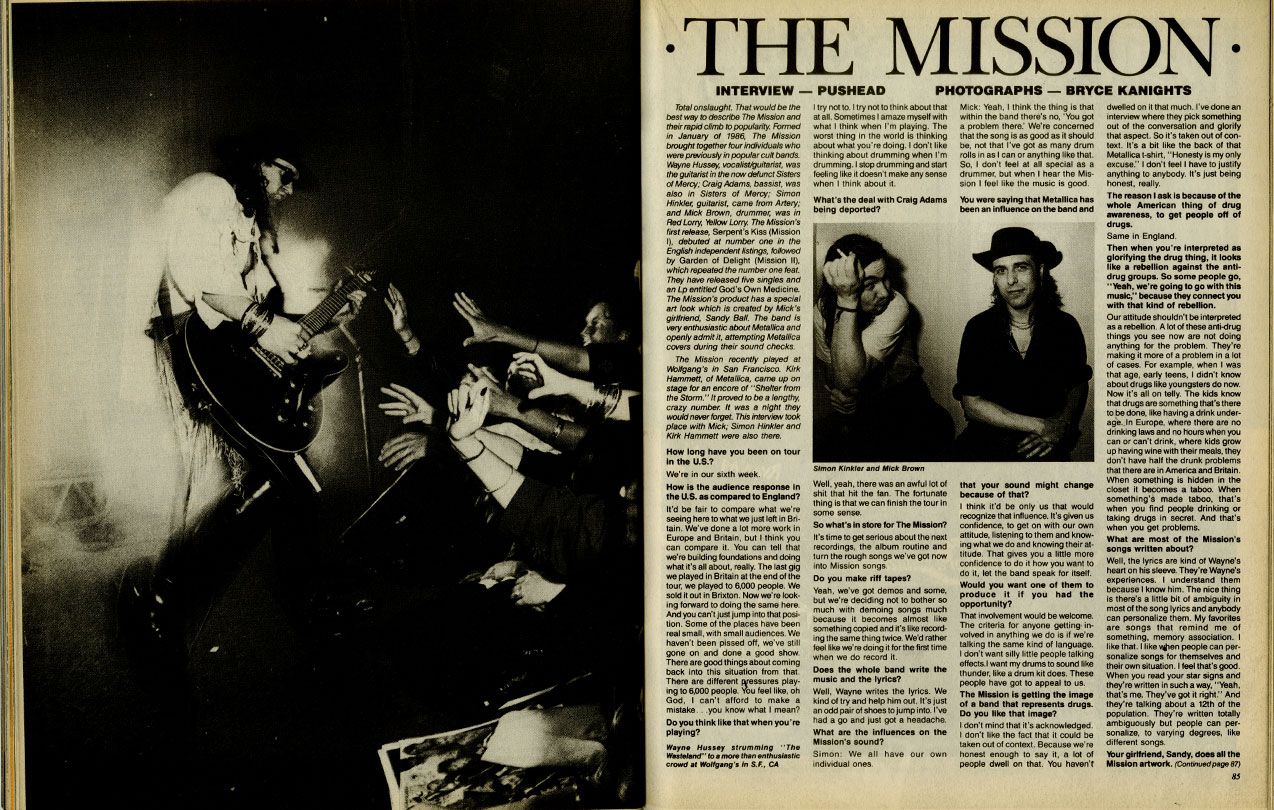
Wayne Hussey strumming "The
Wasteland to a more than enthusiastic
crowd at Wolfgang's in S.F., CA
Simon Kinkler and Mick Brown
Well, yeah, there was an awful lot of
shit that hit the fan. The fortunate
thing is that we can finish the tour in
some sense.
So what's in store for The Mission?
It's time to get serious about the next
recordings, the album routine and
turn the rough songs we've got now
into Mission songs.
Do you make riff tapes?
Yeah, we've got demos and some,
but we're deciding not to bother so
much with demoing songs much
because it becomes almost like
something copied and it's like record-
ing the same thing twice. We'd rather
feel like we're doing it for the first time
when we do record it.
Does the whole band write the
music and the lyrics?
Well, Wayne writes the lyrics. We
kind of try and help him out. It's just
an odd pair of shoes to jump into. I've
had a go and just got a headache.
What are the influences on the
Mission's sound?
Simon: We all have our own
individual ones.
Mick: Yeah, I think the thing is that
within the band there's no, "You got
a problem there. We're concerned
that the song is as good as it should
be, not that I've got as many drum
rolls in as I can or anything like that.
So, I don't feel at all special as a
drummer, but when I hear the Mis-
sion I feel like the music is good.
You were saying that Metallica has
been an influence on the band and
that your sound might change.
because of that?
I think it'd be only us that would
recognize that influence. It's given us
confidence, to get on with our own
attitude, listening to them and know-
ing what we do and knowing their at-
titude. That gives you a little more
confidence to do it how you want to
do it, let the band speak for itself.
Would you want one of them to
produce it if you had the
opportunity?
That involvement would be welcome.
The criteria for anyone getting in-
volved in anything we do is if we're
talking the same kind of language.
I don't want silly little people talking
effects.I want my drums to sound like
thunder, like a drum kit does. These
people have got to appeal to us.
The Mission is getting the image
of a band that represents drugs.
Do you like that image?
I don't mind that it's acknowledged.
I don't like the fact that it could be
taken out of context. Because we're
honest enough to say it, a lot of
people dwell on that. You haven't
dwelled on it that much. I've done an
interview where they pick something
out of the conversation and glorify
that aspect. So it's taken out of con-
text. It's a bit like the back of that
Metallica t-shirt, "Honesty is my only
excuse." I don't feel I have to justify
anything to anybody. It's just being
honest, really.
The reason I ask is because of the
whole American thing of drug
awareness, to get people off of
drugs.
Same in England.
Then when you're interpreted as
glorifying the drug thing, it looks
like a rebellion against the anti-
drug groups. So some people go,
"Yeah, we're going to go with this
music," because they connect you
with that kind of rebellion.
Our attitude shouldn't be interpreted
as a rebellion. A lot of these anti-drug
things you see now are not doing
anything for the problem. They're
making it more of a problem in a lot
of cases. For example, when I was
that age, early teens, I didn't know
about drugs like youngsters do now.
Now it's all on telly. The kids know
that drugs are something that's there
to be done, like having a drink under-
age. In Europe, where there are no
drinking laws and no hours when you
can or can't drink, where kids grow
up having wine with their meals, they
don't have half the drunk problems
that there are in America and Britain.
When something is hidden in the
closet it becomes a taboo. When
something's made taboo, that's
when you find people drinking or
taking drugs in secret. And that's
when you get problems.
What are most of the Mission's
songs written about?
Well, the lyrics are kind of Wayne's
heart on his sleeve. They're Wayne's
experiences. I understand them
because I know him. The nice thing
is there's a little bit of ambiguity in
most of the song lyrics and anybody
can personalize them. My favorites
are songs that remind me of
something, memory association. I
like that. I like when people can per-
sonalize songs for themselves and
their own situation. I feel that's good.
When you read your star signs and
they're written in such a way, "Yeah,
that's me. They've got it right." And
they're talking about a 12th of the
population. They're written totally
ambiguously but people can per-
sonalize, to varying degrees, like
different songs.
Your girlfriend, Sandy, does all the
Mission artwork. (Continued page 87)
85