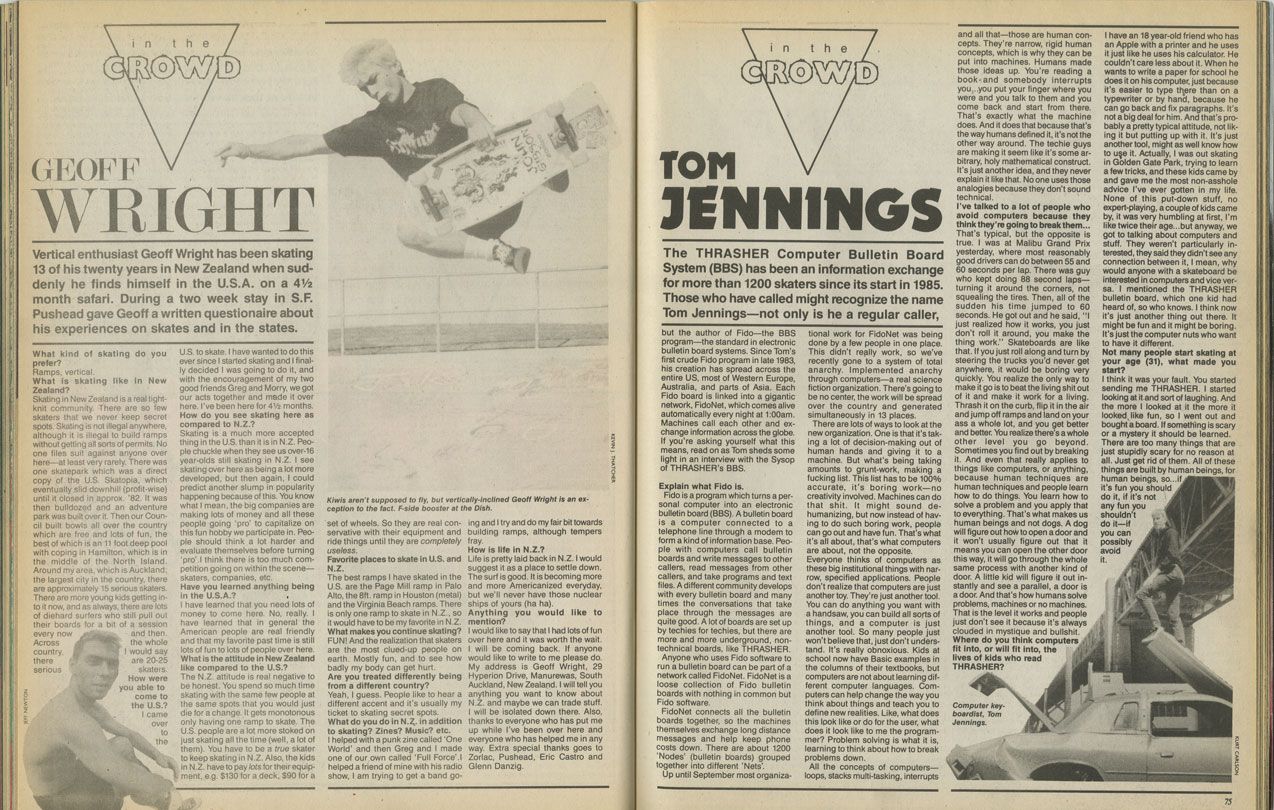
Page Text
            in the
CROWD
GEOFF
WRIGHT
Vertical enthusiast Geoff Wright has been skating
13 of his twenty years in New Zealand when sud-
denly he finds himself in the U.S.A. on a 4½
month safari. During a two week stay in S.F.
Pushead gave Geoff a written questionaire about
his experiences on skates and in the states.
What kind of skating do you
prefer?
Ramps, vertical.
What is skating like in New
Zealand?
Skating in New Zealand is a real tight-
knit community. There are so few
skaters that we never keep secret
spots. Skating is not illegal anywhere,
although it is illegal to build ramps
without getting all sorts of permits. No
one files suit against anyone over
here-at least very rarely. There was
one skatepark which was a direct
copy of the US. Skatopia, which
eventually slid downhill (profit-wise)
until it closed in approx. 82. It was
then bulldozed and an adventure
park was built over it. Then our Coun
cil built bowls all over the country
which are free and lots of fun, the
best of which is an 11 foot deep pool
with coping in Hamilton, which is in
the middle of the North Island.
Around my area, which is Auckland;
the largest city in the country, there
are approximately 15 serious skaters.
There are more young kids getting in-
to it now, and as always, there are lots
of diehard surfers who still pull out
their boards for a bit of a session
every now
Across
country,
there
serious
and then.
the whole
I would say
are 20-25
skaters
How were
you able to
come to
the U.S.?
I came
the
U.S. to skate. I have wanted to do this
ever since I started skating and I final-
ly decided I was going to do it, and
with the encouragement of my two
good friends Greg and Morry, we got
our acts together and made it over
here. I've been here for 4 months.
How do you see skating here as
compared to N.Z.?
Skating is a much more accepted
thing in the U.S. than it is in N.Z. Peo-
ple chuckle when they see us over-16
year-olds still skating in N.Z. I see
skating over here as being a lot more
developed, but then again, I could.
predict another slump in popularity
happening because of this. You know
what I mean, the big companies are
making lots of money and all these
people going 'pro' to capitalize on
this fun hobby we participate in. Peo-
ple should think a lot harder and
evaluate themselves before turning
'pro'.I think there is too much com-
petition going on within the scene-
skaters, companies, etc.
Have you learned anything being
in the U.S.A.?
I have learned that you need lots of
money to come here. No, really. I
have learned that in general the
American people are real friendly
and that my favorite past time is still
lots of fun to lots of people over here.
What is the attitude in New Zealand
like compared to the U.S.?
The N.Z attitude is real negative to
be honest. You spend so much time
skating with the same few people at
the same spots that you would just
die for a change. It gets monotonous
only having one ramp to skate. The
U.S. people are a lot more stoked on
just skating all the time (well, a lot of
them). You have to be a true skater
to keep skating in N.Z. Also, the kids
in N.Z. have to pay lots for their equip-
ment, eg. $130 for a deck, $90 for a
Kiwis aren't supposed to fly, but vertically-inclined Geoff Wright is an ex-
ception to the fact. F-side booster at the Dish.
set of wheels. So they are real con- ing and I try and do my fair bit towards
servative with their equipment and building ramps, although tempers
ride things until they are completely fray.
useless.
Favorite places to skate in U.S. and
N.Z.
The best ramps I have skated in the
U.S. are the Page Mill ramp in Palo
Alto, the 8ft. ramp in Houston (metal)
and the Virginia Beach ramps. There
is only one ramp to skate in N.Z., so
it would have to be my favorite in N.Z.
What makes you continue skating? I
FUN! And the realization that skaters
are the most clued-up people on
earth. Mostly fun, and to see how
badly my body can get hurt.
Are you treated differently being
from a different country?
Yeah, I guess. People like to hear a
different accent and it's usually my
ticket to skating secret spots.
What do you do in N.Z. in addition
How is life in N.Z.?
Life is pretty laid back in N.Z. I would
suggest it as a place to settle down.
The surf is good. It is becoming more
and more Americanized everyday.
but we'll never have those nuclear
ships of yours (ha ha).
Anything you would like to
mention?
would like to say that I had lots of fun
over here and it was worth the wait.
I will be coming back. If anyone
would like to write to me please do.
My address is Geoff Wright, 29
Hyperion Drive, Manurewas, South
Auckland, New Zealand. I will tell you
anything you want to know about
N.Z. and maybe we can trade stuff.
I will be isolated down there. Also,
thanks to everyone who has put me
to skating? Zines? Music? etc. up while I've been over here and
I helped with a punk zine called 'One
World' and then Greg and I made
everyone who has helped me in any
way. Extra special thanks goes to
one of our own called 'Full Force'.I Zorlac, Pushead, Eric Castro and
helped a friend of mine with his radio Glenn Danzig.
show, I am trying to get a band go-
TOM
in the
CROWD
JENNINGS
The THRASHER Computer Bulletin Board
System (BBS) has been an information exchange
for more than 1200 skaters since its start in 1985.
Those who have called might recognize the name
Tom Jennings-not only is he a regular caller,
but the author of Fido-the BBS
program-the standard in electronic
bulletin board systems. Since Tom's
first crude Fido program in late 1983,
his creation has spread across the
entire US, most of Western Europe,
Australia, and parts of Asia. Each
Fido board is linked into a gigantic
network, FidoNet, which comes alive
automatically every night at 1:00am.
Machines call each other and ex-
change information across the globe.
If you're asking yourself what this
means, read on as Tom sheds some
light in an interview with the Sysop
of THRASHER's BBS.
Explain what Fido is.
Fido is a program which turns a per-
sonal computer into an electronic
bulletin board (BBS). A bulletin board
is a computer connected to a
telephone line through a modem to
form a kind of information base. Peo-
ple with computers call bulletin
boards and write messages to other
callers, read messages from other
callers, and take programs and text
files. A different community develops
with every bulletin board and many
times the conversations that take
place through the messages are
quite good. A lot of boards are set up
by techies for techies, but there are
more and more underground, non-
technical boards, like THRASHER.
Anyone who uses Fido software to
run a bulletin board can be part of a
network called FidoNet. FidoNet is a
loose collection of Fido bulletin
boards with nothing in common but
Fido software.
FidoNet connects all the bulletin
boards together, so the machines
themselves exchange long distance
messages and help keep phone
costs down. There are about 1200
'Nodes' (bulletin boards) grouped
together into different 'Nets.
Up until September most organiza-
tional work for FidoNet was being
done by a few people in one place.
This didn't really work, so we've
recently gone to a system of total
anarchy. Implemented anarchy
through computers-a real science
fiction organization. There's going to
be no center, the work will be spread
over the country and generated
simultaneously in 13 places.
There are lots of ways to look at the
new organization. One is that it's tak-
ing a lot of decision-making out of
human hands and giving it to a
machine. But what's being taking
amounts to grunt-work, making a
fucking list. This list has to be 100%
accurate, it's boring work-no
creativity involved. Machines can do
that shit. It might sound de-
humanizing, but now instead of hav-
ing to do such boring work, people
can go out and have fun. That's what
it's all about, that's what computers
are about, not the opposite.
Everyone thinks of computers as
these big institutional things with nar
row, specified applications. People
don't realize that computers are just
another toy. They're just another tool.
You can do anything you want with
a handsaw, you can build all sorts of
things, and a computer is just
another tool. So many people just
won't believe that, just don't unders-
tand. It's really obnoxious. Kids at
school now have Basic examples in
the columns of their textbooks, but
computers are not about learning dif-
ferent computer languages. Com-
puters can help change the way you
think about things and teach you to
define new realities. Like, what does
this look like or do for the user, what
does it look like to me the program-
mer? Problem solving is what it is,
learning to think about how to break
problems down.
All the concepts of computers-
loops, stacks multi-tasking, interrupts
and all that-those are human con-
cepts. They're narrow, rigid human
concepts, which is why they can be
put into machines. Humans made
those ideas up. You're reading a
book and somebody interrupts
you...you put your finger where you
were and you talk to them and you
come back and start from there.
That's exactly what the machine
does. And it does that because that's
the way humans defined it, it's not the
other way around. The techie guys
are making it seem like it's some ar-
bitrary, holy mathematical construct.
It's just another idea, and they never
explain it like that. No one uses those
analogies because they don't sound
technical.
I've talked to a lot of people who
avoid computers because they
think they're going to break them...
That's typical, but the opposite is
true. I was at Malibu Grand Prix
yesterday, where most reasonably
good drivers can do between 55 and
60
seconds per lap. There was guy
turning it around the corners, not
who kept doing 88 second laps-
squealing the tires. Then, all of the
sudden his time jumped to 60
seconds. He got out and he said, "I
just realized how it works, you just
don't roll it around, you make the
thing work." Skateboards are like
that. If you just roll along and turn by
steering the trucks you'd never get
anywhere, it would be boring very
quickly. You realize the only way to
make it go is to beat the living shit out
of it and make it work for a living.
Thrash it on the curb, flip it in the air
and jump off ramps and land on your
ass a whole lot, and you get better
and better. You realize there's a whole
other level you go beyond.
Sometimes you find out by breaking
it. And even that really applies to
things like computers, or anything,
because human techniques are
human techniques and people learn
how to do things. You learn how to
solve a problem and you apply that
to everything. That's what makes us
human beings and not dogs. A dog
will figure out how to open a door and
it won't usually figure out that it
means you can open the other door
this way, it will go through the whole
same process with another kind of
door. A little kid will figure it out in-
stantly and see a parallel, a door is
a door. And that's how humans solve
problems, machines or no machines.
That is the level it works and people
just don't see it because it's always
clouded in mystique and bullshit.
Where do you think computers,
fit into, or will fit into, the
lives of kids who read
THRASHER?
Computer key-
boardist, Tom
Jennings.
I have an 18 year-old friend who has
an Apple with a printer and he uses
it just like he uses his calculator. He
couldn't care less about it. When he
wants to write a paper for school he
does it on his computer, just because
it's easier to type there than on a
typewriter or by hand, because he
can go back and fix paragraphs. It's
not a big deal for him. And that's pro-
bably a pretty typical attitude, not lik-
ing it but putting up with it. It's just
another tool, might as well know how
to use it. Actually, I was out skating
in Golden Gate Park, trying to learn
a few tricks, and these kids came by
and gave me the most non-asshole
advice I've ever gotten in my life.
None of this put-down stuff, no
expert-playing, a couple of kids came
by, it was very humbling at first, I'm
like twice their age...but anyway, we
got to talking about computers and
stuff. They weren't particularly in-
terested, they said they didn't see any
connection between it, I mean, why
would anyone with a skateboard be
interested in computers and vice ver-
sa. I mentioned the THRASHER
bulletin board, which one kid had
heard of, so who knows. I think now
it's just another thing out there. It
might be fun and it might be boring.
It's just the computer nuts who want
to have it different.
Not many people start skating at
your age (31), what made you
start?
I think it was your fault. You started
sending me THRASHER. I started
looking at it and sort of laughing. And
the more I looked at it the more it
looked, like fun, so I went out and
bought a board. If something is scary
or a mystery it should be learned.
There are too many things that are
just stupidly scary for no reason at
all. Just get rid of them. All of these
things are built by human beings, for
human beings, so...if
it's fun you should
do it, if it's not
any fun you
shouldn't
do it-if
you can
possibly
avoid
it.