Page Text
            TRIANGLE BUILDING METHOD
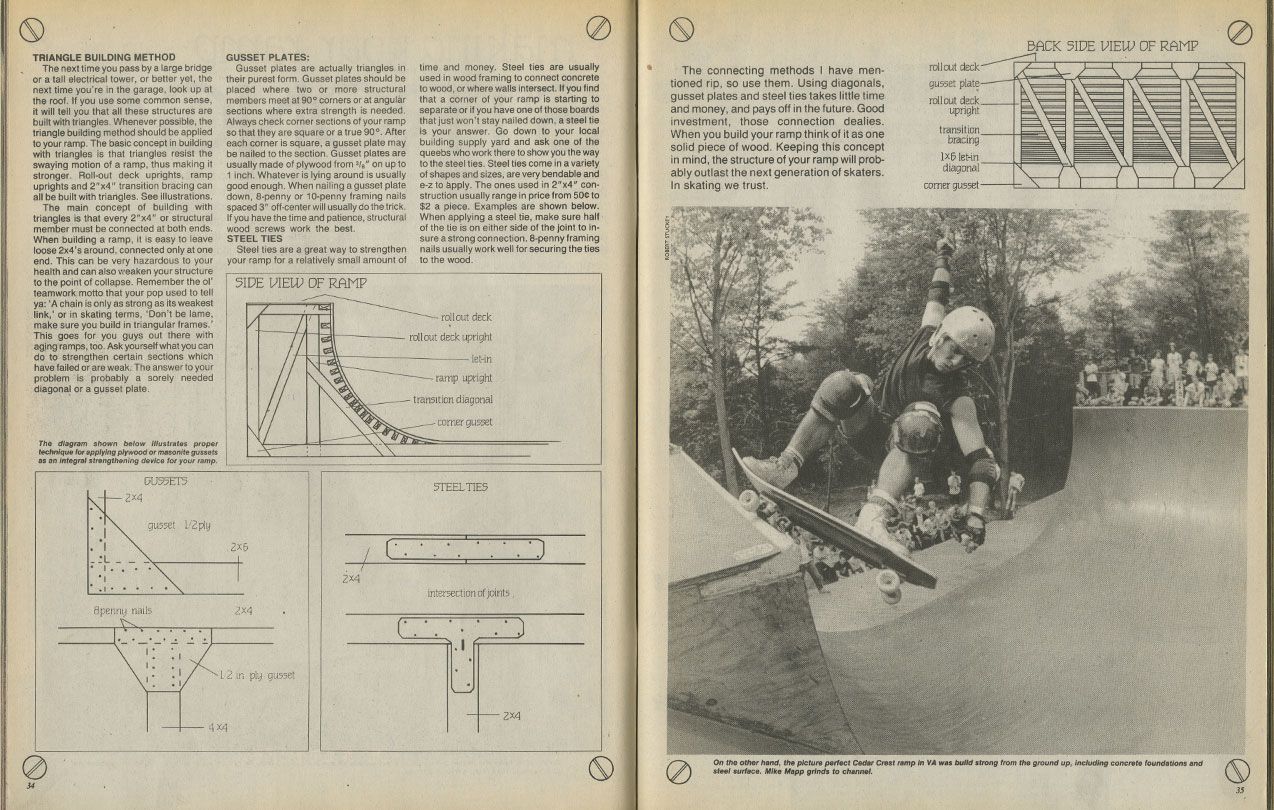
The next time you pass by a large bridge
or a tall electrical tower, or better yet, the
next time you're in the garage, look up at
the roof. If you use some common sense,
it will tell you that all these structures are
built with triangles. Whenever possible, the
triangle building method should be applied
to your ramp. The basic concept in building
with triangles is that triangles resist the
swaying motion of a ramp, thus making it
stronger. Roll-out deck uprights, ramp
uprights and 2"x4" transition bracing can
all be built with triangles. See illustrations.
The main concept of building with
triangles is that every 2"x4" or structural
member must be connected at both ends.
When building a ramp, it is easy to leave
loose 2x4's around, connected only at one
end. This can be very hazardous to your
health and can also weaken your structure
to the point of collapse. Remember the ol'
teamwork motto that your pop used to tell
ya: 'A chain is only as strong as its weakest
link, or in skating terms, 'Don't be lame,
make sure you build in triangular frames."
This goes for you guys out there with
aging ramps, too. Ask yourself what you can
do to strengthen certain sections which
have failed or are weak. The answer to your
problem is probably a sorely needed
diagonal or a gusset plate.
GUSSET PLATES:
Gusset plates are actually triangles in
their purest form. Gusset plates should be
placed where two or more structural
members meet at 90° corners or at angular
sections where extra strength is needed..
Always check corner sections of your ramp
so that they are square or a true 90°. After
each corner is square, a gusset plate may
be nailed to the section. Gusset plates are
usually made of plywood from " on up to
1 inch. Whatever is lying around is usually
good enough. When nailing a gusset plate
down, 8-penny or 10-penny framing nails.
spaced 3" off-center will usually do the trick.
If you have the time and patience, structural
wood screws work the best.
STEEL TIES
Steel ties are a great way to strengthen
your ramp for a relatively small amount of
SIDE VIEW OF RAMP
time and money. Steel ties are usually
used in wood framing to connect concrete
to wood, or where walls intersect. If you find
that a corner of your ramp is starting to
separate or if you have one of those boards
that just won't stay nailed down, a steel tie
is your answer. Go down to your local
building supply yard and ask one of the
queebs who work there to show you the way
to the steel ties. Steel ties come in a variety
of shapes and sizes, are very bendable and
e-z to apply. The ones used in 2"x4" con-
struction usually range in price from 50¢ to
$2 a piece. Examples are shown below.
When applying a steel tie, make sure half
of the tie is on either side of the joint to in-
sure a strong connection. 8-penny framing
nails usually work well for securing the ties
to the wood.
rollout deck
roll out deck upright
-let-in
ramp upright
transition diagonal
comer gusset
The connecting methods I have men-
tioned rip, so use them. Using diagonals,
gusset plates and steel ties takes little time
and money, and pays off in the future. Good
investment, those connection dealies.
When you build your ramp think of it as one
solid piece of wood. Keeping this concept
in mind, the structure of your ramp will prob-
ably outlast the next generation of skaters.
In skating we trust.
rollout deck-
gusset plate-
rollout deck.
upright
transition,
bracing
1x6 let-in
diagonal
comer gusset
The diagram shown below illustrates proper
technique for applying plywood or masonite gussets
as an integral strengthening device for your ramp.
GUSSETS
34
STEEL TIES
2x4
gusset 1/2ply
2x6
2x4
intersection of joints
8penny nails
2x4
-12 in ply gusset
4x4
2x4
BACK SIDE VIEW OF RAMP
On the other hand, the picture perfect Cedar Crest ramp in VA was build strong from the ground up, including concrete foundations and
steel surface. Mike Mapp grinds to channel.
10
35