Page Text
            Skater's Edge
22
There I was, the designated head judge,
talking with a group of five judges desperate-
ly attempting to come up with some criteria
for judging. Someone handed me a piece
of paper with a format they for the 'BMX'
portion of the competition and he sug-
gested we make it easy on ourselves and
just follow it. Slowly things began taking
shape that I had seen many times before.
the same scenario filled with nothing new
and no one caring. For example, no one
cared that only two of the five judges had
any real judging experience. Also, no one
cared that this important' judges meeting
was taking place about ten minutes before
the contest was scheduled to begin and
finally, no one really cared that we were no
better off after the judges meeting than we
were before. Oh sure, we spoke of judging
on 'style, fluidity,' 'amount of tricks,' 'use
of the ramp,' and that all-encompassing term
'radicalness,' but the dialogue was so worn
out it almost made my head spin. Once
again, as it has occurred many times before,
the judges parted ways each with his own
thoughts.
I pondered what had just occurred, how
many times it had occurred in the past, and
how many times it had lead up to a terrible
contest and I decided I wanted no part in
the proceedings. I left, deciding that tacos
and margaritas with my girlfriend was more
important that judging a contest doomed
for failure. Upon my return to spectate, I
happily noticed I had been replaced as head
judge because, as one of the promoters
put it, my "professional attitude as a judge
was not showing through." I watched each
pro take a few runs, decided who was skating
the best, and I split.
Over the next couple of weeks I thought
about that scene, how it had unfolded and
how no one really cared. Then I thought
back to the last time I attended a really
enjoyable skateboard contest. It had been
virtually years since I attended a contest
that showcased an extremely high level of "
modern skating. That ridiculous scene with
the judges, promoters, and my eventual re-
moval from the judges panel really opened
my eyes to an even bigger problem with
modern competitions, that is, they fail mis-
erably to bring out the highest levels of
skating today.
The causes for this problem are deep
in the structures of skateboard competi-
tion. For example, most contests are long
and tiring two day events, or even worse,
crammed into one long, busy day. Your
average skater must endure scheduled
practice sessions, preliminary heats, quar-
ter finals, semi-finals, finals and then pos-
sibly a head to head format or a jam. He
must skate in an extremely controlled envi-
ronment, minimizing his falls, following set
routines, banking on safe points to advance
him up the ladder to the final round. He
must learn to control his energy and adren-
aline, saving his best for last and all the
while, skating when he has to, not when
a low score for the judges
Bob Denike
he wants to. He can't let the pressure from
his fellow competitors affect him, the pres-
sure from the crowd and from the judges,
who after all, will tell him the final story. But
now you have to ask yourself, is competition
and all the B.S. your competitor must endure
cater to him delivering the best skating he
can give, and in turn, what the spectators
really want?
And what does the average skate spec-
tator want out of a contest? After all, paying
an inflated fee, squeezing yourself on unsafe
bleachers with hundreds of other smelly,
sweaty, sunburned skate fans, and most
of the time seeing the back of someone's
head rather than the action, can't be that
much fun. The answer to what the spectator
wants can be seen at the end of every con-
test. What occurs when the last run is taken,
The finals are over and the judges hold up
their last scores? Think about it, everyone
splits. The crowd disperses into the parking
lot, and when the winners are announced,
only about 1/10th of those who witnessed
the event really care who won.
Take for proof another example of your
average round in a contest. Skater 'X' drops
in, does a well-prepared routine filled with
all the essentials to receive a good score,
and he exits. The crowd applauds, the judges
give him a good score and the announcer
goes into, "...well now that was a really
strategic run for so and so..." etc. Now
skater 'Y' drops in with a different approach.
He starts off with consecutive backside
airs into table top alley cops, then an in-
credibly high rocket air until he pitches out
on a lein air, hanging on only to catch on
the lip and flail to the bottom. For his efforts
he receives a low score from the judges,
probably because he fell, and the crowd
doesn't applaud. They aren't applauding be-
cause they are too busy screaming at the
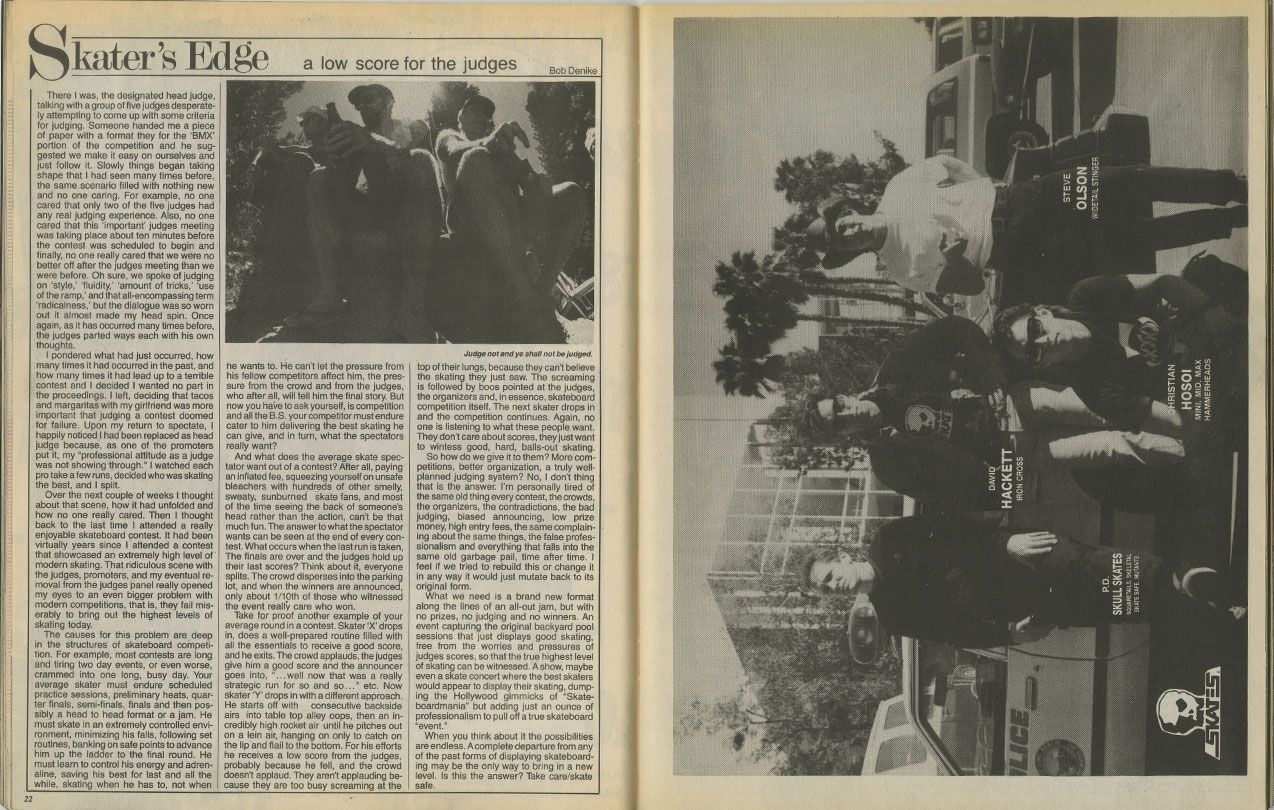
Judge not and ye shall not be judged
top of their lungs, because they can't believe
the skating they just saw. The screaming
is followed by boos pointed at the judges,
the organizers and, in essence, skateboard
competition itself. The next skater drops in
and the competition continues. Again, no
one is listening to what these people want.
They don't care about scores, they just want
to wintess good, hard, balls-out skating.
So how do we give it to them? More com-
petitions, better organization, a truly well-
planned judging system? No, I don't thing
that is the answer. I'm personally tired of
the same old thing every contest, the crowds,
the organizers, the contradictions, the bad
judging, biased announcing, low prize
money, high entry fees, the same complain-
ing about the same things, the false profes-
sionalism and everything that falls into the
same old garbage pail, time after time. I
feel if we tried to rebuild this or change it
in any way it would just mutate back to its
original form.
What we need is a brand new format
along the lines of an all-out jam, but with
no prizes, no judging and no winners. An
event capturing the original backyard pool
sessions that just displays good skating,
free from the worries and pressures of
judges scores, so that the true highest level
of skating can be witnessed. A show, maybe
even a skate concert where the best skaters
would appear to display their skating, dump-
ing the Hollywood gimmicks of "Skate-
boardmania" but adding just an ounce of
professionalism to pull off a true skateboard
"event."
When you think about it the possibilities
are endless. A complete departure from any
of the past forms of displaying skateboard-
ing may be the only way to bring in a new
level. Is this the answer? Take care/skate
safe.
LICE
IOSOH
SKATES
HAMMERHEADS
STEVE
OLSON
WIDETAIL STINGER