Page Text
            Setting
Up
A
Killer
Street
AXE
STREET SKATERS' SURVIVAL GUIDE
by Billy Runaway
When vert is nowhere to be found and
you're too poor to buy wood, too scared to
steal it, can't do slalom and freestyle just
bores you... what can you do? Either a) Be-
come a rock star, or b) Join an ever growing
and ever popular army of skaters: The
street force!
The modern day street skater is capable
of exploiting his or her surrounding environ-
ment to it's maximum potential thru crea-
tive use of board and body. Any bump,
ledge, curb or bank becomes an instant
session, and instant fun, creating your own
is the name of the game here. With the aid
of the proper equipment and a respectable
LQ., you'll be on your way.
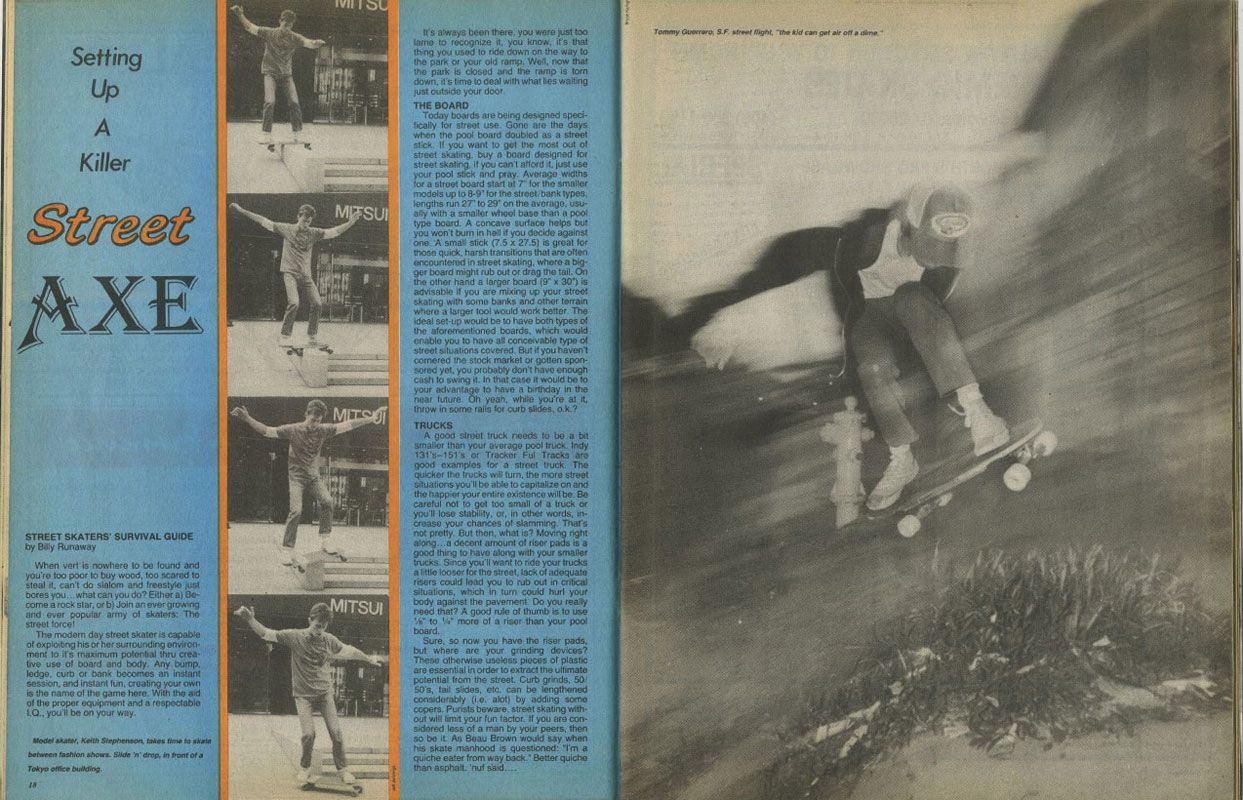
Model skater, Keith Stephenson, takes time to skate
between fashion shows. Slide 'n' drop, in front of a
Tokyo office building.
MITSUI
MITSUI
MITSUI
It's always been there, you were just too
lame to recognize it, you know, it's that
thing you used to ride down on the way to
the park or your old ramp, Well, now that
the park is closed and the ramp is torn
down, it's time to deal with what lies waiting
just outside your door.
THE BOARD
Today boards are being designed speci-
fically for street use. Gone are the days
when the pool board doubled as a street
stick. If you want to get the most out of
street skating, buy a board designed for
street skating, if you can't afford it, just use
your pool stick and pray. Average widths
for a street board start at 7" for the smaller
models up to 8-9 for the street/bank types,
lengths run 27 to 29 on the average, usu-
ally with a smaller whool base than a pool
type board. A concave surface helps but
you won't burn in hell if you decide against
one. A small stick (7.5 x 27.5) is great for
those quick, harsh transitions that are often
encountered in street skating, where a big-
ger board might rub out or drag the tail. On
the other hand a larger board (9" x 30") is
advisable if you are mixing up your street
skating with some banks and other terrain
where a larger tool would work better. The
ideal set-up would be to have both types of
the aforementioned boards, which would
enable you to have all conceivable type of
street situations covered. But if you haven't
comered the stock market or gotten spon-
sored yet, you probably don't have enough
cash to swing it. In that case it would be to
your advantage to have a birthday in the
near future. Oh yeah, while you're at it,
throw in some rails for curb slides, o.k.?
TRUCKS
A good street truck needs to be a bit
smaller than your average pool truck. Indy
131's-151's or Tracker Ful Tracks are
good examples for a street truck. The
quicker the frucks will turn, the more street
situations you'll be able to capitalize on and
the happier your entire existence will be. Be
careful not to get too small of a truck or
you'll lose stability, or, in other words, in-
crease your chances of slamming. That's
not pretty. But then, what is? Moving right
along...a decent amount of riser pads is a
good thing to have along with your smaller
trucks. Since you'll want to ride your trucks
a little looser for the street, lack of adequate
risers could lead you to rub out in critical
situations, which in turn could hurl your
body against the pavement. Do you really
need that? A good rule of thumb is to use
to more of a riser than your pool
board.
Sure, so now you have the riser pads,
but where are your grinding devices?
These otherwise useless pieces of plastic
are essential in order to extract the ultimate
potential from the street. Curb grinds, 50/
50's, tail slides, etc. can be lengthened
considerably (ie. alot) by adding some
copers. Purists beware, street skating with-
out will limit your fun factor. If you are con-
sidered less of a man by your peers, then
so be it. As Beau Brown would say when
his skate manhood is questioned: "I'm a
quiche eater from way back." Better quiche
than asphalt. 'nuf said....
Tommy Guerrero, S.F. street flight, the c
18