Page Text
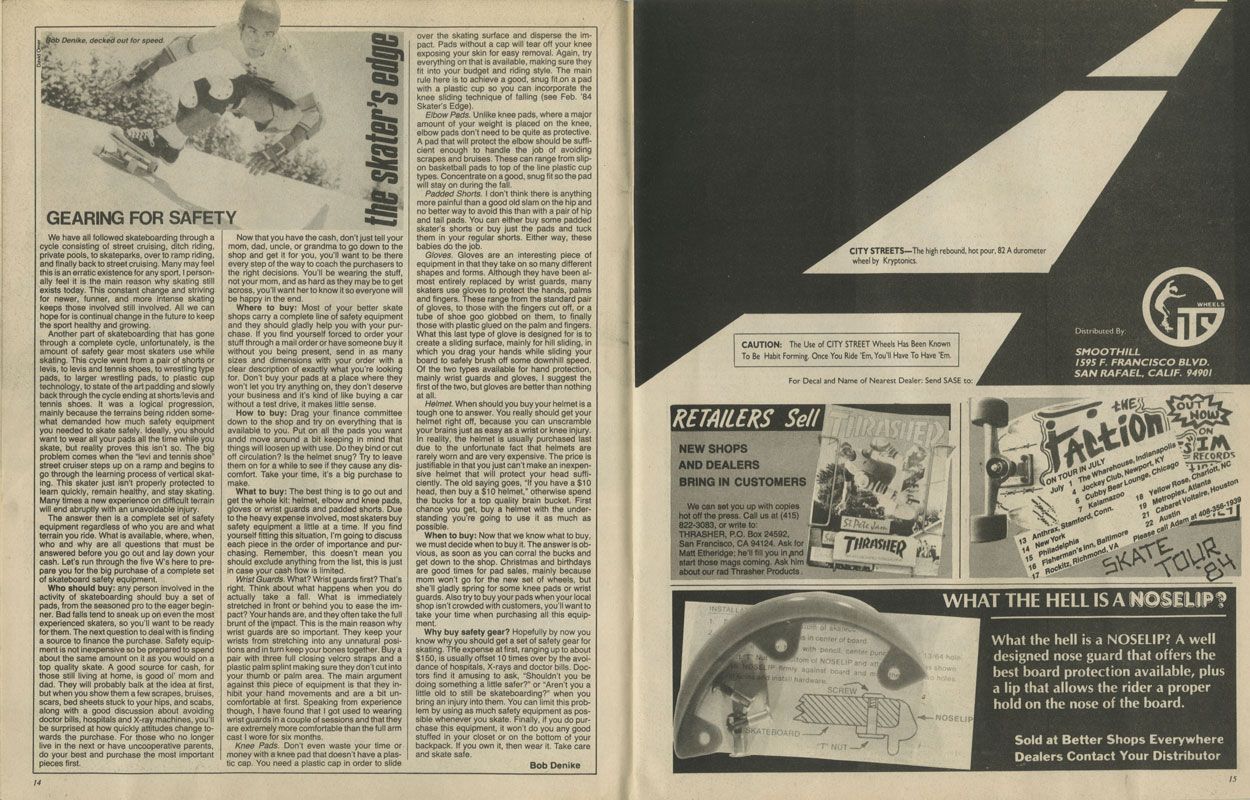
            Bob Denike, decked out for speed.
GEARING FOR SAFETY
We have all followed skateboarding through a
cycle consisting of street cruising, ditch riding.
private pools, to skateparks, over to ramp riding.
and finally back to street cruising. Many may feel
this is an erratic existence for any sport, I person
ally feel it is the main reason why skating still
exists today. This constant change and striving
for newer, funner, and more intense skating
keeps those involved still involved. All we can
hope for is continual change in the future to keep
the sport healthy and growing
Another part of skateboarding that has gone
through a complete cycle, unfortunately, is the
amount of safety gear most skaters use while
skating. This cycle went from a pair of shorts or
levis, to levis and tennis shoes, to wrestling type.
pads, to larger wrestling pads, to plastic cup
technology, to state of the art padding and slowly
back through the cycle ending at shorts/levis and
tennis shoes. It was a logical progression,
mainly because the terrains being ridden some-
what demanded how much safety equipment
you needed to skate safely. Ideally, you should
want to wear all your pads all the time while you
skate, but reality proves this isn't so. The big
problem comes when the "levi and tennis shoe
street cruiser steps up on a ramp and begins to
go through the learning process of vertical skat-
ing. This skater just isn't properly protected to
learn quickly, remain healthy, and stay skating.
Many times a new experience on difficult terrain
will end abruptly with an unavoidable injury.
The answer then is a complete set of safety
equipment regardless of who you are and what
terrain you ride. What is available, where, when,
who and why are all questions that must be
answered before you go out and lay down your
cash. Let's run through the five W's here to pre-
pare you for the big purchase of a complete set
of skateboard safety equipment.
Who should buy: any person involved in the
activity of skateboarding should buy a set of
pads, from the seasoned pro to the eager begin-
ner. Bad falls tend to sneak up on even the most
experienced skaters, so you'll want to be ready
for them. The next question to deal with is finding
a source to finance the purchase. Safety equip-
ment is not inexpensive so be prepared to spend
about the same amount on it as you would on a
top quality skate. A good source for cash, for
those still living at home, is good ol' mom and
dad. They will probably balk at the idea at first,
but when you show them a few scrapes, bruises,
scars, bed sheets stuck to your hips, and scabs,
along with a good discussion about avoiding
doctor bills, hospitals and X-ray machines, you'll
be surprised at how quickly attitudes change to-
wards the purchase. For those who no longer
live in the next or have uncooperative parents,
do your best and purchase the most important
pieces first
the skater's edge
Now that you have the cash, don't just tell your
mom, dad, uncle, or grandma to go down to the
shop and get it for you, you'll want to be there
every step of the way to coach the purchasers to
the right decisions. You'll be wearing the stuff,
not your mom, and as hard as they may be to get
across, you'll want her to know it so everyone will
be happy in the end.
Where to buy: Most of your better skate
shops carry a complete line of safety equipment
and they should gladly help you with your pur-
chase. If you find yourself forced to order your
stuff through a mail order or have someone buy it
without you being present, send in as many
sizes and dimensions with your order with a
clear description of exactly what you're looking
for. Don't buy your pads at a place where they
won't let you try anything on, they don't deserve
your business and it's kind of like buying a car
without a test drive, it makes little sense.
How to buy: Drag your finance committee -
down to the shop and try on everything that is
available to you. Put on all the pads you want
andd move around a bit keeping in mind that
things will loosen up with use. Do they bind or cut
off circulation? Is the helmet snug? Try to leave
them on for a while to see if they cause any dis-
comfort. Take your time, it's a big purchase to
make.
What to buy: The best thing is to go out and
get the whole kit: helmet, elbow and knee pads,
gloves or wrist guards and padded shorts. Due
to the heavy expense involved, most skaters buy
safety equipment a little at a time. If you find
yourself fitting this situation, I'm going to discuss
each piece in the order of importance and pur-
chasing. Remember, this doesn't mean you
should exclude anything from the list, this is just
in case your cash flow is limited.
Wrist Guards. What? Wrist guards first? That's
right. Think about what happens when you do
actually take a fall. What is immediately
stretched in front or behind you to ease the im-
pact? Your hands are, and they often take the full
brunt of the impact. This is the main reason why
wrist guards are so important. They keep your
wrists from stretching into any unnatural posi
tions and in turn keep your bones together. Buy a
pair with three full closing velcro straps and a
plastic palm splint making sure they don't cut into
your thumb or palm area. The main argument
against this piece of equipment is that they in-
hibit your hand movements and are a bit un-
comfortable at first. Speaking from experience
though, I have found that I got used to wearing
wrist guards in a couple of sessions and that they
are extremely more comfortable than the full arm
cast I wore for six months.
Knee Pads. Don't even waste your time or
money with a knee pad that doesn't have a plas-
tic cap. You need a plastic cap in order to slide
over the skating surface and disperse the im-
pact. Pads without a cap will tear off your knee
exposing your skin for easy removal. Again, try
everything on that is available, making sure they
fit into your budget and riding style. The main
rule here is to achieve a good, snug fit on a pad
with a plastic cup so you can incorporate the
knee sliding technique of falling (see Feb. '84
Skater's Edge).
Elbow Pads. Unlike knee pads, where a major
amount of your weight is placed on the knee,
elbow pads don't need to be quite as protective.
A pad that will protect the elbow should be suffi-
cient enough to handle the job of avoiding
scrapes and bruises. These can range from slip-
on basketball pads to top of the line plastic cup
types. Concentrate on a good, snug fit so the pad
will stay on during the fall.
Padded Shorts. I don't think there is anything
more painful than a good old slam on the hip and
no better way to avoid this than with a pair of hip
and tail pads. You can either buy some padded
skater's shorts or buy just the pads and tuck
them in your regular shorts. Either way, these
babies do the job.
Gloves Gloves are an interesting piece of
equipment in that they take on so many different
shapes and forms. Although they have been al-
most entirely replaced by wrist guards, many
skaters use gloves to protect the hands, palms
and fingers. These range from the standard pair
of gloves, to those with the fingers cut off, or a
tube of shoe goo globbed on them, to finally
those with plastic glued on the palm and fingers.
What this last type of glove is designed for is to
create a sliding surface, mainly for hill sliding, in
which you drag your hands while sliding your
board to safely brush off some downhill speed.
Of the two types available for hand protection,
mainly wrist guards and gloves, I suggest the
first of the two, but gloves are better than nothing
at all.
Helmet. When should you buy your helmet is a
tough one to answer. You really should get your
helmet right off, because you can unscramble
your brains just as easy as a wrist or knee injury.
In reality, the helmet is usually purchased last
due to the unfortunate fact that helmets are
rarely worn and are very expensive. The price is
justifiable in that you just can't make an inexpen-
sive helmet that will protect your head suffi-
ciently. The old saying goes, "If you have a $10
head, then buy a $10 helmet," otherwise spend
the bucks for a top quality brain bucket. First
chance you get, buy a helmet with the under-
standing you're going to use it as much as
possible.
When to buy: Now that we know what to buy,
we must decide when to buy it. The answer is ob-
vious, as soon as you can corral the bucks and
get down to the shop. Christmas and birthdays
are good times for pad sales, mainly because
mom won't go for the new set of wheels, but
she'll gladly spring for some knee pads or wrist
guards. Also try to buy your pads when your local
shop isn't crowded with customers, you'll want to
take your time when purchasing all this equip-
ment
Why buy safety gear? Hopefully by now your
know why you should get a set of safety gear for
skating. The expense at first, ranging up to about
$150, is usually offset 10 times over by the avol-
dance of hospitals, X-rays and doctor bills. Doc-
tors find it amusing to ask, "Shouldn't you be
doing something a little safer?" or "Aren't you a
little old to still be skateboarding?" when you
bring an injury into them. You can limit this prob-
lem by using as much safety equipment as pos
sible whenever you skate. Finally, if you do pur-
chase this equipment, it won't do you any good
stuffed in your closet or on the bottom of your
backpack. If you own it, then wear it. Take care
and skate safe.
Bob Denike
CITY STREETS-The high rebound, hot pour, 82 A durometer
wheel by Kryptonics
CAUTION: The Use of CITY STREET Wheels Has Been Known
To Be Habit Forming, Once You Ride 'Em, You'll Have To Have 'Em
For Decal and Name of Nearest Dealer: Send SASE to:
RETAILERS Sell THRASHED
NEW SHOPS
AND DEALERS
BRING IN CUSTOMERS
We can set you up with copies
hot off the press. Call us at (415)
822-3083, or write to:
THRASHER, P.O. Box 24592,
San Francisco, CA 94124. Ask for
Matt Etheridge; he'll fill you in and
start those mags coming. Ask him
about our rad Thrasher Products.
St Pete Jam
THRASHER
INSTALLA
s in center of board
with pencil center pung
tom of NOSELIP and att
NOSIP my against board and m
install hardware
SCREW
SKATEBOARD
TNUT
Distributed By:
SMOOTHILL
1595 F. FRANCISCO BLVD.
SAN RAFAEL, CALIF. 94901
HE
TALLION
FOUTL
NOW
July 1 The Wharehouse, Indianapolis
ON TOUR IN JULY
4 Jockey Club, Newport, KY
6 Cubby Bear Lounge, Chicago
7 Kalamazoo
13 Anthrax, Stamford, Conn
14 New York
15 Philadelphia
16 Fisherman's Inn, Baltimore
17 Rockitz, Richmond, VA
ON
SIM
18 Yellow Rose,
RECORDS
19 Metroplex, Atlanta
NC
21 Cabaret Voltaire, Houston
22 Austin
Please call Adam at 408-356-1939
SKATE
TOUR
84
WHAT THE HELL IS A NOSELIP?
13/64 hole
No holes
NOSELIP
What the hell is a NOSELIP? A well
designed nose guard that offers the
best board protection available, plus
a lip that allows the rider a proper
hold on the nose of the board.
Sold at Better Shops Everywhere
Dealers Contact Your Distributor
14
15