Page Text
            THE
AY
RAMP
SEA FLEX
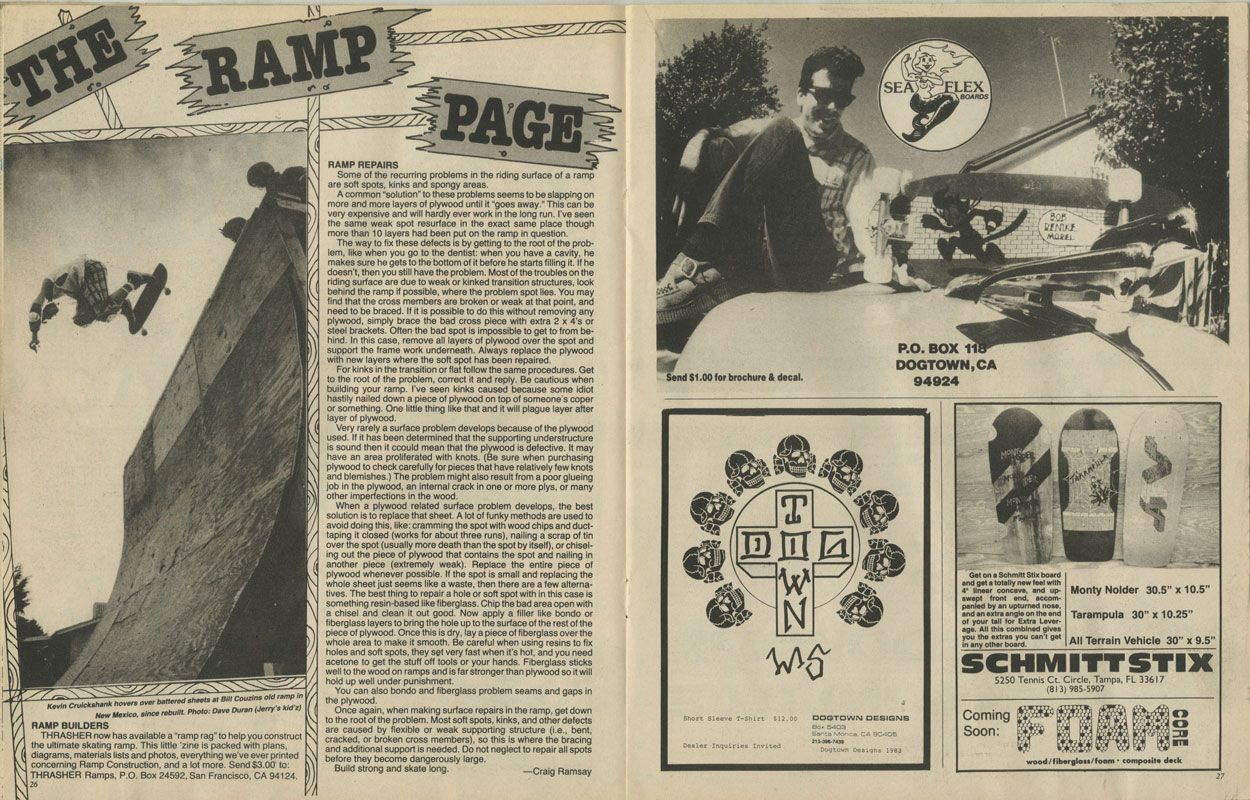
Kevin Cruickshank hovers over battered sheets at Bill Couzins old ramp in
New Mexico, since rebuilt. Photo: Dave Duran (Jerry's kidz)
RAMP BUILDERS
THRASHER now has available a "ramp rag" to help you construct
the ultimate skating ramp. This little 'zine is packed with plans,
diagrams, materials lists and photos, everything we've ever printed
concerning Ramp Construction, and a lot more. Send $3.00 to:
THRASHER Ramps, P.O. Box 24592, San Francisco, CA 94124.
26
RAMP REPAIRS
PAGE
Some of the recurring problems in the riding surface of a ramp
are soft spots, kinks and spongy areas.
A common "solution" to these problems seems to be slapping on
more and more layers of plywood until it "goes away." This can be
very expensive and will hardly ever work in the long run. I've seen
the same weak spot resurface in the exact same place though
more than 10 layers had been put on the ramp in question.
The way to fix these defects is by getting to the root of the prob-
lem, like when you go to the dentist: when you have a cavity, he
makes sure he gets to the bottom of it before he starts filling it. If he
doesn't, then you still have the problem. Most of the troubles on the
riding surface are due to weak or kinked transition structures, look
behind the ramp if possible, where the problem spot lies. You may
find that the cross members are broken or weak at that point, and
need to be braced. If it is possible to do this without removing any
plywood, simply brace the bad cross piece with extra 2 x 4's or
steel brackets. Often the bad spot is impossible to get to from be-
hind. In this case, remove all layers of plywood over the spot and
support the frame work underneath. Always replace the plywood.
with new layers where the soft spot has been repaired.
For kinks in the transition or flat follow the same procedures. Get
to the root of the problem, correct it and reply. Be cautious when
building your ramp. I've seen kinks caused because some idiot
hastily nailed down a piece of plywood on top of someone's coper
or something. One little thing like that and it will plague layer after
layer of plywood.
Very rarely a surface problem develops because of the plywood
used. If it has been determined that the supporting understructure
is sound then it ccould mean that the plywood is defective. It may
have an area proliferated with knots. (Be sure when purchasing
plywood to check carefully for pieces that have relatively few knots
and blemishes.) The problem might also result from a poor glueing
job in the plywood, an internal crack in one or more plys, or many
other imperfections in the wood.
When a plywood related surface problem develops, the best.
solution is to replace that sheet. A lot of funky methods are used to
avoid doing this, like: cramming the spot with wood chips and duct-
taping it closed (works for about three runs), nailing a scrap of tin
over the spot (usually more death than the spot by itself), or chisel-
ing out the piece of plywood that contains the spot and nailing in
another piece (extremely weak). Replace the entire piece of
plywood whenever possible. If the spot is small and replacing the
whole sheet just seems like a waste, then there are a few alterna-
tives. The best thing to repair a hole or soft spot with in this case is
something resin-based like fiberglass. Chip the bad area open with
a chisel and clean it out good. Now apply a filler like bondo or
fiberglass layers to bring the hole up to the surface of the rest of the
piece of plywood. Once this is dry, lay a piece of fiberglass over the
whole area to make it smooth. Be careful when using resins to fix
holes and soft spots, they set very fast when it's hot, and you need
acetone to get the stuff off tools or your hands. Fiberglass sticks
well to the wood on ramps and is far stronger than plywood so it will
hold up well under punishment.
You can also bondo and fiberglass problem seams and gaps in
the plywood.
Once again, when making surface repairs in the ramp, get down
to the root of the problem. Most soft spots, kinks, and other defects
are caused by flexible or weak supporting structure (ie., bent,
cracked, or broken cross members), so this is where the bracing
and additional support is needed. Do not neglect to repair all spots
before they become dangerously large.
Build strong and skate long.
-Craig Ramsay
Send $1.00 for brochure & decal.
T
DIG
W
Mo
Short Sleeve T-Shirt $12.00
Dealer Inquiries Invited
BOARDS
P.O. BOX 118
DOGTOWN, CA
DOGTOWN DESIGNS
Box 5403
Santa Monica, CA 90405
213-09-743
Dogtown Designs 1983
94924
MONTE
BOB
RENIKE
MOREL
Get on a Schmitt Stix board
and get a totally new feel with
4 linear concave, and up- Monty Nolder 30.5" x 10.5"
swept front end, accom-
panied by an upturned nose,
and an extra angle on the end Tarampula 30" x 10.25"
of your tail for Extra Lever-
age. All this combined gives
you the extras you can't get All Terrain Vehicle 30" x 9.5"
in any other board.
SCHMITTSTIX
5250 Tennis Ct. Circle, Tampa, FL 33617
Coming
Soon:
(813) 985-5907
FORMS
wood/fiberglass/foam composite deck