Page Text
            12
THE SKATER'S EDGE/B
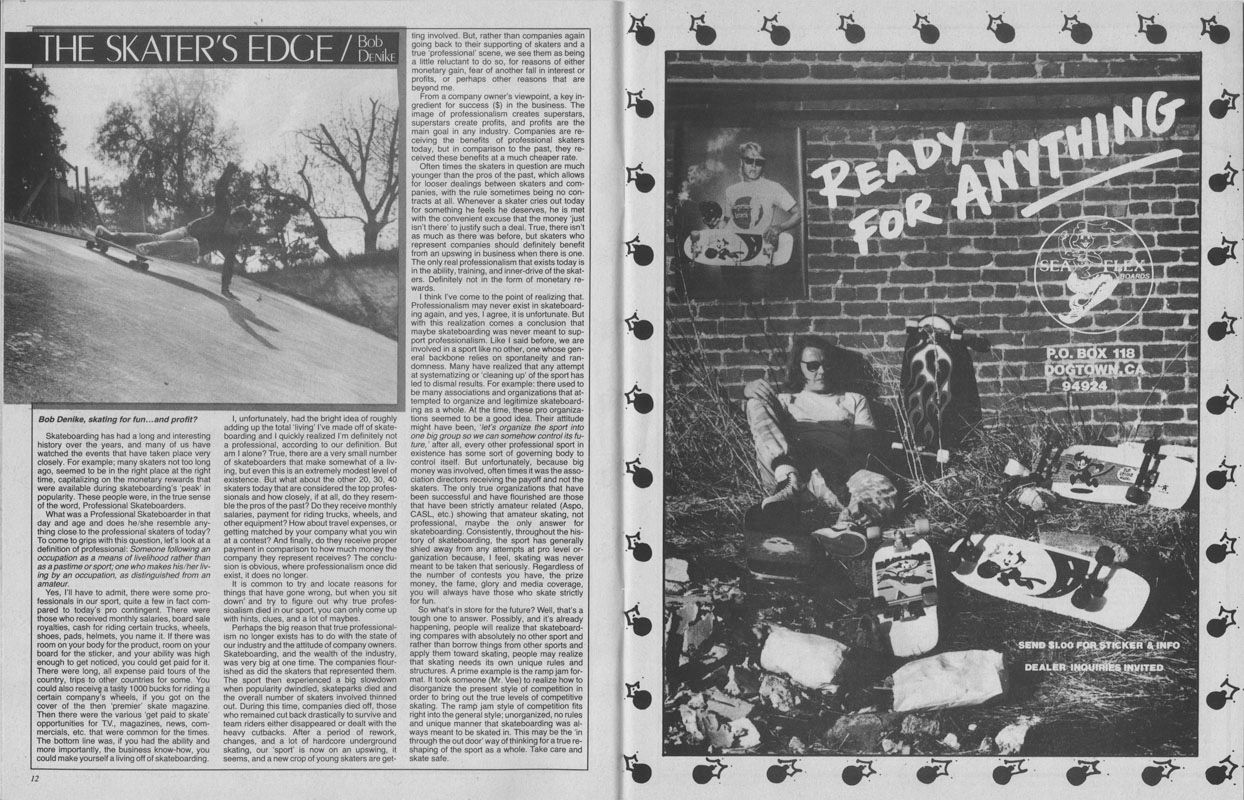
Bob Denike, skating for fun...and profit?
Skateboarding has had a long and interesting
history over the years, and many of us have
watched the events that have taken place very
closely. For example; many skaters not too long
ago, seemed to be in the right place at the right
time, capitalizing on the monetary rewards that
were available during skateboarding's 'peak' in
popularity. These people were, in the true sense
of the word, Professional Skateboarders.
What was a Professional Skateboarder in that
day and age and does he/she resemble any-
thing close to the professional skaters of today?
To come to grips with this question, let's look at a
definition of professional: Someone following an
occupation as a means of livelihood rather than
as a pastime or sport; one who makes his/her liv-
ing by an occupation, as distinguished from an
amateur.
Yes, I'll have to admit, there were some pro-
fessionals in our sport, quite a few in fact com-
pared to today's pro contingent. There were
those who received monthly salaries, board sale
royalties, cash for riding certain trucks, wheels,
shoes, pads, helmets, you name it. If there was
room on your body for the product, room on your
board for the sticker, and your ability was high
enough to get noticed, you could get paid for it.
There were long, all expense paid tours of the
country, trips to other countries for some. You
could also receive a tasty 1000 bucks for riding a
certain company's wheels, if you got on the
cover of the then 'premier' skate magazine.
Then there were the various 'get paid to skate
opportunities for TV, magazines, news, com-
mercials, etc. that were common for the times.
The bottom line was, if you had the ability and
more importantly, the business know-how, you
could make yourself a living off of skateboarding.
I, unfortunately, had the bright idea of roughly
adding up the total 'living' I've made off of skate-
boarding and I quickly realized I'm definitely not
a professional, according to our definition. But
am I alone? True, there are a very small number
of skateboarders that make somewhat of a liv-
ing, but even this is an extremely modest level of
existence. But what about the other 20, 30, 40
skaters today that are considered the top profes-
sionals and how closely, if at all, do they resem-
ble the pros of the past? Do they receive monthly
salaries, payment for riding trucks, wheels, and
other equipment? How about travel expenses, or
getting matched by your company what you win
at a contest? And finally, do they receive proper
payment in comparison to how much money the
company they represent receives? The conclu
sion is obvious, where professionalism once did
exist, it does no longer.
It is common to try and locate reasons for
things that have gone wrong, but when you sit
down' and try figure out why true profes
sioalism died in our sport, you can only come up
with hints, clues, and a lot of maybes.
Perhaps the big reason that true professional-
ism no longer exists has to do with the state of
our industry and the attitude of company owners.
Skateboarding, and the wealth of the industry.
was very big at one time. The companies flour-
ished as did the skaters that represented them.
The sport then experienced a big slowdown
when popularity dwindled, skateparks died and
the overall number of skaters involved thinned
out. During this time, companies died off, those
who remained cut back drastically to survive and
team riders either disappeared or dealt with the
heavy cutbacks. After a period of rework,
changes, and a lot of hardcore underground
skating, our 'sport' is now on an upswing, it
seems, and a new crop of young skaters are get-
ting involved. But, rather than companies again
going back to their supporting of skaters and a
true professional' scene, we see them as being
a little reluctant to do so, for reasons of either
monetary gain, fear of another fall in interest or
profits, or perhaps other reasons that are
beyond me.
From a company owner's viewpoint, a key in-
gredient for success ($) in the business. The
image of professionalism creates superstars,
superstars create profits, and profits are the
main goal in any industry. Companies are re-
ceiving the benefits of professional skaters
today, but in comparison to the past, they re-
ceived these benefits at a much cheaper rate.
Often times the skaters in question are much
younger than the pros of the past, which allows
for looser dealings between skaters and com-
panies, with the rule sometimes being no con-
tracts at all. Whenever a skater cries out today
for something he feels he deserves, he is met
with the convenient excuse that the money just
isn't there' to justify such a deal. True, there isn't
as much as there was before, but skaters who
represent companies should definitely benefit
from an upswing in business when there is one.
The only real professionalism that exists today is
in the ability, training, and inner-drive of the skat-
ers. Definitely not in the form of monetary re-
wards.
I think I've come to the point of realizing that.
Professionalism may never exist in skateboard-
ing again, and yes, I agree, it is unfortunate. But
with this realization comes a conclusion that
maybe skateboarding was never meant to sup-
port professionalism. Like I said before, we are
involved in a sport like no other, one whose gen-
eral backbone relies on spontaneity and ran-
domness. Many have realized that any attempt
at systematizing or 'cleaning up' of the sport has
led to dismal results. For example: there used to
be many associations and organizations that at-
tempted to organize and legitimize skateboard-
ing as a whole. At the time, these pro organiza-
tions seemed to be a good idea. Their attitude
might have been, 'let's organize the sport into
one big group so we can somehow control its fu-
ture, after all, every other professional sport in
existence has some sort of governing body to
control itself. But unfortunately, because big
money was involved, often times it was the asso-
ciation directors receiving the payoff and not the
skaters. The only true organizations that have
been successful and have flourished are those
that have been strictly amateur related (Aspo,
CASL, etc.) showing that amateur skating, not
professional, maybe the only answer for
skateboarding. Consistently, throughout the his-
tory of skateboarding, the sport has generally
shied away from any attempts at pro level or
ganization because, I feel, skating was never
meant to be taken that seriously. Regardless of
the number of contests you have, the prize
money, the fame, glory and media coverage,
you will always have those who skate strictly
for fun.
So what's in store for the future? Well, that's at
tough one to answer. Possibly, and it's already
happening, people will realize that skateboard-
ing compares with absolutely no other sport and
rather than borrow things from other sports and
apply them toward skating, people may realize
that skating needs its own unique rules and
structures. A prime example is the ramp jam for-
mat. It took someone (Mr. Vee) to realize how to
disorganize the present style of competition in
order to bring out the true levels of competitive
skating. The ramp jam style of competition fits
right into the general style; unorganized, no rules
and unique manner that skateboarding was al-
ways meant to be skated in. This may be the in
through the outdoor' way of thinking for a true re-
shaping of the sport as a whole. Take care and
skate safe.
READY
FOR ANYTHING
SEA FLEX
BOARDS
P.O. BOX 118
DOGTOWN CA
94924
SEND $1.00 FOR STICKER & INFO
DEALER INQUIRIES INVITED
H