Page Text
            SLIDING
Everyone-young, old, male or
female who intends to ride a skateboard
on the public roadways "should" learn
how to slide their skateboard. Then use
this technique to safely slow your speed
or stop completely if necessary.
WHY? SAFETY.
Have you ever been chased by a dog
while skating or had a car suddenly pull
from a driveway right in front of your line
of descent? Maybe you just took off on a
speed run and start to wobble before
you've reached the level or uphill run-off.
If you've encountered any of these or
many other frightening situations because
you happen to be going too fast to run it
out, then learn to slide and eliminate or
reduce the severity of these problems
permanently.
WHICH SLIDES & HOW TO
The first two slides to learn would be
the Bert and lay-back slides. Once
mastered, these basic slides will allow a
skateboarder to ride any road with at least
a fair surface. These slides, Bert and Lay-
back, are both the same except one starts
from the regular foot position and the Lay-
back starts from the fakie position.
34
STREET
SLIDIN'
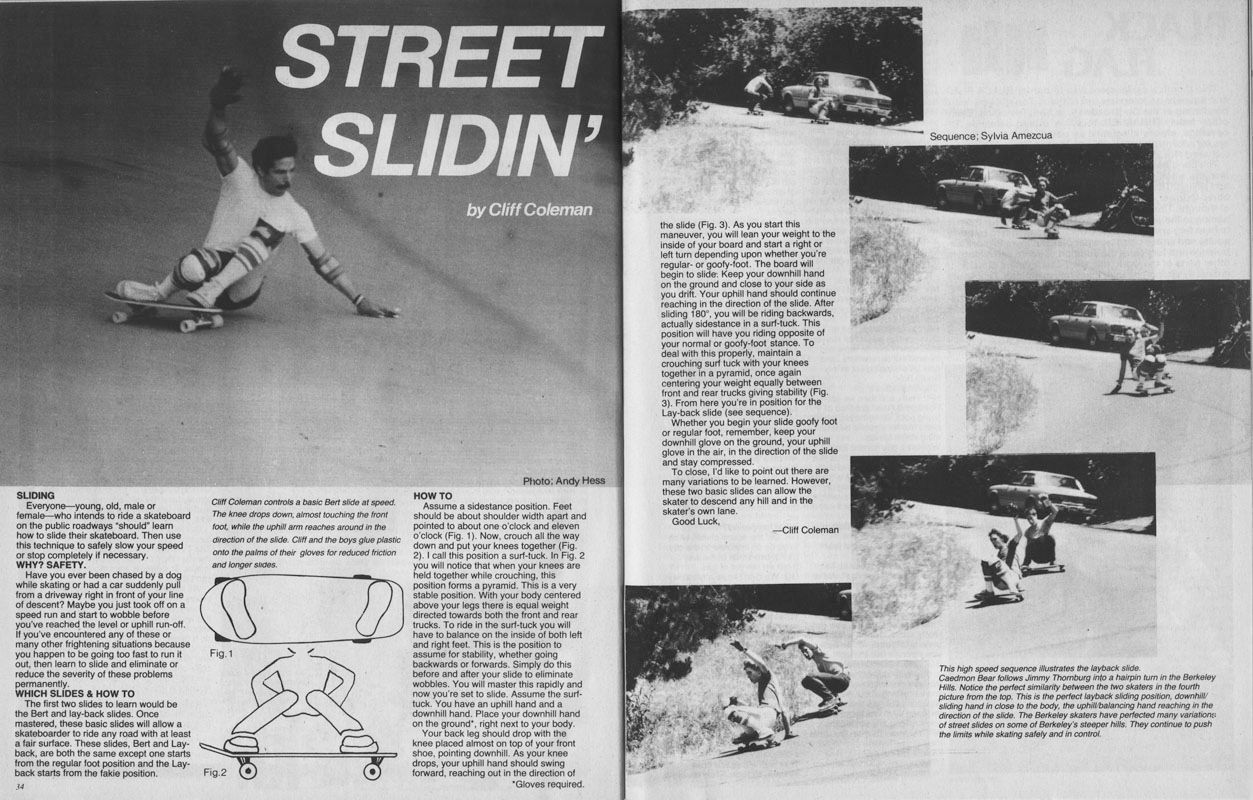
Cliff Coleman controls a basic Bert slide at speed.
The knee drops down, almost touching the front
foot, while the uphill arm reaches around in the
direction of the slide. Cliff and the boys glue plastic
onto the palms of their gloves for reduced friction
and longer sides.
Fig.1
Fig.2
HOW TO
by Cliff Coleman
Photo: Andy Hess
Assume a sidestance position. Feet
should be about shoulder width apart and
pointed to about one o'clock and eleven
o'clock (Fig. 1). Now, crouch all the way
down and put your knees together (Fig.
2). I call this position a surf-tuck. In Fig. 2
you will notice that when your knees are
held together while crouching, this
position forms a pyramid. This is a very
stable position. With your body centered
above your legs there is equal weight
directed towards both the front and rear
trucks. To ride in the surf-tuck you will
have to balance on the inside of both left
and right feet. This is the position to
assume for stability, whether going
backwards or forwards. Simply do this
before and after your slide to eliminate
wobbles. You will master this rapidly and
now you're set to slide. Assume the surf-
tuck. You have an uphill hand and a
downhill hand. Place your downhill hand
on the ground", right next to your body.
Your back leg should drop with the
knee placed almost on top of your front
shoe, pointing downhill. As your knee
drops, your uphill hand should swing
forward, reaching out in the direction of
"Gloves required.
the slide (Fig. 3). As you start this
maneuver, you will lean your weight to the
inside of your board and start a right or
left turn depending upon whether you're
regular- or goofy-foot. The board will
begin to slide. Keep your downhill hand
on the ground and close to your side as
you drift. Your uphill hand should continue
reaching in the direction of the slide. After
sliding 180", you will be riding backwards,
actually sidestance in a surf-tuck. This
position will have you riding opposite of
your normal or goofy-foot stance. To
deal with this properly, maintain a
crouching surf tuck with your knees
together in a pyramid, once again
centering your weight equally between
front and rear trucks giving stability (Fig.
3). From here you're in position for the
Lay-back slide (see sequence).
Whether you begin your slide goofy foot
or regular foot, remember, keep your
downhill glove on the ground, your uphill
glove in the air, in the direction of the slide
and stay compressed.
To close, I'd like to point out there are
many variations to be learned. However,
these two basic slides can allow the
skater to descend any hill and in the
skater's own lane.
Good Luck,
-Cliff Coleman
Sequence: Sylvia Amezcua
This high speed sequence ilustrates the layback slide.
Caedmon Bear follows Jimmy Thornburg into a hairpin turn in the Berkeley
Hills. Notice the perfect similarity between the two skaters in the fourth
picture from the top. This is the perfect layback sliding position, downhill/
sliding hand in close to the body, the uphill/balancing hand reaching in the
direction of the slide. The Berkeley skaters have perfected many variations
of street slides on some of Berkeley's steeper hills. They continue to push
the limits while skating safely and in control.