Page Text
            FLATLAND FOLLIES
IN CANADA
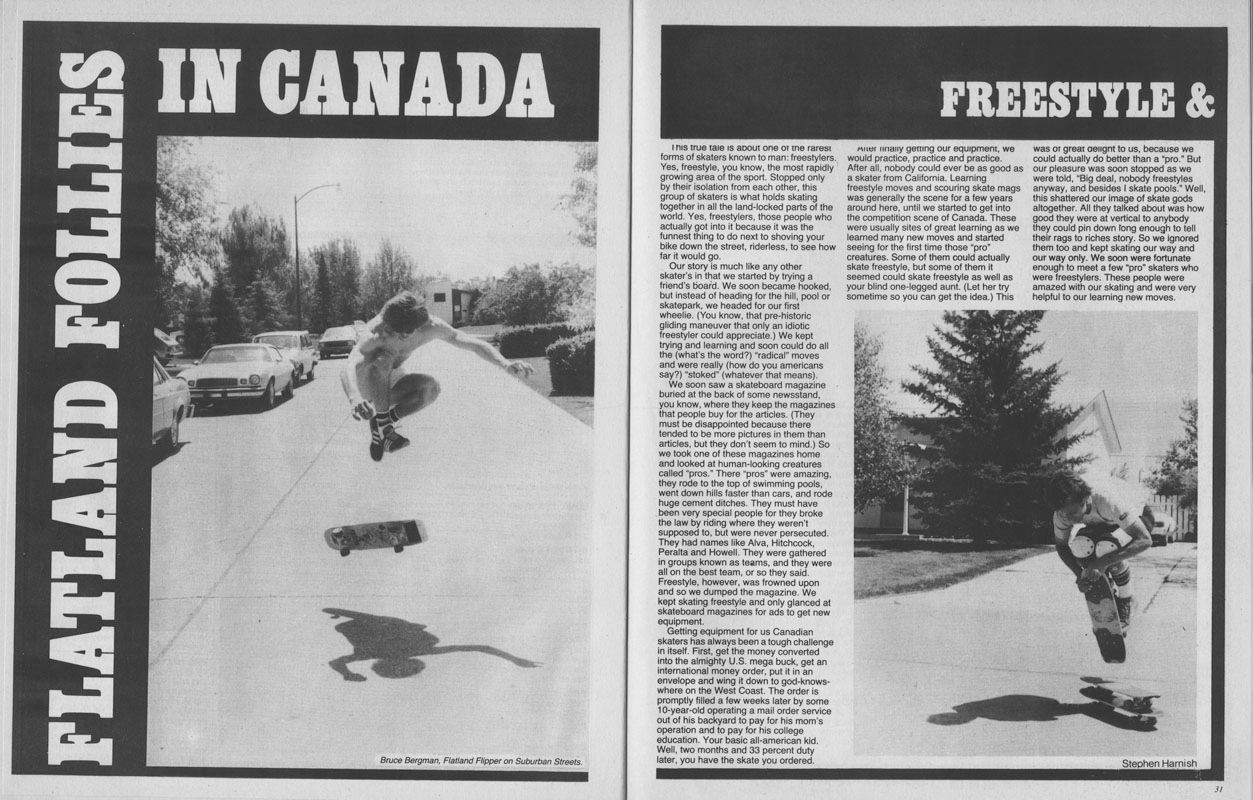
Bruce Bergman, Flatland Flipper on Suburban Streets.
FREESTYLE &
Inis true tale is about one of the rarest
forms of skaters known to man: freestylers.
Yes, freestyle, you know, the most rapidly
growing area of the sport. Stopped only
by their isolation from each other, this
group of skaters is what holds skating
together in all the land-locked parts of the
world. Yes, freestylers, those people who
actually got into it because it was the
funnest thing to do next to shoving your
bike down the street, riderless, to see how
far it would go.
Our story is much like any other
skater's in that we started by trying a
friend's board. We soon became hooked,
but instead of heading for the hill, pool or
skatepark, we headed for our first
wheelie. (You know, that pre-historic
gliding maneuver that only an idiotic
freestyler could appreciate.) We kept
trying and learning and soon could do all
the (what's the word?) "radical" moves
and were really (how do you americans
say?) "stoked" (whatever that means).
We soon saw a skateboard magazine
buried at the back of some newsstand,
you know, where they keep the magazines
that people buy for the articles. (They
must be disappointed because there
tended to be more pictures in them than
articles, but they don't seem to mind.) So.
we took one of these magazines home
and looked at human-looking creatures
called "pros." There "pros" were amazing,
they rode to the top of swimming pools,
went down hills faster than cars, and rode
huge cement ditches. They must have
been very special people for they broke
the law by riding where they weren't
supposed to, but were never persecuted.
They had names like Alva, Hitchcock,
Peralta and Howell. They were gathered
in groups known as teams, and they were
all on the best team, or so they said.
Freestyle, however, was frowned upon
and so we dumped the magazine. We
kept skating freestyle and only glanced at
skateboard magazines for ads to get new
equipment.
Getting equipment for us Canadian
skaters has always been a tough challenge
in itself. First, get the money converted
into the almighty U.S. mega buck, get an
international money order, put it in an
envelope and wing it down to god-knows-
where on the West Coast. The order is
promptly filled a few weeks later by some
10-year-old operating a mail order service
out of his backyard to pay for his mom's
operation and to pay for his college
education. Your basic all-american kid.
Well, two months and 33 percent duty
later, you have the skate you ordered.
Alter finally getting our equipment, we
would practice, practice and practice.
After all, nobody could ever be as good as
a skater from California. Learning
freestyle moves and scouring skate mags
was generally the scene for a few years
around here, until we started to get into
the competition scene of Canada. These
were usually sites of great learning as we
learned many new moves and started
seeing for the first time those "pro"
creatures. Some of them could actually
skate freestyle, but some of them it
seemed could skate freestyle as well as
your blind one-legged aunt. (Let her try
sometime so you can get the idea.) This
was or great designt to us, because we
could actually do better than a "pro." But
our pleasure was soon stopped as we
were told, "Big deal, nobody freestyles
anyway, and besides I skate pools." Well,
this shattered our image of skate gods
altogether. All they talked about was how
good they were at vertical to anybody
they could pin down long enough to tell
their rags to riches story. So we ignored
them too and kept skating our way and
our way only. We soon were fortunate
enough to meet a few "pro" skaters who
were freestylers. These people were
amazed with our skating and were very
helpful to our learning new moves.
後
Stephen Harnish
31