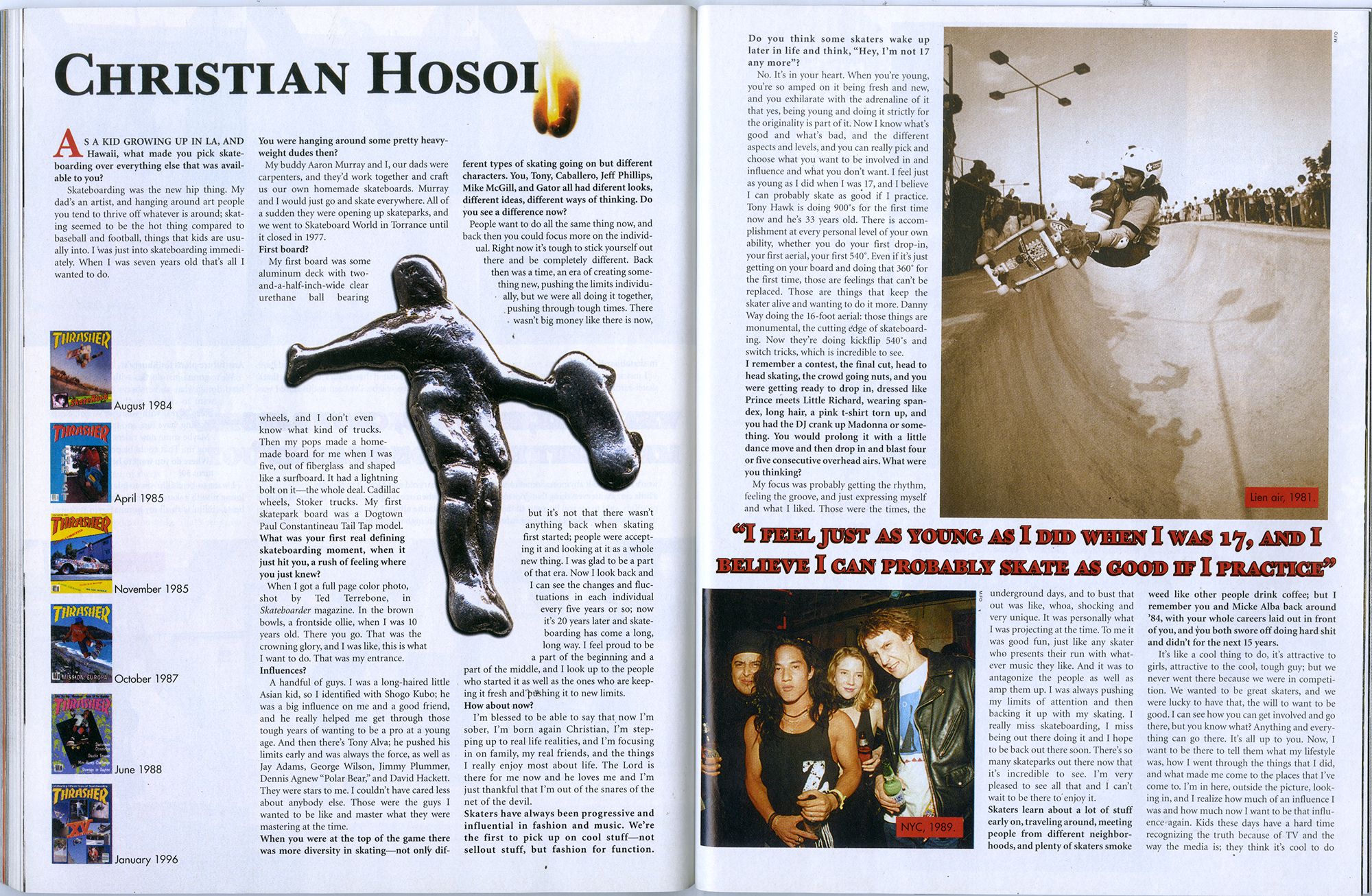
Page Text
            CHRISTIAN HOSOI
SA KID GROWING UP IN LA, AND
Hawaii, what made you pick skate-
boarding over everything else that was avail-
able to you?
Skateboarding was the new hip thing. My
dad's an artist, and hanging around art people
you tend to thrive off whatever is around; skat-
ing seemed to be the hot thing compared to
baseball and football, things that kids are usu-
ally into. I was just into skateboarding immedi-
ately. When I was seven years old that's all I
wanted to do.
THRASHER
THRASHER
THRASHER
August 1984
April 1985
A
You were hanging around some pretty heavy-
weight dudes then?
My buddy Aaron Murray and I, our dads were
carpenters, and they'd work together and craft
us our own homemade skateboards. Murray
and I would just go and skate everywhere. All of
a sudden they were opening up skateparks, and
we went to Skateboard World in Torrance until
it closed in 1977.
First board?
My first board was some
aluminum deck with two-
and-a-half-inch-wide clear
urethane
ball bearing
wheels, and I don't even
know what kind of trucks.
Then my pops made a home-
made board for me when I was
five, out of fiberglass and shaped
like a surfboard. It had a lightning
bolt on it-the whole deal. Cadillac
wheels, Stoker trucks. My first
skatepark board was a Dogtown
Paul Constantineau Tail Tap model.
What was your first real defining
skateboarding moment, when it
just hit you, a rush of feeling where
you just knew?
November 1985
shot
MISSION EUROPA October 1987
THRASHER
June 1988
January 1996
in
When I got a full page color photo,
Terrebone,
by Ted
Skateboarder magazine. In the brown
bowls, a frontside ollie, when I was 10
years old. There you go. That was the
crowning glory, and I was like, this is what
I want to do. That was my entrance.
Influences?
A handful of guys. I was a long-haired little
Asian kid, so I identified with Shogo Kubo; he
was a big influence on me and a good friend,
and he really helped me get through those
tough years of wanting to be a pro at a young
age. And then there's Tony Alva; he pushed his
limits early and was always the force, as well as
Jay Adams, George Wilson, Jimmy Plummer,
Dennis Agnew "Polar Bear," and David Hackett.
They were stars to me. I couldn't have cared less
about anybody else. Those were the guys I
wanted to be like and master what they were
mastering at the time.
When you were at the top of the game there
was more diversity in skating-not only dif-
ferent types of skating going on but different
characters. You, Tony, Caballero, Jeff Phillips,
Mike McGill, and Gator all had diferent looks,
different ideas, different ways of thinking. Do
you see a difference now?
People want to do all the same thing now, and
back then you could focus more on the individ-
ual. Right now it's tough to stick yourself out
there and be completely different. Back
then was a time, an era of creating some-
thing new, pushing the limits individu-
ally, but we were all doing it together,
pushing through tough times. There
wasn't big money like there is now,
but it's not that there wasn't
anything back when skating
first started; people were accept-
ing it and looking at it as a whole
new thing. I was glad to be a part
of that era. Now I look back and
I can see the changes and fluc-
tuations in each individual
every five years or so; now
it's 20 years later and skate-
boarding has come a long,
long way. I feel proud to be
a part of the beginning and a
part of the middle, and I look up to the people
who started it as well as the ones who are keep-
ing it fresh and pushing it to new limits.
How about now?
I'm blessed to be able to say that now I'm
sober, I'm born again Christian, I'm step-
ping up to real life realities, and I'm focusing
in on family, my real friends, and the things
I really enjoy most about life. The Lord is
there for me now and he loves me and I'm
just thankful that I'm out of the snares of the
net of the devil.
Skaters have always been progressive and
influential in fashion and music. We're
the first to pick up on cool stuff-not
sellout stuff, but fashion for function.
Do you think some skaters wake up
later in life and think, "Hey, I'm not 17
any more"?
No. It's in your heart. When you're young,
you're so amped on it being fresh and new,
and you exhilarate with the adrenaline of it
that yes, being young and doing it strictly for
the originality is part of it. Now I know what's
good and what's bad, and the different
aspects and levels, and you can really pick and
choose what you want to be involved in and
influence and what you don't want. I feel just
as young as I did when I was 17, and I believe
I can probably skate as good if I practice.
Tony Hawk is doing 900's for the first time
now and he's 33 years old. There is accom-
plishment at every personal level of your own
ability, whether you do your first drop-in,
your first aerial, your first 540°. Even if it's just
getting on your board and doing that 360° for
the first time, those are feelings that can't be
replaced. Those are things that keep the
skater alive and wanting to do it more. Danny
Way doing the 16-foot aerial: those things are
monumental, the cutting edge of skateboard-
ing. Now they're doing kickflip 540's and
switch tricks, which is incredible to see.
I remember a contest, the final cut, head to
head skating, the crowd going nuts, and you
were getting ready to drop in, dressed like
Prince meets Little Richard, wearing span-
dex, long hair, a pink t-shirt torn up, and
you had the DJ crank up Madonna or some-
thing. You would prolong it with a little
dance move and then drop in and blast four
or five consecutive overhead airs. What were
you thinking?
My focus was probably getting the rhythm,
feeling the groove, and just expressing myself
and what I liked. Those were the times, the
LOLA
Lien air, 1981.
"I FEEL JUST AS YOUNG AS I DID WHEN I WAS 17, AND I
BELIEVE I CAN PROBABLY SKATE AS GOOD IF I PRACTICE"
NYC, 1989.
underground days, and to bust that
out was like, whoa, shocking and
very unique. It was personally what
I was projecting at the time. To me it
was good fun, just like any skater
who presents their run with what-
ever music they like. And it was to
antagonize the people as well as
amp them up. I was always pushing
my limits of attention and then
backing it up with my skating. I
really miss skateboarding, I miss
being out there doing it and I hope
to be back out there soon. There's so
many skateparks out there now that
it's incredible to see. I'm very
pleased to see all that and I can't
wait to be there to enjoy it.
Skaters learn about a lot of stuff
early on, traveling around, meeting
people from different neighbor-
hoods, and plenty of skaters smoke
weed like other people drink coffee; but I
remember you and Micke Alba back around
'84, with your whole careers laid out in front
of you, and you both swore off doing hard shit
and didn't for the next 15 years.
It's like a cool thing to do, it's attractive to
girls, attractive to the cool, tough guy; but we
never went there because we were in competi-
tion. We wanted to be great skaters, and we
were lucky to have that, the will to want to be
good. I can see how you can get involved and go
there, but you know what? Anything and every-
thing can go there. It's all up to you. Now, I
want to be there to tell them what my lifestyle
was, how I went through the things that I did,
and what made me come to the places that I've
come to. I'm in here, outside the picture, look-
ing in, and I realize how much of an influence I
was and how much now I want to be that influ-
ence again. Kids these days have a hard time
recognizing the truth because of TV and the
way the media is; they think it's cool to do