Page Text
            SKATE DOWN BY
THE RIVERSIDE
T
Words and photos by Sean Peterson
HE CITY OF RIVERSIDE HAS DEVELOPED A PROPER SOLUTION TO A
social dilemma. The FBI has reported that juvenile crime increases 300 percent
between the hours of 2:30 PM and 6:30 PM. To combat this problem, the mayor
of Riverside, Ron Loveridge, has implemented the Young Action Council. From this coun-
cil the Partners in Riverside Investing in Middle School Education, PRIME-Time, has
been put into action. The purpose of this program is to create after-school extracurricu-
lar-type activities for middle schoolers to be involved with in hopes that it will help them
avoid problematic behavior.
PRIME-Time is offered after school in all nine middle schools in the city of Riverside. It oper-
ates every school day from 3:00 PM to 6:00 PM providing academic and enrichment activities
and is funded by the After School Learning and Safe Neighborhoods Partnership grant of 3.5 mil-
lion dollars, offered by the California Department of Education.,
The program in the Alvord School District offers skateboarding as one of the activities at Wells,
Loma Vista, and Arizona Intermediate Schools. The district has been extremely supportive of the
program and doesn't see supervised skateboarding as a crime, as long as it is done in full safety
gear, with proof of insurance, a release of physical liability agreement, and using equipment that
is district approved. Students involved in the program benefit both academically and athletically.
The program offers skateboarding two days a week at each school, field trips to local
skateparks, and safety gear for students who cannot afford it. During the after-school sessions
the kids first do an hour of homework, then skate and listen to music for about an hour and
a half, and then are given some juice and cookies before the program ends.
Because skateboarding is such a specialized sport, the district concluded that an outside
contractor would have to be employed to bring a level of expertise to the program. Active
Ride Shops' Hunter Chapman was hired in February by the program's coordinator Gale
"the kids first do an hour of home-
work, then skate and listen to music
for about an hour and a half, and then
are given some juice and cookies"
Gorke. His responsibilities include the design and construction of ramps and obstacles, the coor-
dination of activities during program hours, skateboard instructor/teacher of skateboard edict,
and overall skateboard program director. Other teachers provide onsite supervision.
Another aspect of the program Chapman has helped incorporate is bringing in guest speakers.
Just like Career Day, when the local scientist would come to your class and tell you all about the
applications of science, pro skateboarders will occasionally attend the after-school events to
share their experience and expertise. While at Wells Intermediate School, Ray Barbee told a story
about his first pro model setup. He had brought it to school to show his friends, but someone
stole it when he had to hide it in the bushes because skateboards weren't allowed on campus.
CIRCAFOOTBARE
ACTIVE
After signing autographs Barbee
exclaimed, "If I was in school, I would be so
psyched on this."
Properly establishing a pioneer after-
school skateboarding program is a lot
of work, and Hunter Chapman would
like to acknowledge some of the peo-
ple who have provided him with the
help he has needed-Active Ride
Shops, John Wallace in Chino and
Shane Wallace at San Dimas for
hooking him up with necessary
products, The Firm, Lance Mountain,
Ray Barbee, Brickyard skatepark in
Redlands, Caesar Herrera, Tom
Chapman, John Nava, Marvin Schuler
for building the ramps, Gale Gorke,
Linda Fujiu and the great taxpayers of
California for dishin' out the cash, and
the Creator for inventing skateboarding.
Due to all these people, the skate program
has helped to establish the consistent atten-
dance required to maintain granted funds
and reduce campus vandalism during
PRIME-Time hours. Parents support this-
program because it gives them peace of
mind knowing that their children are par-
ticipating in a safe school-sponsored
sports program. The participants like it
because it gives them a time and place
to skate with their friends without
having to worry about getting sweated
by the fuzz.
Programs like PRIME-Time show a
growing acceptance of skateboarding
into popular culture. Many of these
kids might not understand what a
great opportunity this is for them to be
allowed to skateboard on campus in a
state-funded program after school.
Skateboarding has reached a status in our
culture where it's no longer generally por-
trayed as the sport of delinquent youth.
Today it is endorsed by some of the same
money that once naively condemned it. Even
though skateboarders are still often treated as
criminals, it is reassuring to see that local
skateparks are springing up by the thou-
sands, pros are making respectable.
amounts of money, and the same bureau-
cratic powers that have for years denied.
skateboarders the right to skate on
school property are now allowing it in
the educational setting.
These kinds of programs are good for
kids and provide them with a better
understanding of why the founders of
this country held public education in
such high regard. Without state and
social acceptance and respect for skate-
boarding, skateboarding will never
respect the establishment in return.
Now that the state has accepted skate-
boarding, perhaps skateboarding will
return the favor, something it already
does by providing large amounts of tax-
able dollars and jobs.
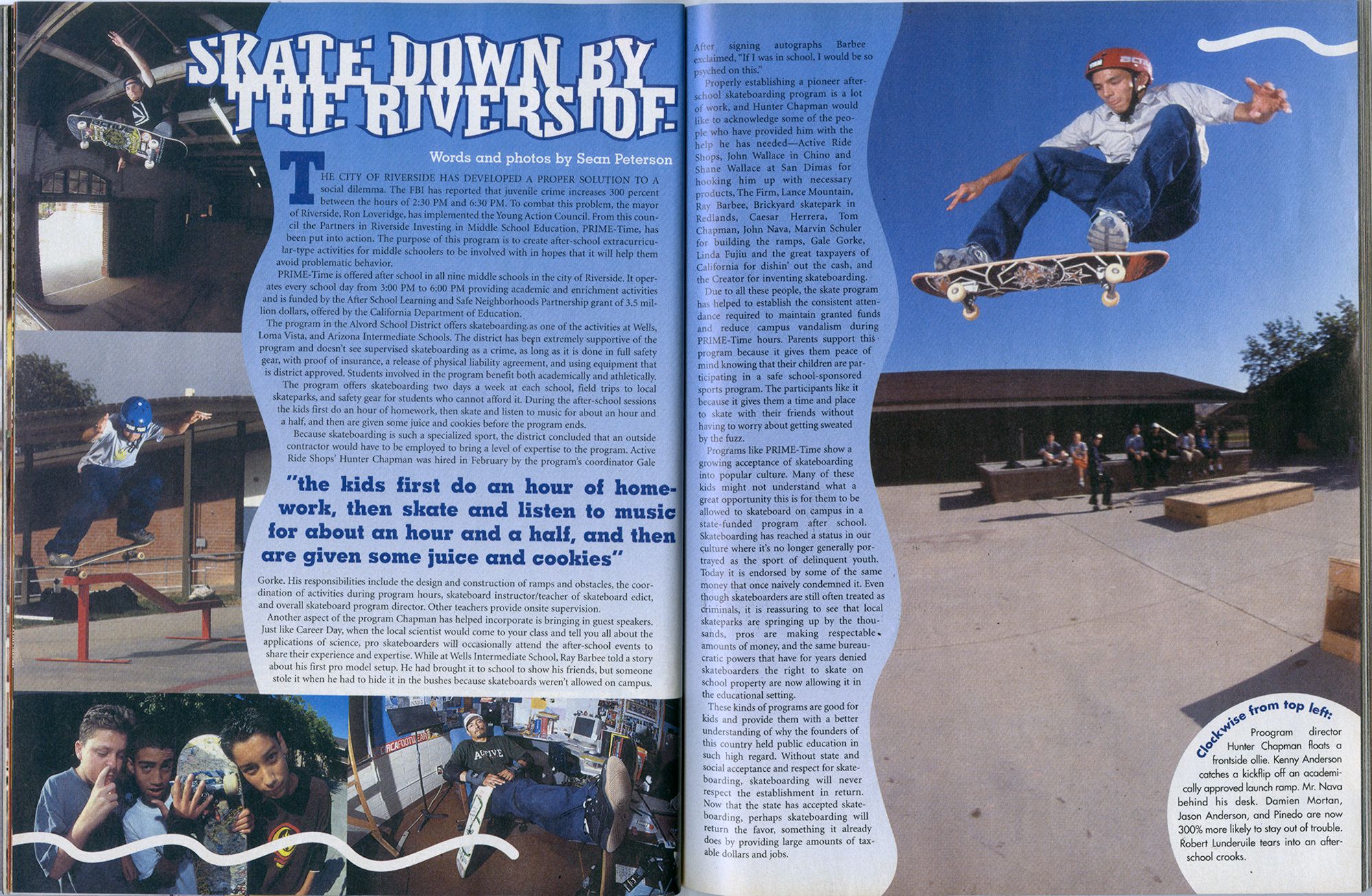
Clockwise
from top left:
Proogram
director
Hunter Chapman floats a
frontside ollie. Kenny Anderson
catches a kickflip off an academi-
cally approved launch ramp. Mr. Nava
behind his desk. Damien Mortan,
Jason Anderson, and Pinedo are now.
300% more likely to stay out of trouble.
Robert Lunderuile tears into an after-
school crooks.