Page Text
            44 THRASHER
he Science Of Skateboarding
HOW IT GOT STARTED
It was a normal day at work when a guy by the
name of Lowell Robinson and a lady named
Robin Higdon said that they wanted my help
with getting some people together for an exhibi-
tion on the physics of skateboarding at San
Francisco's Exploratorium. Everyone knows that
this museum is about science, but now it strikes
the skateboarders. What does science have to do
with skateboarding? The connection is physics. I
recommended a bunch of people I know: Jake
Phelps, Greg Carroll, and a few others. I also
showed them some recent skateboarding videos.
Then they needed to build some kind of course
for the demo; it couldn't be too big, or else it
would have been a fire hazard. With that in mind,
it was hard to think of a course, but they came
up with one using the Thrasher "Ramp Plans"
booklet. I guess that helped them out a lot,
because the ramps they built were good.
THE SHOW
Our scientist on hand, Paul Doherty, explained the physics of skate-
boarding. The demo that the Exploratorium put on was a huge success.
Our staff put a lot of effort into building the ramps and organizing the
show. Sometimes they would stay late just to get the job done. This was
a big change for the Exploratorium; I've never seen them do anything
outlandish. The show started earlier than planned because the skaters
couldn't wait to skate. A good amount of skaters came out to put on a
show for the visitors. Greg Carroll was there to name some of the tricks
and try to explain how they work. This skateboarding demo was very dif-
ferent from other demos-the reason being that it wasn't just skate-
boarding. It also included the science of skateboarding, different kinds of
decks, and the different materials that skateboards are made of. Also, it
wasn't your average skateboard audience. We had parents, children, and
some skaters in the crowd.
THE END
In the end everything worked out well, and I would like to thank every-
body who came out for the show, the staff at the Exploratorium (thanks for
all the hard work), and all the people in the skateboarding industry.
-Cameron Bohannon
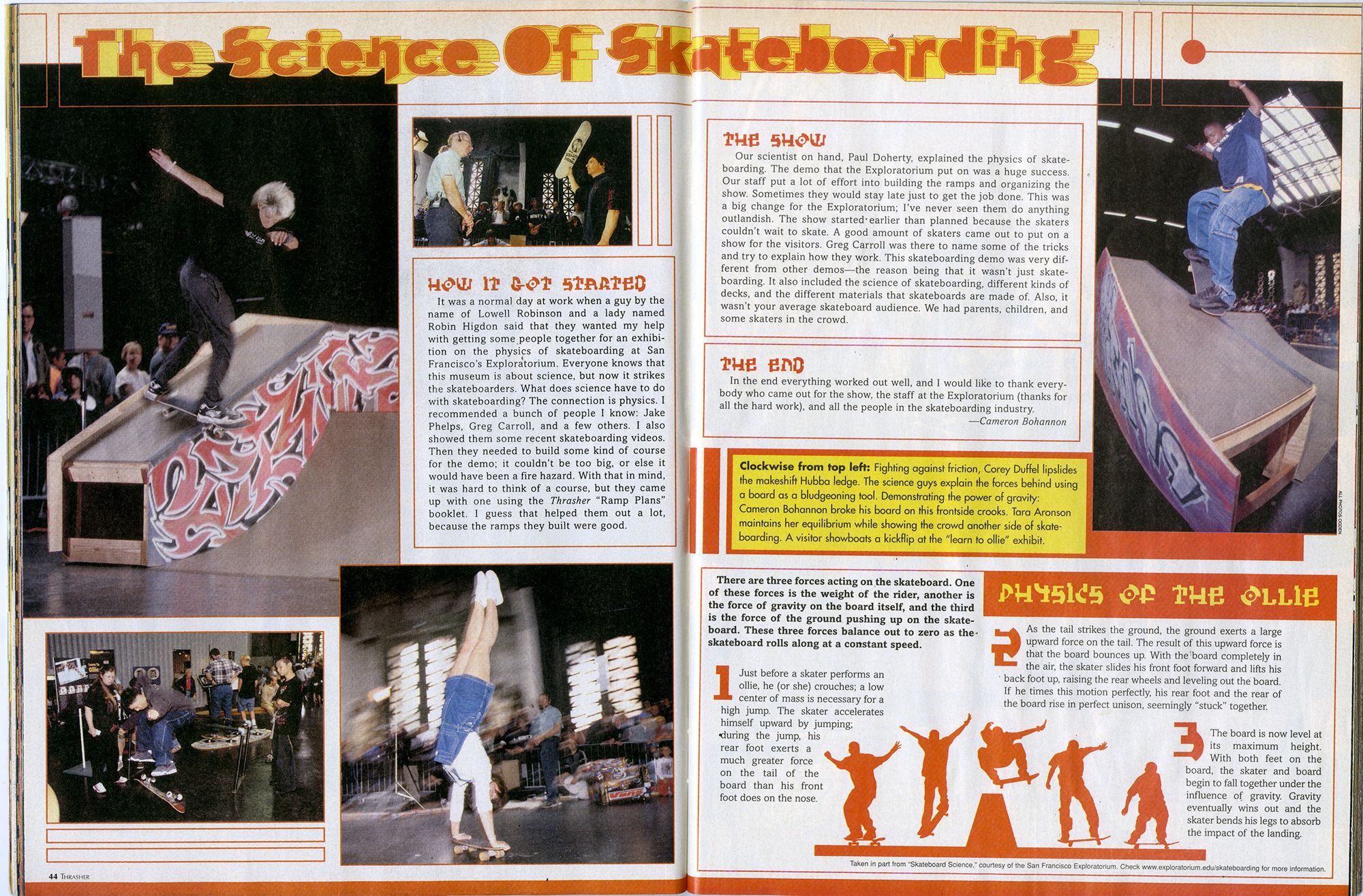
Clockwise from top left: Fighting against friction, Corey Duffel lipslides
the makeshift Hubba ledge. The science guys explain the forces behind using
a board as a bludgeoning tool. Demonstrating the power of gravity:
Cameron Bohannon broke his board on this frontside crooks. Tara Aronson
maintains her equilibrium while showing the crowd another side of skate-
boarding. A visitor showboats a kickflip at the "learn to ollie" exhibit.
There are three forces acting on the skateboard. One
of these forces is the weight of the rider, another is
the force of gravity on the board itself, and the third
is the force of the ground pushing up on the skate-
board. These three forces balance out to zero as the-
skateboard rolls along at a constant speed.
Just before a skater performs an
ollie, he (or she) crouches; a low
center of mass is necessary for a
high jump. The skater accelerates
himself upward by jumping;
during the jump, his
rear foot exerts a
much greater force
on the tail of the
board than his front
foot does on the nose.
PHYSICS OF THE OLLIE
As the tail strikes the ground, the ground exerts a large
upward force on the tail. The result of this upward force is
that the board bounces up. With the board completely in
the air, the skater slides his front foot forward and lifts his
back foot up, raising the rear wheels and leveling out the board.
If he times this motion perfectly, his rear foot and the rear of
the board rise in perfect unison, seemingly "stuck" together.
3
The board is now level at
its maximum height.
With both feet on the
board, the skater and board
begin to fall together under the
influence of gravity. Gravity
eventually wins out and the
skater bends his legs to absorb
the impact of the landing.
Taken in part from "Skateboard Science," courtesy of the San Francisco Exploratorium. Check www.exploratorium.edu/skateboarding for more information.