Page Text
            72 THRASHER
PROS
Almost all Japanese pros are sponsored by a distributor who
hooks them up with one of the lines of products that they
carry and a paycheck. But since they're not sponsored
directly by the
company that they
ride for, you'll
never see them in
ads here. Demos,
contests, and
videos with just
Japanese pros that
you never hear
about on this side
of the Pacific hap-
pen all the time.
BUMAS
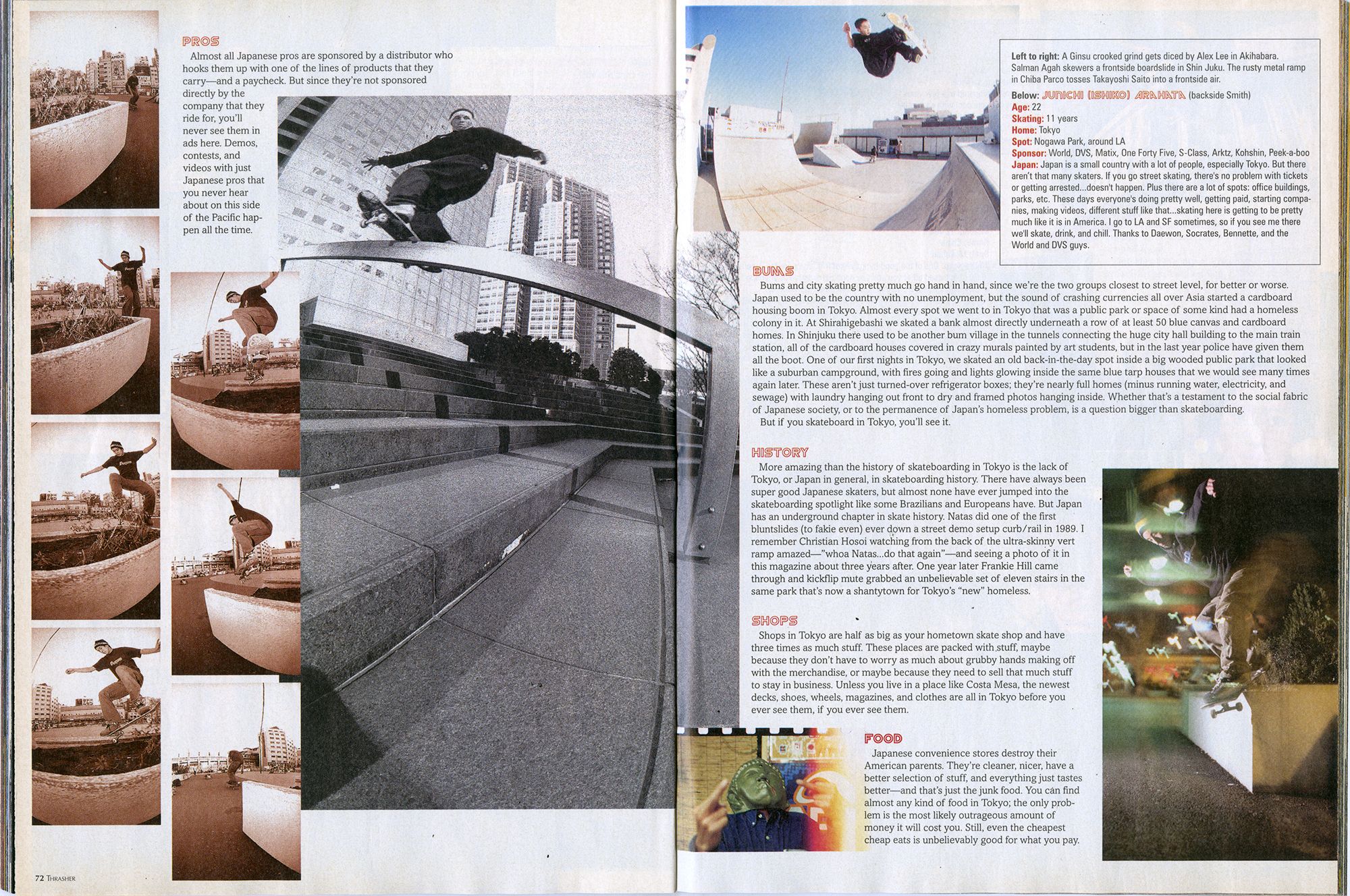
Left to right: A Ginsu crooked grind gets diced by Alex Lee in Akihabara.
Salman Agah skewers a frontside boardslide in Shin Juku. The rusty metal ramp
in Chiba Parco tosses Takayoshi Saito into a frontside air.
Below: JUNICHI (ISHIKO) ARAHATA (backside Smith)
Age: 22
Skating: 11 years
Home: Tokyo
Spot: Nogawa Park, around LA
Sponsor: World, DVS, Matix, One Forty Five, S-Class, Arktz, Kohshin, Peek-a-boo
Japan: Japan is a small country with a lot of people, especially Tokyo. But there
aren't that many skaters. If you go street skating, there's no problem with tickets
or getting arrested...doesn't happen. Plus there are a lot of spots: office buildings,
parks, etc. These days everyone's doing pretty well, getting paid, starting compa-
nies, making videos, different stuff like that...skating here is getting to be pretty
much like it is in America. I go to LA and SF sometimes, so if you see me there
we'll skate, drink, and chill. Thanks to Daewon, Socrates, Bennette, and the
World and DVS guys.
Bums and city skating pretty much go hand in hand, since we're the two groups closest to street level, for better or worse.
Japan used to be the country with no unemployment, but the sound of crashing currencies all over Asia started a cardboard
housing boom in Tokyo. Almost every spot we went to in Tokyo that was a public park or space of some kind had a homeless
colony in it. At Shirahigebashi we skated a bank almost directly underneath a row of at least 50 blue canvas and cardboard
homes. In Shinjuku there used to be another bum village in the tunnels connecting the huge city hall building to the main train
station, all of the cardboard houses covered in crazy murals painted by art students, but in the last year police have given them
all the boot. One of our first nights in Tokyo, we skated an old back-in-the-day spot inside a big wooded public park that looked
like a suburban campground, with fires going and lights glowing inside the same blue tarp houses that we would see many times
again later. These aren't just turned-over refrigerator boxes; they're nearly full homes (minus running water, electricity, and
sewage) with laundry hanging out front to dry and framed photos hanging inside. Whether that's a testament to the social fabric
of Japanese society, or to the permanence of Japan's homeless problem, is a question bigger than skateboarding.
But if you skateboard in Tokyo, you'll see it.
HISTORY
More amazing than the history of skateboarding in Tokyo is the lack of
Tokyo, or Japan in general, in skateboarding history. There have always been
super good Japanese skaters, but almost none have ever jumped into the
skateboarding spotlight like some Brazilians and Europeans have. But Japan
has an underground chapter in skate history. Natas did one of the first
bluntslides (to fakie even) ever down a street demo setup curb/rail in 1989. I
remember Christian Hosoi watching from the back of the ultra-skinny vert
ramp amazed-"whoa Natas...do that again"-and seeing a photo of it in
this magazine about three years after. One year later Frankie Hill came
through and kickflip mute grabbed an unbelievable set of eleven stairs in the
same park that's now a shantytown for Tokyo's "new" homeless.
SHOPS
Shops in Tokyo are half as big as your hometown skate shop and have
three times as much stuff. These places are packed with stuff, maybe
because they don't have to worry as much about grubby hands making off
with the merchandise, or maybe because they need to sell that much stuff
to stay in business. Unless you live in a place like Costa Mesa, the newest
decks, shoes, wheels, magazines, and clothes are all in Tokyo before you
ever see them, if you ever see them.
FOOD
Japanese convenience stores destroy their
American parents. They're cleaner, nicer, have a
better selection of stuff, and everything just tastes
better and that's just the junk food. You can find
almost any kind of food in Tokyo; the only prob-
lem is the most likely outrageous amount of
money it will cost you. Still, even the cheapest
cheap eats is unbelievably good for what you pay.